

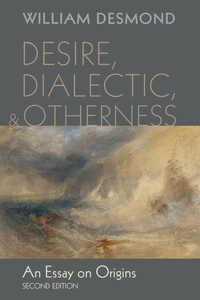
Desire, Dialectic, and Otherness
An Essay on Origins, Second Edition
Published on 8. November 2013
292 pages
978-1-63087-043-0 (ISBN)
Description

Many philosophers since Hegel have been disturbed by the thought that philosophy inevitably favors sameness over otherness or identity over difference. Originally published at a time when the issue was not so widely discussed in the English-speaking world, William Desmond here offers a constructive and positive approach to the problem of difference and otherness. He systematically explores the question of dialectic and otherness by analyzing how human desire inevitably seeks immanent wholeness in a manner that opens it to irreducible otherness. He faces the difficulties bequeathed to Continental thought by Hegelian dialectic and its tendency to subordinate difference to identity, whether appropriately or not. Unlike many recent critics of Hegel, he argues that we must preserve what is genuine in dialectic. Granting the positive power of dialectic, Desmond offers his first articulation of a further philosophical possibility--what he terms the Metaxological--a discourse of the "between," a discourse doing justice to desire's search for wholeness without any truncating of its radical openness to otherness. In a wide-ranging yet unified discussion, Desmond tackles such issues as the nature of the self, the ambiguous restlessness and inherent power of being revealed by human desire, desire's relation to transcendence, its openness to otherness in agapeic good will and in relation to the sublime as an aesthetic infinitude. Finally, Desmond brings this metaxological understanding to bear on the metaphysical question of the ultimate origin.
This book is a remarkable introduction to Desmond's metaxological philosophy, prefiguring many of the ideas with which his later thought is associated. This second edition contains a substantial new preface and an afterword to each chapter in which Desmond reflects on the material from the standpoint of his current thinking.
More details
Other editions
Additional editions
Book
11/2013
2nd Edition
Wipf & Stock Publishers
€33.20
Shipment within 3-4 weeks
Book
11/2013
2nd Edition
Wipf & Stock Publishers
€50.50
Shipment within 15-20 days
Person
William Desmond is Professor of Philosophy at Katholieke Universiteit Leuven as well as David Cook Visiting Chair in Philosophy at Villanova University.
Content
- Title Page
- Preface to the First Edition
- Preface to the Second Edition
- Introduction
- Part 1: Intentional Infinitude
- Chapter 1: Desire, Lack, and the Absorbing God
- Chapter 2: Desire and Original Selfness
- Chapter 3: Desire's Infinitude and Wholeness
- Part 2: Actual Finitude
- Chapter 4: Desire, Transcendence, and Static Eternity
- Chapter 5: Desire, Knowing, and Otherness
- Chapter 6: Desire, Concreteness, and Being
- Chapter 7: Desire, Otherness, and Infinitude
- Part 3: Actual Infinitude
- Chapter 8: Desire and the Absolute Original
- Bibliography
