

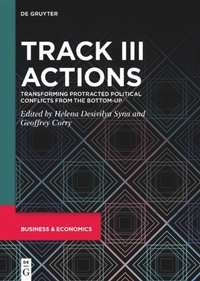
Track III Actions
Description

Since the end of the Cold War in the early '90s, a multi-track approach to peacemaking has been developed by academics and practitioners to bring political and civil society leaders together from across the divide of contested societies to find ways out of the conflict. Much of the focus up to now has been given to the strategic contribution of Track II conflict analysis and problem-solving workshops.
This book puts the spotlight on the role that grassroots leaders and citizens can play at Track III level in the community in building and strengthening a bottom-up approach to conflict transformation following protracted conflicts. In Part 1, the focus is on the post-conflict situation of Northern Ireland twenty years after the Belfast Good Friday Agreement. Part 2 portrays scholarly and practitioners' perspectives and actions in communities and organizations designed to build partnerships in order to counteract the legacies of active protracted conflict.
- Plots the role of Track III approaches within a multi-track peacemaking pyramid in the protracted conflict and post-conflict phases of confl ict transformation.
- Provides case studies on how to engage community leaders in thinking together how to work with deep-seated legacies of protracted conflicts.
- Explores the contribution of bottom-up models to build intergroup partnerships within and between local communities.
- Focuses on the interface between research and practice.
Reviews / Votes
Under the radars: http://www.processnorth.co.uk/good-practice-conflict-resolution/under-the-radars/ , Mike Makin-Waite, July 2023More details
Other editions
Additional editions
Persons
Helena Desivilya Syna is Associate Professor in the Department of Sociology and Anthropology at The Max Stern Yezreel Valley College, Israel. She conducts research on social conflict, organizational behaviour and diversity management in organizations and communities. Her work integrates a micro-level social psychological perspective with a macro-level, social-constructivism approach, using a mixed-method approach - quantitative and qualitative methodologies and research tools. It leverages her expertise and experience in program evaluation promoting deeper and more comprehensive study of the research-practice interface.
Professor Geoffrey Corry is a dialogue facilitator at the Glencree Centre for Peace and Reconciliation outside Dublin. He facilitated over 50 political dialogue workshops during the years of the peace process from 1994 through to 2006 and since then a number of large acknowledgement circles for victims of political violence. He has trained mediators and facilitators not only in Ireland but also in Colombia, Israel/Palestine and Haiti. He has served as Chairman of Glencree Centre (1984-87), Mediators Institute of Ireland (1999-2002) and Facing Forward (2006-2012). He was director of two leading national youth organisations from 1976-1988.
Content
- Intro
- Acknowledgments
- Foreword
- Contents
- 1 Introduction to Track III Perspectives: Transforming Protracted Political Conflicts in Post-Conflict and Active Conflict Societies
- Part I: Transforming from below the Post-Armed conflict phase in Northern Ireland
- 2 Post-Agreement Northern Ireland: a slow generational change or a peace process in crisis?
- 3 Community-Based peacebuilding: Signals for Track III
- 4 Community Development since the 1970's: Track II Forward, Track III Back?
- 5 Insider Mediation of Contentious Parading
- 6 Reducing Sectarianism and Hate at the grassroots
- 7 Inter-communal Dialogue
- 8 Making Peace with the Past
- Part II: Track III processes and actions in the context of active political conflict
- 9 Track III initiatives in the context of Israel's divided society and the protracted Israeli-Palestinian political conflict
- 10 The long-term impact of a transformative learning-experience of rival co-existence activists
- 11 Developing Spaces for Dialogue in a Complex and Diverse Academic Environment: A Critical-Humanistic Organizational Approach
- 12 Developing a model for intergroup dialogue in academia: Jewish and Arab Students in Israel
- 13 The Intercultural Encounter of college students in a Research Seminar
- 14 Developing Regional Mediational Leadership as a Means for Cultivating Dialogue
- 15 Contact at work: Appraising the effect of the confrontation and Joint- Project models on intra-organizational dynamics, workers' experience and political consciousness
- List of Figures
- List of Tables
- List of Contributors
- Index
