

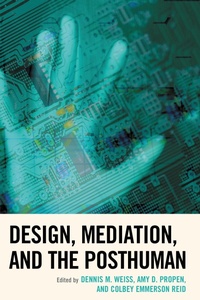
Design, Mediation, and the Posthuman
Lexington Books (Publisher)
1st Edition
Published on 14. August 2014
1 pages
979-8-8818-8656-1 (ISBN)
Description

Though the progress of technology continually pushes life toward virtual existence, the last decade has witnessed a renewed focus on materiality. Design, Mediation, and the Posthuman bears witness to the attention paid byliterary theorists, digital humanists, rhetoricians, philosophers, and designers to the crafted environment, the manner in which artifacts mediate human relations, and the constitution of a world in which the boundary between humans and things has seemingly imploded. The chapters reflect on questions about the extent to which we ought to view humans and nonhuman artifacts as having equal capacity for agency and life, and the ways in which technological mediation challenges the central tenets of humanism and anthropocentrism.
Contemporary theories of human-object relations presage the arrival of the posthuman, which is no longer a futuristic or science-fictional concept but rather one descriptive of the present, and indeed, the past. Discussions of the posthuman already have a long history in fields like literary theory, rhetoric, and philosophy, and as advances in design and technology result in increasingly engaging artifacts that mediate more and more aspects of everyday life, it becomes necessary to engage in a systematic, interdisciplinary, critical examination of the intersection of the domains of design, technological mediation, and the posthuman. Thus, this collection brings diverse disciplines together to foster a dialogue on significant technological issues pertinent to philosophy, rhetoric, aesthetics, and science.
Contemporary theories of human-object relations presage the arrival of the posthuman, which is no longer a futuristic or science-fictional concept but rather one descriptive of the present, and indeed, the past. Discussions of the posthuman already have a long history in fields like literary theory, rhetoric, and philosophy, and as advances in design and technology result in increasingly engaging artifacts that mediate more and more aspects of everyday life, it becomes necessary to engage in a systematic, interdisciplinary, critical examination of the intersection of the domains of design, technological mediation, and the posthuman. Thus, this collection brings diverse disciplines together to foster a dialogue on significant technological issues pertinent to philosophy, rhetoric, aesthetics, and science.
More details
Series
Edition
1. Auflage
Language
English
Place of publication
United States
Publishing group
Bloomsbury Publishing Plc
Target group
Professional and scholarly
Illustrations
13 b/w illustrations;
ISBN-13
979-8-8818-8656-1 (9798881886561)
Copyright in bibliographic data and cover images is held by Nielsen Book Services Limited or by the publishers or by their respective licensors: all rights reserved.
Schweitzer Classification
Other editions
Additional editions
Dennis M. Weiss | Amy D. Propen | Colbey Emmerson Reid
Design, Mediation, and the Posthuman
Book
08/2016
Lexington Books
€74.40
Shipment within 15-20 days
Persons
Dennis Weiss is professor of philosophy in the English and Humanities Department at York College of Pennsylvania.
Amy Propen is lecturer of rhetoric and composition in the Writing Program at the University of California, Santa Barbara.
Colbey Emmerson Reid is director of the Consumer Innovation Consortium in the Poole College of Management at North Carolina State University.
Amy Propen is lecturer of rhetoric and composition in the Writing Program at the University of California, Santa Barbara.
Colbey Emmerson Reid is director of the Consumer Innovation Consortium in the Poole College of Management at North Carolina State University.
Content
Introduction: MIND versus THING and Other 'Central Events' of the Twenty-First Century
Part One: Interface
Introduction
Chapter One: Posthuman Topologies: Thinking Through the Hoard, Anthony Miccoli
Chapter Two: The Rhetorical Work of the GPS: Geographic Knowledge-Making and the Technologically-Mediated Body, Amy D. Propen
Chapter Three: Neo-Baroque Computing: Interface and the Subject-Object Divide, Elise Takehana
Chapter Four: Techno-Geographic Interfaces: Layers of Text and Agency in Mobile Augmented Reality, John Tinnell
Part Two: Artifact
Introduction
Chapter Five: The Plastic Art of LEGO: An Essay into Material Culture, Jonathan Rey Lee
Chapter Six: The iPhone Erfahrung: Siri, the Auditory Unconscious, and Walter Benjamin's "Aura", Emily McArthur
Chapter Seven: Victorian Cybernetics: Networking Technology, Disability and Interior Design, Colbey Emmerson Reid
Chapter Eight: Extending "Extension": A Reappraisal of the Technology-as-Extension Idea through the Case of Self-Tracking Techno
Part One: Interface
Introduction
Chapter One: Posthuman Topologies: Thinking Through the Hoard, Anthony Miccoli
Chapter Two: The Rhetorical Work of the GPS: Geographic Knowledge-Making and the Technologically-Mediated Body, Amy D. Propen
Chapter Three: Neo-Baroque Computing: Interface and the Subject-Object Divide, Elise Takehana
Chapter Four: Techno-Geographic Interfaces: Layers of Text and Agency in Mobile Augmented Reality, John Tinnell
Part Two: Artifact
Introduction
Chapter Five: The Plastic Art of LEGO: An Essay into Material Culture, Jonathan Rey Lee
Chapter Six: The iPhone Erfahrung: Siri, the Auditory Unconscious, and Walter Benjamin's "Aura", Emily McArthur
Chapter Seven: Victorian Cybernetics: Networking Technology, Disability and Interior Design, Colbey Emmerson Reid
Chapter Eight: Extending "Extension": A Reappraisal of the Technology-as-Extension Idea through the Case of Self-Tracking Techno
