

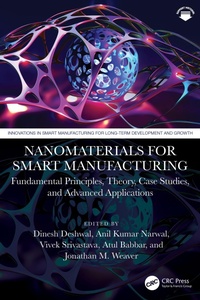
Nanomaterials for Smart Manufacturing
Fundamental Principles, Theory, Case Studies, and Advanced Applications
1st Edition
Published on 29. January 2026
340 pages
978-1-040-65795-9 (ISBN)
Description

This textbook discusses the realm of nanomaterials science, offering a detailed and comprehensive exploration of materials at the nanoscale level. The book breaks traditional boundaries to provide a dynamic investigation of the rapidly evolving field of nanomaterials science. It offers a thorough examination of the subject, encompassing essential aspects such as the properties of nanomaterials, various synthesis methods, characterization techniques, and their diverse applications across multiple disciplines.
Nanomaterials for Smart Manufacturing: Fundamental Principles, Theory, Case Studies, and Advanced Applications explores the practical aspects of nanomaterial fabrication, moving beyond theoretical concepts. This textbook is divided into four parts, covering fundamental concepts to advanced applications and case studies, and discusses a wide array of techniques including traditional bottom-up methods like chemical vapor deposition to cutting-edge top-down approaches such as lithography, offering students valuable insights into the precise fabrication of nanomaterials. It covers topics ranging from strength and toughness at the nanoscale to thermal conductivity and nanoscale heat transfer, providing a comprehensive understanding of how these materials perform under various conditions. Additionally, the textbook showcases the tangible impact of nanomaterials across industries such as electronics, medicine, energy, and catalysis. Real-world case studies, examples, and reader comprehension questions illustrate the revolutionary role of nanomaterials in shaping our world.
This definitive guide is tailored for students, researchers, and industry professionals seeking to unravel the mysteries of the nanoworld. Serving as a bridge between the macro and micro worlds, this textbook offers a holistic understanding of nanomaterials.
Figure slides are available to instructors for qualified textbook adoption.
Nanomaterials for Smart Manufacturing: Fundamental Principles, Theory, Case Studies, and Advanced Applications explores the practical aspects of nanomaterial fabrication, moving beyond theoretical concepts. This textbook is divided into four parts, covering fundamental concepts to advanced applications and case studies, and discusses a wide array of techniques including traditional bottom-up methods like chemical vapor deposition to cutting-edge top-down approaches such as lithography, offering students valuable insights into the precise fabrication of nanomaterials. It covers topics ranging from strength and toughness at the nanoscale to thermal conductivity and nanoscale heat transfer, providing a comprehensive understanding of how these materials perform under various conditions. Additionally, the textbook showcases the tangible impact of nanomaterials across industries such as electronics, medicine, energy, and catalysis. Real-world case studies, examples, and reader comprehension questions illustrate the revolutionary role of nanomaterials in shaping our world.
This definitive guide is tailored for students, researchers, and industry professionals seeking to unravel the mysteries of the nanoworld. Serving as a bridge between the macro and micro worlds, this textbook offers a holistic understanding of nanomaterials.
Figure slides are available to instructors for qualified textbook adoption.
More details
Series
Edition
1. Auflage
Language
English
Place of publication
London
United Kingdom
Publishing group
Taylor & Francis Ltd
Target group
College/higher education
Professional and scholarly
Product notice
Reflowable
Illustrations
30 Tables, black and white; 92 Line drawings, black and white; 15 Halftones, black and white; 107 Illustrations, black and white
File size
39,17 MB
ISBN-13
978-1-040-65795-9 (9781040657959)
Copyright in bibliographic data and cover images is held by Nielsen Book Services Limited or by the publishers or by their respective licensors: all rights reserved.
Schweitzer Classification
Other editions
Additional editions
Dinesh Deshwal | Anil Kumar Narwal | Vivek Srivastava
Nanomaterials for Smart Manufacturing
Fundamental Principles, Theory, Case Studies, and Advanced Applications
Book
01/2026
1st Edition
CRC Press
€136.10
Shipment within 10-20 days
Persons
Dinesh Deshwal is Head of the Mechanical Engineering Department at Shree Guru Gobind Singh Tricentenary University, Gurugram, India, and is pursuing a Ph.D. from Deenbandhu Chhotu Ram University of Science and Technology, India, in the Department of Mechanical Engineering. He earned his master's degree from the same institute in 2014, laying the foundation for a career dedicated to research and education. Mr. Deshwal has contributed significantly to the field of Nanomaterials, and his publications reflect a commitment to exploring diverse aspects of mechanical engineering and nanotechnology. Beyond publications, Mr. Deshwal holds more than 10 Indian patents. His academic journey is complemented by a teaching role at Shree Guru Gobind Singh Tricentenary University, Gurgaon, India, where he imparts knowledge and contributes to the academic community. Driven by a commitment to excellence, Mr. Deshwal continues to shape the landscape of mechanical engineering and nanotechnology through his research, publications, and innovative contributions to the field.
Anil Kumar Narwal is an accomplished Assistant Professor in the Mechanical Engineering Department at Deenbandhu Chhotu Ram University of Science and Technology, in Murthal, Sonipat, Haryana, India. Dr. Narwal has made significant contributions to the field of mechanical engineering, particularly in the areas of dynamics, soft contact rolling, and nanotechnology-enabled sensing. With a strong academic background and extensive research experience, Dr. Narwal has authored several research papers published in reputable journals and presented at international conferences. His research focuses on the dynamics of soft contact rolling, utilizing innovative approaches such as the multiband graph approach to model and analyzing complex interactions between rigid bodies and soft materials. Furthermore, he has made significant contributions to the emerging field of bio-mass sensing using boron nitride nanotubes (BNNTs). His papers on the analysis of surface deviation impact on bio-mass sensing application and resonant frequency analysis of wavy BNNT-based bio-mass sensors highlight his innovative research endeavors in this area. His work has earned him recognition within the academic community and positions him as a leading researcher in the field.
Vivek Srivastava is a Dean and Professor at the Faculty of Engineering and Technology, Shree Guru Gobind Singh Tricentenary University, Gurugram, India. Dr. Srivastava is an experienced academic leader with over 18 years of expertise in academic administration, policymaking, and research. Dr. Srivastava has been recognized for his academic leadership, his successful record of program development and management, and has extensive experience implementing various policies, including assessment and accreditation, online learning management systems, and the National Education Policy (NEP). His strong commitment to academic integrity and professional ethics is evident throughout his career. Dr. Srivastava is passionate about contributing to academic excellence and looks forward to continuing his contributions as an academic leader.
Atul Babbar serves as Deputy Dean (Research & Development) at SGT University, Gurugram, India. He completed his Doctor of Philosophy Ph.D. at the Thapar Institute of Engineering and Technology, Patiala, India, and has since been teaching and guiding students in academics and research. His research interests include Composites, Manufacturing, Abrasive Machining Technologies, Hybrid Machining Processes, Biomedical and Additive Manufacturing. He has authored over 50 research articles in various International/National Web of Science (SCI/SCIE), and Scopus indexed journals. Dr. Babbar has filed 17 Indian patents and 4 international patents, of which, 5 of the Indian patents have been accepted, and 4 have been granted. He has reviewed research articles for various peer-reviewed Web of Science and Scopus-indexed journals and has published many international books and chapters in multiple databases. He has also chaired various international conferences under reputed publishing partners and is an associate member of the Institution of Engineers (AMIE), India.
Jonathan Weaver is a professor in the Mechanical Engineering Department at the University of Detroit Mercy, United States. Dr. Weaver teaches statics, dynamics, vehicle dynamics, robotics, machine design, DOE, mechanical measurements laboratory, CAE, innovation, product planning and development, systems engineering and systems architecture. His research interests relate to robotics, vehicle dynamics, design of experiments, robust design, innovation and creativity, and the product development process. Dr. Weaver has published many articles in the various high-quality peer reviewed journals and has reviewed articles for multiple international and national peer-review journals. He has supervised many postgraduate and doctoral students and is a certified professional member of ICAgile.
Anil Kumar Narwal is an accomplished Assistant Professor in the Mechanical Engineering Department at Deenbandhu Chhotu Ram University of Science and Technology, in Murthal, Sonipat, Haryana, India. Dr. Narwal has made significant contributions to the field of mechanical engineering, particularly in the areas of dynamics, soft contact rolling, and nanotechnology-enabled sensing. With a strong academic background and extensive research experience, Dr. Narwal has authored several research papers published in reputable journals and presented at international conferences. His research focuses on the dynamics of soft contact rolling, utilizing innovative approaches such as the multiband graph approach to model and analyzing complex interactions between rigid bodies and soft materials. Furthermore, he has made significant contributions to the emerging field of bio-mass sensing using boron nitride nanotubes (BNNTs). His papers on the analysis of surface deviation impact on bio-mass sensing application and resonant frequency analysis of wavy BNNT-based bio-mass sensors highlight his innovative research endeavors in this area. His work has earned him recognition within the academic community and positions him as a leading researcher in the field.
Vivek Srivastava is a Dean and Professor at the Faculty of Engineering and Technology, Shree Guru Gobind Singh Tricentenary University, Gurugram, India. Dr. Srivastava is an experienced academic leader with over 18 years of expertise in academic administration, policymaking, and research. Dr. Srivastava has been recognized for his academic leadership, his successful record of program development and management, and has extensive experience implementing various policies, including assessment and accreditation, online learning management systems, and the National Education Policy (NEP). His strong commitment to academic integrity and professional ethics is evident throughout his career. Dr. Srivastava is passionate about contributing to academic excellence and looks forward to continuing his contributions as an academic leader.
Atul Babbar serves as Deputy Dean (Research & Development) at SGT University, Gurugram, India. He completed his Doctor of Philosophy Ph.D. at the Thapar Institute of Engineering and Technology, Patiala, India, and has since been teaching and guiding students in academics and research. His research interests include Composites, Manufacturing, Abrasive Machining Technologies, Hybrid Machining Processes, Biomedical and Additive Manufacturing. He has authored over 50 research articles in various International/National Web of Science (SCI/SCIE), and Scopus indexed journals. Dr. Babbar has filed 17 Indian patents and 4 international patents, of which, 5 of the Indian patents have been accepted, and 4 have been granted. He has reviewed research articles for various peer-reviewed Web of Science and Scopus-indexed journals and has published many international books and chapters in multiple databases. He has also chaired various international conferences under reputed publishing partners and is an associate member of the Institution of Engineers (AMIE), India.
Jonathan Weaver is a professor in the Mechanical Engineering Department at the University of Detroit Mercy, United States. Dr. Weaver teaches statics, dynamics, vehicle dynamics, robotics, machine design, DOE, mechanical measurements laboratory, CAE, innovation, product planning and development, systems engineering and systems architecture. His research interests relate to robotics, vehicle dynamics, design of experiments, robust design, innovation and creativity, and the product development process. Dr. Weaver has published many articles in the various high-quality peer reviewed journals and has reviewed articles for multiple international and national peer-review journals. He has supervised many postgraduate and doctoral students and is a certified professional member of ICAgile.
Content
Part 1: Fundamentals of Nanomaterials. 1. Properties and Behaviour of Nanomaterials: Mechanical, Thermal, and Chemical Aspects. 2. Synthetic Techniques In Nanomaterials Manufacture. 3. Nanoparticles - Synthesis Techniques of Nanomaterials. 4. Different Techniques Used for Characterizing Nanomaterials. 5. Green Synthesis Approaches for Nanomaterials: Recent Advances and Applications. Part 2: Advanced Manufacturing and AI Integration. 6. Smart Manufacturing at the Nanoscale: Exploring AI-Enhanced Magnetorheological Finishing. 7. Nanomanufacturing and Artificial Intelligence: Opportunities and Applications. 8. Nanomaterials: Synthesis Strategies and Emerging Applications Across Science and Industry. Part 3: Applications Across Industries. 9. Nanomaterials in Contemporary Science: Applications and Cognate Risks. 10. Advanced Applications of Nanomaterials Across Industries: Transforming the Future of Manufacturing. 11. Biomedical Nanomanufacturing: Implants, Diagnostics, and Drug Delivery Systems. 12. Advancements in Nanomaterials and Nanofluids for Enhanced Tribological and Thermal Applications. 13. Exploring the use of nanoparticles to improve the properties of denture resins. Part 4: Specialized Applications and Case Studies.14. Case Study: Nonlinear Dynamic Behavior of Boron Nitride Nanotube-Based Mass Sensors in Smart Manufacturing. 15. Nanotube-Based Sensors and Actuators for Smart Manufacturing Systems.
