

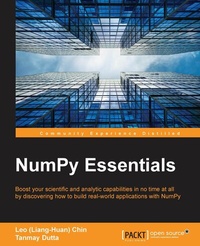
NumPy Essentials
Boost your scientific and analytic capabilities in no time at all by discovering how to build real-world applications with NumPy
Published on 8. July 2025
156 pages
978-1-78439-218-5 (ISBN)
Description

Boost your scientific and analytic capabilities in no time at all by discovering how to build real-world applications with NumPy
Key Features
[*] Optimize your Python scripts with powerful NumPy modules
[*] Explore the vast opportunities to build outstanding scientific/ analytical modules by yourself
[*] Packed with rich examples to help you master NumPy arrays and universal functions
Book DescriptionIn today's world of science and technology, it's all about speed and flexibility. When it comes to scientific computing, NumPy tops the list. NumPy gives you both the speed and high productivity you need. This book will walk you through NumPy using clear, step-by-step examples and just the right amount of theory. We will guide you through wider applications of NumPy in scientific computing and will then focus on the fundamentals of NumPy, including array objects, functions, and matrices, each of them explained with practical examples. You will then learn about different NumPy modules while performing mathematical operations such as calculating the Fourier Transform; solving linear systems of equations, interpolation, extrapolation, regression, and curve fitting; and evaluating integrals and derivatives. We will also introduce you to using Cython with NumPy arrays and writing extension modules for NumPy code using the C API. This book will give you exposure to the vast NumPy library and help you build efficient, high-speed programs using a wide range of mathematical features.What you will learn
[*] Manipulate the key attributes and universal functions of NumPy
[*] Utilize matrix and mathematical computation using linear algebra modules
[*] Implement regression and curve fitting for models
[*] Perform time frequency / spectral density analysis using the Fourier Transform modules
[*] Collate with the distutils and setuptools modules used by other Python libraries
[*] Establish Cython with NumPy arrays
[*] Write extension modules for NumPy code using the C API
[*] Build sophisticated data structures using NumPy array with libraries such as Panda and Scikits
Who this book is forIf you are an experienced Python developer who intends to drive your numerical and scientific applications with NumPy, this book is for you. Prior experience or knowledge of working with the Python language is required.
Key Features
[*] Optimize your Python scripts with powerful NumPy modules
[*] Explore the vast opportunities to build outstanding scientific/ analytical modules by yourself
[*] Packed with rich examples to help you master NumPy arrays and universal functions
Book DescriptionIn today's world of science and technology, it's all about speed and flexibility. When it comes to scientific computing, NumPy tops the list. NumPy gives you both the speed and high productivity you need. This book will walk you through NumPy using clear, step-by-step examples and just the right amount of theory. We will guide you through wider applications of NumPy in scientific computing and will then focus on the fundamentals of NumPy, including array objects, functions, and matrices, each of them explained with practical examples. You will then learn about different NumPy modules while performing mathematical operations such as calculating the Fourier Transform; solving linear systems of equations, interpolation, extrapolation, regression, and curve fitting; and evaluating integrals and derivatives. We will also introduce you to using Cython with NumPy arrays and writing extension modules for NumPy code using the C API. This book will give you exposure to the vast NumPy library and help you build efficient, high-speed programs using a wide range of mathematical features.What you will learn
[*] Manipulate the key attributes and universal functions of NumPy
[*] Utilize matrix and mathematical computation using linear algebra modules
[*] Implement regression and curve fitting for models
[*] Perform time frequency / spectral density analysis using the Fourier Transform modules
[*] Collate with the distutils and setuptools modules used by other Python libraries
[*] Establish Cython with NumPy arrays
[*] Write extension modules for NumPy code using the C API
[*] Build sophisticated data structures using NumPy array with libraries such as Panda and Scikits
Who this book is forIf you are an experienced Python developer who intends to drive your numerical and scientific applications with NumPy, this book is for you. Prior experience or knowledge of working with the Python language is required.
All prices
More details
Edition
Digital original
Language
English
Place of publication
Birmingham
United Kingdom
Target group
Professional and scholarly
US School Grade: College Graduate Student
Edition type
Digital original
File size
5,72 MB
ISBN-13
978-1-78439-218-5 (9781784392185)
Copyright in bibliographic data and cover images is held by Nielsen Book Services Limited or by the publishers or by their respective licensors: all rights reserved.
Schweitzer Classification
Other editions
Additional editions
Liang-Hua Chin | Tanmay Datta
NumPy Essentials
Book
04/2016
Packt Publishing
€39.00
Shipment within 3-4 weeks
Persons
Deshpande Jaidev :
Contacted 23/5/14Chin Leo (Liang-Huan) :
Leo (Liang-Huan) Chin is a data engineer with more than 5 years of experience in the field of Python. He works for Gogoro smart scooter, Taiwan, where his job entails discovering new and interesting biking patterns . His previous work experience includes ESRI, California, USA, which focused on spatial-temporal data mining. He loves data, analytics, and the stories behind data and analytics. He received an MA degree of GIS in geography from State University of New York, Buffalo. When Leo isn't glued to a computer screen, he spends time on photography, traveling, and exploring some awesome restaurants across the world. You can reach Leo at http://chinleock.github.io/portfolio/.Dutta Tanmay :
Tanmay Dutta is a seasoned programmer with expertise in programming languages such as Python, Erlang, C++, Haskell, and F#. He has extensive experience in developing numerical libraries and frameworks for investment banking businesses. He was also instrumental in the design and development of a risk framework in Python (pandas, NumPy, and Django) for a wealth fund in Singapore. Tanmay has a master's degree in financial engineering from Nanyang Technological University, Singapore, and a certification in computational finance from Tepper Business School, Carnegie Mellon University.Holloway Shane :
http://shaneholloway.com/resume/
Contacted 23/5/14Chin Leo (Liang-Huan) :
Leo (Liang-Huan) Chin is a data engineer with more than 5 years of experience in the field of Python. He works for Gogoro smart scooter, Taiwan, where his job entails discovering new and interesting biking patterns . His previous work experience includes ESRI, California, USA, which focused on spatial-temporal data mining. He loves data, analytics, and the stories behind data and analytics. He received an MA degree of GIS in geography from State University of New York, Buffalo. When Leo isn't glued to a computer screen, he spends time on photography, traveling, and exploring some awesome restaurants across the world. You can reach Leo at http://chinleock.github.io/portfolio/.Dutta Tanmay :
Tanmay Dutta is a seasoned programmer with expertise in programming languages such as Python, Erlang, C++, Haskell, and F#. He has extensive experience in developing numerical libraries and frameworks for investment banking businesses. He was also instrumental in the design and development of a risk framework in Python (pandas, NumPy, and Django) for a wealth fund in Singapore. Tanmay has a master's degree in financial engineering from Nanyang Technological University, Singapore, and a certification in computational finance from Tepper Business School, Carnegie Mellon University.Holloway Shane :
http://shaneholloway.com/resume/
Content
Table of Contents
Introduction to NumPy
The numpy.ndarray object
Using NumPy arrays
The numpy core and lib submodules
Linear Algebra in NumPy
Fourier Analysis in NumPy
Building and distributing NumPy Code
Speeding up NumPy with Cython
Introduction to the NumPy C API
Further reading
Introduction to NumPy
The numpy.ndarray object
Using NumPy arrays
The numpy core and lib submodules
Linear Algebra in NumPy
Fourier Analysis in NumPy
Building and distributing NumPy Code
Speeding up NumPy with Cython
Introduction to the NumPy C API
Further reading

