

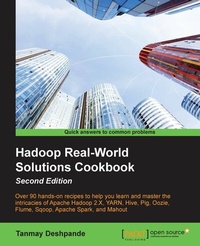
Hadoop Real-World Solutions Cookbook
Over 90 hands-on recipes to help you learn and master the intricacies of Apache Hadoop 2.X, YARN, Hive, Pig, Oozie, Flume, Sqoop, Apache Spark, and Mahout
2nd Edition
Published on 8. July 2025
290 pages
978-1-78439-800-2 (ISBN)
Description

Over 90 hands-on recipes to help you learn and master the intricacies of Apache Hadoop 2.X, YARN, Hive, Pig, Oozie, Flume, Sqoop, Apache Spark, and Mahout.
Key Features
[*]Implement outstanding Machine Learning use cases on your own analytics models and processes.
[*]Solutions to common problems when working with the Hadoop ecosystem.
[*]Step-by-step implementation of end-to-end big data use cases.
Book DescriptionBig data is the current requirement. Most organizations produce huge amount of data every day. With the arrival of Hadoop-like tools, it has become easier for everyone to solve big data problems with great efficiency and at minimal cost. Grasping Machine Learning techniques will help you greatly in building predictive models and using this data to make the right decisions for your organization. Hadoop Real World Solutions Cookbook gives readers insights into learning and mastering big data via recipes. The book not only clarifies most big data tools in the market but also provides best practices for using them. The book provides recipes that are based on the latest versions of Apache Hadoop 2.X, YARN, Hive, Pig, Sqoop, Flume, Apache Spark, Mahout and many more such ecosystem tools. This real-world-solution cookbook is packed with handy recipes you can apply to your own everyday issues. Each chapter provides in-depth recipes that can be referenced easily. This book provides detailed practices on the latest technologies such as YARN and Apache Spark. Readers will be able to consider themselves as big data experts on completion of this book. This guide is an invaluable tutorial if you are planning to implement a big data warehouse for your business. What you will learn
[*]Installing and maintaining Hadoop 2.X cluster and its ecosystem.
[*]Write advanced Map Reduce programs and understand design patterns.
[*]Advanced Data Analysis using the Hive, Pig, and Map Reduce programs.
[*]Import and export data from various sources using Sqoop and Flume.
[*]Data storage in various file formats such as Text, Sequential, Parquet, ORC, and RC Files.
[*]Machine learning principles with libraries such as Mahout
[*]Batch and Stream data processing using Apache Spark
Who this book is forReaders who have a basic knowledge of big data systems and want to advance their knowledge with hands-on recipes.
Key Features
[*]Implement outstanding Machine Learning use cases on your own analytics models and processes.
[*]Solutions to common problems when working with the Hadoop ecosystem.
[*]Step-by-step implementation of end-to-end big data use cases.
Book DescriptionBig data is the current requirement. Most organizations produce huge amount of data every day. With the arrival of Hadoop-like tools, it has become easier for everyone to solve big data problems with great efficiency and at minimal cost. Grasping Machine Learning techniques will help you greatly in building predictive models and using this data to make the right decisions for your organization. Hadoop Real World Solutions Cookbook gives readers insights into learning and mastering big data via recipes. The book not only clarifies most big data tools in the market but also provides best practices for using them. The book provides recipes that are based on the latest versions of Apache Hadoop 2.X, YARN, Hive, Pig, Sqoop, Flume, Apache Spark, Mahout and many more such ecosystem tools. This real-world-solution cookbook is packed with handy recipes you can apply to your own everyday issues. Each chapter provides in-depth recipes that can be referenced easily. This book provides detailed practices on the latest technologies such as YARN and Apache Spark. Readers will be able to consider themselves as big data experts on completion of this book. This guide is an invaluable tutorial if you are planning to implement a big data warehouse for your business. What you will learn
[*]Installing and maintaining Hadoop 2.X cluster and its ecosystem.
[*]Write advanced Map Reduce programs and understand design patterns.
[*]Advanced Data Analysis using the Hive, Pig, and Map Reduce programs.
[*]Import and export data from various sources using Sqoop and Flume.
[*]Data storage in various file formats such as Text, Sequential, Parquet, ORC, and RC Files.
[*]Machine learning principles with libraries such as Mahout
[*]Batch and Stream data processing using Apache Spark
Who this book is forReaders who have a basic knowledge of big data systems and want to advance their knowledge with hands-on recipes.
All prices
More details
Edition
2nd Revised edition
Language
English
Place of publication
Birmingham
United Kingdom
Target group
Professional and scholarly
US School Grade: College Graduate Student
Edition type
Revised edition
File size
2,60 MB
ISBN-13
978-1-78439-800-2 (9781784398002)
Copyright in bibliographic data and cover images is held by Nielsen Book Services Limited or by the publishers or by their respective licensors: all rights reserved.
Schweitzer Classification
Other editions
Additional editions
Tanmay Deshpande
Hadoop Real-World Solutions Cookbook Second Edition
Book
03/2016
Packt Publishing
€69.00
Shipment within 3-4 weeks
Person
Deshpande Tanmay :
Tanmay Deshpande is a Hadoop and big data evangelist. He currently works with Schlumberger as a Big Data Architect in Pune, India. He has interest in a wide range of technologies, such as Hadoop, Hive, Pig, NoSQL databases, Mahout, Sqoop, Java, cloud computing, and so on. He has vast experience in application development in various domains, such as oil and gas, finance, telecom, manufacturing, security, and retail. He enjoys solving machine-learning problems and spends his time reading anything that he can get his hands on. He has great interest in open source technologies and has been promoting them through his talks. Before Schlumberger, he worked with Symantec, Lumiata, and Infosys. Through his innovative thinking and dynamic leadership, he has successfully completed various projects. He regularly blogs on his website http://hadooptutorials.co.in. You can connect with him on LinkedIn at https://www.linkedin.com/in/deshpandetanmay/. He has also authored Mastering DynamoDB, published in August 2014, DynamoDB Cookbook, published in September 2015, Hadoop Real World Solutions Cookbook-Second Edition, published in March 2016, Hadoop: Data Processing and Modelling, published in August, 2016, and Hadoop Blueprints, published in September 2016, all by Packt Publishing.
Tanmay Deshpande is a Hadoop and big data evangelist. He currently works with Schlumberger as a Big Data Architect in Pune, India. He has interest in a wide range of technologies, such as Hadoop, Hive, Pig, NoSQL databases, Mahout, Sqoop, Java, cloud computing, and so on. He has vast experience in application development in various domains, such as oil and gas, finance, telecom, manufacturing, security, and retail. He enjoys solving machine-learning problems and spends his time reading anything that he can get his hands on. He has great interest in open source technologies and has been promoting them through his talks. Before Schlumberger, he worked with Symantec, Lumiata, and Infosys. Through his innovative thinking and dynamic leadership, he has successfully completed various projects. He regularly blogs on his website http://hadooptutorials.co.in. You can connect with him on LinkedIn at https://www.linkedin.com/in/deshpandetanmay/. He has also authored Mastering DynamoDB, published in August 2014, DynamoDB Cookbook, published in September 2015, Hadoop Real World Solutions Cookbook-Second Edition, published in March 2016, Hadoop: Data Processing and Modelling, published in August, 2016, and Hadoop Blueprints, published in September 2016, all by Packt Publishing.
Content
Table of Contents
Getting Started with Hadoop
Exploring HDFS
Mastering Map Reduce Programs
Performing Common tasks using Hive, Pig and Hbase
Big Data Analysis using Hive, Impala
Data import/Export using Sqoop and Flume
Automation Hadoop tasks using Oozie
Machine Learning and Predictive Analytics using Mahout and R
Integration with Apache Spark
Hadoop Use Cases
Getting Started with Hadoop
Exploring HDFS
Mastering Map Reduce Programs
Performing Common tasks using Hive, Pig and Hbase
Big Data Analysis using Hive, Impala
Data import/Export using Sqoop and Flume
Automation Hadoop tasks using Oozie
Machine Learning and Predictive Analytics using Mahout and R
Integration with Apache Spark
Hadoop Use Cases

