

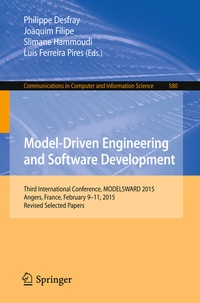
Model-Driven Engineering and Software Development
Third International Conference, MODELSWARD 2015, Angers, France, February 9-11, 2015, Revised Selected Papers
Published on 4. January 2016
XV, 438 pages
978-3-319-27869-8 (ISBN)
Description

This book constitutes thoroughly revised and selected papers from the Third International Conference on Model-Driven Engineering and Software Development, MODELSWARD 2015, held in Angers, France, in February 2015.
The 25 thoroughly revised and extended papers presented in this volume were carefully reviewed and selected from 94 submissions. They are organized in topical sections named: invited papers; modeling languages, tools and architectures; methodologies, processes and platforms; applications and software development.
More details
Series
Edition
1st ed. 2015
Language
English
Place of publication
Cham
Switzerland
Publishing group
Springer International Publishing
Target group
Professional and scholarly
Product notice
Reflowable
Illustrations
XV, 438 p. 237 illus.
File size
42,82 MB
ISBN-13
978-3-319-27869-8 (9783319278698)
DOI
10.1007/978-3-319-27869-8
Schweitzer Classification
Other editions
Additional editions
Philippe Desfray | Joaquim Filipe | Slimane Hammoudi
Model-Driven Engineering and Software Development
Third International Conference, MODELSWARD 2015, Angers, France, February 9-11, 2015, Revised Selected Papers
Book
01/2016
Springer
€53.49
Shipment within 10-15 days
Persons
Content
- Intro
- Preface
- Organization
- Contents
- Invited Paper
- Safety Case Development with SBVR-Based Controlled Language
- 1 Introduction
- 2 Background
- 2.1 Goal Structuring Notation
- 2.2 Semantics of Business Vocabulary and Rules
- 3 Methodology
- 3.1 Conceptual Phase: From Conceptual Model to SBVR Model
- 3.2 Vocabulary Phase: Creating Vocabulary with an SBVR Editor
- 3.3 Modeling Phase: Construct Safety Cases with Vocabulary
- 4 Case Study
- 5 Related Work
- 6 Conclusions and Future Work
- References
- Modeling Languages, Tools and Architectures
- Realizing a Conceptual Framework to Integrate Model-Driven Engineering, Software Product Line Engineering, and Software Configuration Management
- 1 Introduction
- 2 The Conceptual Framework
- 2.1 Overview
- 2.2 Version Space
- 2.3 Product Space
- 3 Model-Driven Realization
- 3.1 Metamodels for the Repository
- 3.2 Workspace and Local Synchronization
- 3.3 Realization of Check-Out and Commit
- 4 Optimization
- 4.1 Hierarchical Evaluation of Visibilities
- 4.2 Visibility Forests
- 4.3 Substitution of Ambition Expressions
- 5 Related Work
- 6 Conclusion
- References
- Composition of Heterogeneous Modeling Languages
- 1 Introduction
- 2 Motivation
- 2.1 Software Architecture
- 2.2 Domain and Data Modeling
- 3 Language Integration Concepts
- 3.1 Language Aggregation
- 3.2 Language Embedding
- 3.3 Language Inheritance
- 3.4 Context Conditions
- 4 Language Integration Framework
- 4.1 Symbol Table Concepts
- 4.2 Symbol Table Components
- 4.3 Configuration of Language Compositions
- 5 Related Work
- 6 Conclusion
- References
- A Model-driven Approach for the Generation of Customizable Model Migrations
- 1 Introduction
- 2 Motivation
- 3 Formal Framework for Adaptable Model Migrations
- 3.1 Migration Specification Foundations
- 3.2 Migration Specification Implementation
- 4 Experiment
- 5 Current and Related Works
- 6 Conclusion and Future Works
- References
- Parallel Application Development Using Architecture View Driven Model Transformations
- Abstract
- 1 Introduction
- 2 Preliminaries
- 2.1 Modeling Parallel Applications
- 2.2 Architecture Viewpoints for Modeling Parallel Applications
- 3 Architecture View Driven Transformations
- 3.1 Algorithm Decomposition Generator
- 3.2 Component Generator
- 3.3 Deployment Generator
- 3.4 Logical Configuration Generator
- 4 Implementation and Toolset
- 5 Related Work
- 6 Conclusion
- References
- Runtime Translation of Model-Level Queries to Persistence-Level
- 1 Introduction
- 2 MQT: Overview
- 2.1 Data-schema
- 2.2 Conceptual Model
- 3 MQT: EOL to SQL Translation
- 3.1 Query Model Elements
- 3.2 Element Filtering
- 3.3 Query Results (EDBObjectList)
- 3.4 Query Results (EDBObject)
- 4 Empirical Study
- 4.1 Results
- 5 Related Work
- 6 Conclusions and Further Work
- References
- Integration of Handwritten and Generated Object-Oriented Code
- 1 Introduction
- 2 Evaluation Criteria
- 3 Integration Mechanisms Based on Language Concepts
- 3.1 Generation Gap
- 3.2 Extended Generation Gap
- 3.3 Delegation
- 3.4 Include Mechanism
- 3.5 Partial Classes
- 3.6 Aspect-Oriented Programming
- 4 General Integration Mechanisms
- 4.1 PartMerger Mechanism
- 4.2 Protected Regions
- 5 Discussion
- 6 Related Work
- 7 Extend Generated Code with Action Languages
- 8 Conclusion
- References
- A Framework for Metamodel Composition and Adaptation with Conformance-Preserving Model Migration
- 1 Introduction
- 2 Motivating Example
- 3 Metamodel Adaptations
- 3.1 The Analysis Environment
- 3.2 The Adaptation Rules
- 3.3 Example Revisited
- 4 Conformance
- 4.1 Example Revisited
- 5 Related Work
- 6 Conclusion and Future Work
- References
- A Textual Domain-Specific Language Based on the UML Testing Profile
- 1 Introduction
- 2 Related Work
- 3 Test Specification Language -- Ubtl
- 3.1 General
- 3.2 Applications
- 3.3 Software Architecture
- 3.4 Language Elements
- 4 Use Case
- 4.1 Context of the Use Case
- 4.2 System Under Test
- 4.3 Specifying Test Case
- 4.4 Transformation to Matlab Code
- 4.5 Resulting Matlab Script
- 5 Conclusion
- References
- Metamodel and Model Composition by Integration of Operational Semantics
- 1 Introduction
- 2 Definitions
- 3 Example
- 4 The Framework
- 4.1 Specification of Unification Model
- 4.2 Definition of Code Generators
- 4.3 Code Generation
- 4.4 Specification of Linking Model
- 4.5 Execution of Models
- 5 Evaluation
- 6 Related Work
- 7 Conclusion and Future Work
- References
- Computability Assurance for UML Template Binding
- Abstract
- 1 Introduction
- 2 An Introduction to UML Templates
- 3 Some Limitations of UML Templates
- 4 Functional Conformance
- 4.1 Type Conformance
- 4.2 Multiplicity Conformance
- 4.3 Contents Conformance
- 4.4 Staticity Conformance
- 4.5 Visibility Requirement
- 4.6 Computability Assurance
- 5 Related Work
- 6 Conclusions and Future Work
- 1 Appendix: OCL Formulation of Functional Conformance
- References
- Challenging a Transformation-Wise Architecture Framework in a Comparative Case Study
- 1 Introduction
- 2 Related Work and Motivation
- 3 Design Method in Short
- 3.1 Requirement Listing
- 3.2 Architecture Description and Transformations
- 3.3 A Transformational Approach
- 4 Case Study Protocol
- 4.1 Participants' Profiles
- 4.2 Initial Phase to Build Comparable Groups
- 4.3 Case Study Startup
- 4.4 Case Description
- 4.5 Evaluation Method
- 5 Case Study Results
- 5.1 Functional Correctness and Quality of Deliverables
- 5.2 Paper-Based Survey
- 6 Discussion
- 6.1 Evaluation of the Approach
- 6.2 Threats to Validity
- 7 Conclusions
- References
- Meta Model Extensibility of BPMN: Current Limitations and Proposed Improvements
- 1 Introduction
- 2 Fundamentals
- 2.1 Extensibility of Conceptual Modeling Languages
- 2.2 Excursus: Extensibility of Programming Languages
- 3 BPMN Extensibility
- 3.1 Implicit Capabilities
- 3.2 Explicit Capabilities
- 3.3 Problematic Aspects of Extending the BPMN Meta Model
- 4 Profiling
- 4.1 Modus Operandi
- 4.2 Modeling Concepts
- 4.3 Application and Example
- 5 Under Specification (Hooking)
- 5.1 Modus Operandi
- 5.2 Modeling Concepts
- 5.3 Application and Example
- 6 Annotation (Plug-ins and Add-Ons)
- 6.1 Modus Operandi of Plug-Ins
- 6.2 Modus Operandi of Add-Ons
- 6.3 Modeling Concepts
- 6.4 Application and Example for Plug-Ins
- 6.5 Application and Example for Add-Ons
- 7 Comparison and Conclusion
- 7.1 Comparison of Extension Approaches
- 7.2 Conclusion and Further Research
- References
- An Approach to Define and Apply Collaboration Process Patterns for Software Development
- Abstract
- 1 Introduction
- 2 Modelling Collaborative Processes
- 2.1 Software Process Modelling
- 2.2 Collaboration in Software Process Modeling
- 2.3 Workflow Patterns
- 3 An Approach to Collaboration Patterns
- 3.1 Introduction
- 3.2 Pattern "Duplicate in Sequence with Multiple Actors" (DSMA)
- 3.3 Pattern "Duplicate in Parallel with Multiple Actors and Merge" (DPMAM)
- 3.4 Conclusion
- 4 Application of Collaboration Patterns
- 5 Realization and Case Study
- 5.1 Case Study
- 5.2 Supporting Tool Prototype
- 6 Conclusion
- References
- An Ontology-Based Process Editor for Generating Model Mapping in Tool Integration
- Abstract
- 1 Introduction
- 2 Illustrating Example
- 3 iSPEM -- A Multilevels Process Modeling Language
- 3.1 SPEM 2.0
- 3.2 Multi-level Process Elements
- 4 Combining Process Editor and Ontology
- 4.1 Reusable Process Ontology
- 4.2 Generation of Transformation Rules for a Tool Integration Point
- 5 iSPEM Process Editor
- 5.1 Implementation of iSPEM System
- 5.2 Case-Study
- 6 Conclusions
- References
- Using Model Driven Engineering to Support Multi-paradigms Security Analysis
- Abstract
- 1 Introduction
- 2 Background
- 2.1 EBIOS Method
- 2.2 Attack Tree Quantitative Method
- 2.3 Motivation
- 3 Model Driven Approach
- 3.1 Process Description
- 3.2 Model-Based Security Framework Description
- 4 Cyber-Power System Case Study
- 5 Related Work
- 6 Conclusion, Perspectives
- References
- Designing Safe and Secure Embedded and Cyber-Physical Systems with SysML-Sec
- 1 Introduction
- 2 Impact of Attacks
- 3 The Fundamental Role of the System Architecture for Security
- 3.1 Software/Hardware Partitioning
- 3.2 Model-Driven Engineering
- 4 Specifying the Security Requirements
- 4.1 Security Goals and Threats
- 4.2 SysML-Sec: A SysML-Based Model-Oriented Approach
- 4.3 Methodology
- 4.4 Toolkit
- 5 Safety- and Security-Oriented Validations
- 5.1 Safety Properties
- 5.2 Security Properties
- 5.3 Safety and Security, Safety vs. Security
- 6 Example: Safety and Security Analysis of a Communicating Vehicle
- 6.1 Security Requirements
- 6.2 Threats and Attacks
- 6.3 Hardware/Software Partitioning
- 7 Conclusion and Future Work
- References
- Methodologies, Processes and Platforms
- Architecture Optimization with SysML Modeling: A Case Study Using Variability
- Abstract
- 1 Introduction
- 2 Methodology
- 2.1 Design Flow with MBSE
- 2.2 Our Proposal
- 3 SysML Modeling for Optimization
- 3.1 Case Study
- 3.2 Requirements Capture
- 3.3 MDO Context and Objective Functions Definition
- 3.4 System Composition and Redundancy Modeling
- 3.5 Component Interface Modeling
- 4 Problem Statement
- 5 Model Transformation
- 5.1 CSP Problem
- 5.2 Creation of CSP Variables
- 5.3 Constraints and CSP Resolution
- 5.4 Evaluation of the CSP Solutions
- 5.5 Pareto Frontier
- 5.6 Results
- 6 Related Work
- 7 Conclusions and Future Work
- References
- Knowledge Modeling in the Health Care Domain: Capturing Semantics to Bridge the Gap Between Complex ...
- Abstract
- 1 Introduction
- 2 Concept Mapping and Knowledge Modeling
- 3 The Research Project
- 4 Research Methods
- 5 Data Analysis
- 6 Related Work
- 7 Conclusions
- References
- The Interface-Modular Method for Global System Behaviour Specification
- 1 Introduction
- 2 Functional Requirements
- 3 Functional Specification
- 3.1 Service Structure
- 3.2 Interface Functionality
- 3.3 Modelling the Core Functionality
- 3.4 Composing the Core and Interface Functionality
- 4 Method Validation
- 5 Related Work
- 6 Conclusion and Future Work
- References
- Identifying Code Generation Candidates Using Software Categories
- 1 Introduction
- 2 Software Categories
- 3 Categories for Generative Software
- 4 Dependency Rules for Categories
- 5 Categorization Approach
- 6 Analyzing Usefulness on an Illustrative Example
- 7 Further Dependencies
- 8 Related Work
- 9 Conclusion
- References
- Applications and Software Development
- Model-in-the-Loop Testing of a Railway Interlocking System
- 1 Introduction
- 2 Related Work
- 3 The Overall Approach
- 4 Environment Modeling
- 4.1 The Computation Independent Test Model
- 4.2 Case Study
- 4.3 Model-in-the-Loop Testing
- 5 Discussion and Conclusions
- References
- Model Transformation Configuration and Variability Management for User Interface Design
- 1 Introduction
- 2 Related Work
- 2.1 Feature Modelling
- 2.2 SPL Configuration
- 2.3 Model-Driven User Interfaces Variability
- 3 UI-SPL Approach
- 3.1 Multi-FM Approach
- 3.2 Configuration: The Specific Case of Rapid Prototyping
- 4 Implementation
- 4.1 Feature Models: Selection and Reconciliation
- 4.2 Generation of the Configuration UI
- 4.3 Transformations
- 4.4 Example of Product Configuration
- 5 Conclusions and Perspectives
- References
- Sustainable Enterprise Interoperability in Dynamic Collaborative Environments: A Knowledge Link Approach
- 1 Introduction
- 2 Related Work
- 3 Knowledge Base Structure
- 4 Event-Driven Architecture Approach
- 5 Knowledge Links
- 5.1 Syntax of Knowledge Links
- 5.2 Modelling and Execution
- 6 Model-Driven Architecture Approach
- 7 Summary and Conclusion
- References
- Services for Business Knowledge Representation and Capture
- Abstract
- 1 Introduction
- 2 Literature Review
- 2.1 SSME and MDSE
- 2.2 Model-Driven Architectures
- 2.3 Model-Driven Interoperability
- 3 Business Knowledge Capture
- 3.1 Capture Information System
- 3.2 Knowledge Representation and Enrichment Process
- 3.3 Tools for Business Heterogeneity
- 3.4 Proposed Framework
- 3.5 Use-Case Validation
- 4 Conclusions and Future Work
- References
- Author Index
