

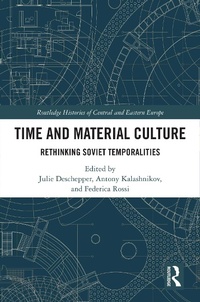
Time and Material Culture
Rethinking Soviet Temporalities
1st Edition
Published on 5. July 2024
276 pages
978-1-040-09218-7 (ISBN)
Description

This edited volume offers an original exploration into the ways in which Soviet culture and experience of time were unique, examining the temporalities expressed in the world of socialist things: from the objects of everyday life to urban architecture.
Grounding the analysis of Soviet temporalities in their material incarnations not only lends concreteness to discussions of temporal culture, but also draws out ways in which the specificities of Soviet things-and their planning, design, manufacture, and consumption-mediated and produced particular ways of experiencing, perceiving, and representing time. As such, Time and Material Culture turns a new page in the study of the temporal and material culture of Soviet socialism and, in doing so, contributes to broader debates on the changing experiences of time in the global twentieth century. The book integrates interdisciplinary perspectives as well as regional approaches sensitive to the multinational nature of the Soviet project.
Time and Material Culture will be useful to academics, upper-level undergraduates, and graduate students interested in twentieth-century cultures of time.
Grounding the analysis of Soviet temporalities in their material incarnations not only lends concreteness to discussions of temporal culture, but also draws out ways in which the specificities of Soviet things-and their planning, design, manufacture, and consumption-mediated and produced particular ways of experiencing, perceiving, and representing time. As such, Time and Material Culture turns a new page in the study of the temporal and material culture of Soviet socialism and, in doing so, contributes to broader debates on the changing experiences of time in the global twentieth century. The book integrates interdisciplinary perspectives as well as regional approaches sensitive to the multinational nature of the Soviet project.
Time and Material Culture will be useful to academics, upper-level undergraduates, and graduate students interested in twentieth-century cultures of time.
More details
Series
Edition
1. Auflage
Language
English
Place of publication
London
United Kingdom
Publishing group
Taylor & Francis Ltd
Target group
College/higher education
Illustrations
18 Halftones, black and white; 18 Illustrations, black and white
ISBN-13
978-1-040-09218-7 (9781040092187)
Copyright in bibliographic data and cover images is held by Nielsen Book Services Limited or by the publishers or by their respective licensors: all rights reserved.
Schweitzer Classification
Other editions
Additional editions
Julie Deschepper | Antony Kalashnikov | Federica Rossi
Time and Material Culture
Rethinking Soviet Temporalities
Book
approx. 07/2026
1st Edition
Routledge
€57.50
Not yet published
Julie Deschepper | Antony Kalashnikov | Federica Rossi
Time and Material Culture
Rethinking Soviet Temporalities
Book
07/2024
1st Edition
Routledge
€206.60
Shipment within 10-20 days

Julie Deschepper | Antony Kalashnikov | Federica Rossi
Time and Material Culture
Rethinking Soviet Temporalities
Book
07/2024
Routledge
Unfortunately, price unknown
Available (delivery time upon request)
Persons
Julie Deschepper is an Assistant Professor in Heritage and Museum Studies at Utrecht University. She specialises in the material culture of socialism, with a focus on Soviet monumental heritage in the twentieth and twenty-first centuries.
Antony Kalashnikov is a Postdoctoral Fellow in the Department of History at the University of Waterloo. He works on Soviet understandings of futurity. His monograph, Monuments for Posterity: Self-Commemoration and the Stalinist Culture of Time, came out in 2023.
Federica Rossi is an Assistant Professor in the History of Architecture at Iuav University of Venice, and a Research Associate at Kunsthistorisches Institut in Florenz and Universita della Svizzera Italiana. She works on Russian and Soviet art, architecture and culture.
Antony Kalashnikov is a Postdoctoral Fellow in the Department of History at the University of Waterloo. He works on Soviet understandings of futurity. His monograph, Monuments for Posterity: Self-Commemoration and the Stalinist Culture of Time, came out in 2023.
Federica Rossi is an Assistant Professor in the History of Architecture at Iuav University of Venice, and a Research Associate at Kunsthistorisches Institut in Florenz and Universita della Svizzera Italiana. She works on Russian and Soviet art, architecture and culture.
Content
Introduction: Soviet Temporal and Material Cultures in Dialogue Part 1: Alternatives, Dissonances, and Disjunctions 1. Chronopolitics: Restoring "Backward" Spaces to Modern Time in Soviet Baku after WWII 2. Soviet Industrial Time and Nonscalable Temporalities: Telling Time with Hydraulic Seas 3. The Golden Age of Soviet Heritage: An Alternative Presentism? 4. Conflicting Temporalities of Socialist Urbanity: Modernisation vis-a-vis Architectural Heritage in the Development of Minsk Part 2: Representations, Imaginations, and Narratives 5. Last Stop, Communism: Time as Space in Early Soviet Political Posters 6. From Survey to Inspiration: Accommodating Pre-Soviet Materiality in Soviet Lviv (1940s-1960s) 7. Immortalising Yurts? The Temporalities of Nomadic Architecture in Stalinist Central Asia 8. Hybrid Temporality Unveiled: Bridging People and State in the Late Soviet Union Through the Amateur Filmmaking Kit Part 3: Bodies, Experiences, and Perceptions 9. Stitches in Time: Maiakovskii's Overcoat and Temporal Self-Fashioning in the Soviet Union 10. Poets' "Hand" on Display: Soviet Literary Museums as Curators of Sacral Materiality 11. Socialist Time in Fashion: The Late Soviet Interpretation Conclusion: The Matter of Time
