

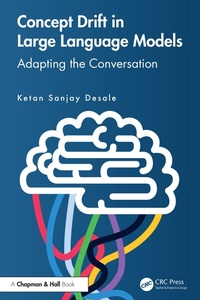
Concept Drift in Large Language Models
Adapting the Conversation
Published on 8. May 2025
104 pages
978-1-040-34143-8 (ISBN)
Description

This book explores the application of the complex relationship between concept drift and cutting-edge large language models to address the problems and opportunities in navigating changing data landscapes. It discusses the theoretical basis of concept drift and its consequences for large language models, particularly the transformative power of cutting-edge models such as GPT-3.5 and GPT-4. It offers real-world case studies to observe firsthand how concept drift influences the performance of language models in a variety of circumstances, delivering valuable lessons learnt and actionable takeaways. The book is designed for professionals, AI practitioners, and scholars, focused on natural language processing, machine learning, and artificial intelligence.
Examines concept drift in AI, particularly its impact on large language models
Analyses how concept drift affects large language models and its theoretical and practical consequences
Covers detection methods and practical implementation challenges in language models
Showcases examples of concept drift in GPT models and lessons learnt from their performance
Identifies future research avenues and recommendations for practitioners tackling concept drift in large language models
Examines concept drift in AI, particularly its impact on large language models
Analyses how concept drift affects large language models and its theoretical and practical consequences
Covers detection methods and practical implementation challenges in language models
Showcases examples of concept drift in GPT models and lessons learnt from their performance
Identifies future research avenues and recommendations for practitioners tackling concept drift in large language models
More details
Language
English
Place of publication
London
United Kingdom
Publishing group
Taylor & Francis Ltd
Target group
Professional and scholarly
Illustrations
8 Tables, black and white; 9 Line drawings, black and white; 9 Illustrations, black and white
File size
2,56 MB
ISBN-13
978-1-040-34143-8 (9781040341438)
Copyright in bibliographic data and cover images is held by Nielsen Book Services Limited or by the publishers or by their respective licensors: all rights reserved.
Schweitzer Classification
Other editions
Additional editions

Book
07/2025
CRC Press
Unfortunately, price unknown
Available (delivery time upon request)
Book
05/2025
1st Edition
Chapman & Hall/CRC
€115.90
Shipment within 10-20 days
Person
Dr. Ketan Sanjay Desale is a distinguished researcher and educator in the field of computer science, with a specialized focus on artificial intelligence, machine learning, and concept drift detection. Holding a Ph.D. in Computer Engineering, he has built a reputation for his impactful research and commitment to advancing the discipline through both academic and practical applications.
Currently serving as an Assistant Professor at Department of Computer Engineering of Pimpri Chinchwad College of Engineering (PCCOE), Pune, India. His contributions to the field are evidenced by his impressive record of publications in esteemed international journals, many of which are indexed in Scopus. Dr. Desale is an active participant in the academic community, regularly presenting his findings at national and international conferences.
Dr. Ketan Desale is also the Digital Marketing Head at Pimpri Chinchwad Education Trust (PCET) and serves as the Associate Dean of Management Information Systems (MIS) at Pimpri Chinchwad College of Engineering (PCCOE). In these roles, he leverages his expertise to enhance the institution's digital presence and streamline management information systems, ensuring that both faculty and students benefit from efficient, data-driven decision-making processes. His leadership in these areas reflects his commitment to integrating technology into educational management, ultimately fostering a more innovative and responsive academic environment.
Dr. Ketan Desale's academic influence is complemented by his online presence, where he actively shares his research and insights. His profiles on platforms such as Google Scholar, Scopus, and Web of Science highlight his contributions to the scientific community. To learn more about his work, you can visit his personal website or connect with him on LinkedIn.
Currently serving as an Assistant Professor at Department of Computer Engineering of Pimpri Chinchwad College of Engineering (PCCOE), Pune, India. His contributions to the field are evidenced by his impressive record of publications in esteemed international journals, many of which are indexed in Scopus. Dr. Desale is an active participant in the academic community, regularly presenting his findings at national and international conferences.
Dr. Ketan Desale is also the Digital Marketing Head at Pimpri Chinchwad Education Trust (PCET) and serves as the Associate Dean of Management Information Systems (MIS) at Pimpri Chinchwad College of Engineering (PCCOE). In these roles, he leverages his expertise to enhance the institution's digital presence and streamline management information systems, ensuring that both faculty and students benefit from efficient, data-driven decision-making processes. His leadership in these areas reflects his commitment to integrating technology into educational management, ultimately fostering a more innovative and responsive academic environment.
Dr. Ketan Desale's academic influence is complemented by his online presence, where he actively shares his research and insights. His profiles on platforms such as Google Scholar, Scopus, and Web of Science highlight his contributions to the scientific community. To learn more about his work, you can visit his personal website or connect with him on LinkedIn.
Content
1. Introduction 2. Concept Drift Fundamentals 3. Large Language Models 4. Concept Drift and Large Language Models 5. Detecting Concept Drift in Language Models 6. Adapting Language Models 7. Natural Language Processing 8. Limitations and Challenges 9. Conclusion and Future Directions
