
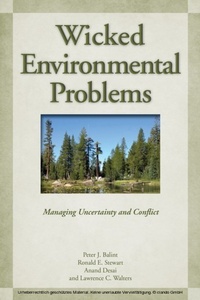
Wicked Environmental Problems
Description
Alles über E-Books | Antworten auf Fragen rund um E-Books, Kopierschutz und Dateiformate finden Sie in unserem Info- & Hilfebereich.
"Wicked" problems are large-scale, long-term policy dilemmas in which multiple and compounding risks and uncertainties combine with sharply divergent public values to generate contentious political stalemates; wicked problems in the environmental arena typically emerge from entrenched conflicts over natural resource management and over the prioritization of economic and conservation goals more generally. This new book examines past experience and future directions in the management of wicked environmental problems and describes new strategies for mitigating the conflicts inherent in these seemingly intractable situations. The book:
- reviews the history of the concept of wicked problems
- examines the principles and processes that managers have applied
- explores the practical limitations of various approaches
All prices
More details
Other editions
Additional editions
Persons
Ronald E. Stewart, now retired, sp30 years with the USDA Forest Service, ending his career as Deputy Chief for Programs and Legislation before serving five years on the faculty of Departmof Environmental Science and Policy, George Mason University.
Anand Desai is a Professor at the John Glenn School of Public Affairs at the Ohio State University, in Columbus.
Lawrence C. Walters is Stewart Grow Professor of Public Policy and Managemin the Romney Institute, Brigham Young University, in Provo, Utah.
Content
Preface
Chapter 1. The Challenge of Wicked Problems
Chapter 2. Risk and Uncertainty in Environmental Management
Chapter 3. Four Wicked Cases
Chapter 4. The Precautionary Principle
Chapter 5. Adaptive Management
Chapter 6. Participatory Processes
Chapter 7. A Proposed Adaptive, Deliberative Decision Process
Chapter 8. The Sierra Nevada Example: Survey of Stakeholders
Chapter 9. The Sierra Nevada Example: Elicitation and Analysis of Preferences
Chapter 10. Managing Wicked Environmental Problems
References
Authors
Index

System requirements
File format: PDF
Copy protection: Watermark-DRM (Digital Rights Management)
System requirements:
- Computer (Windows; MacOS X; Linux): Use the free software Adobe Reader, Adobe Digital Editions, or any other PDF viewer of your choice (see eBook Help).
- Tablet/Smartphone (Android; iOS): Install the free app Adobe Digital Editions or another reading app for eBooks, e.g., PocketBook (see eBook Help).
- E-reader: Bookeen, Kobo, Pocketbook, Sony, Tolino and many more (only limited: Kindle).
The file format PDF always displays a book page identically on any hardware. This makes PDF suitable for complex layouts such as those used in textbooks and reference books (images, tables, columns, footnotes). Unfortunately, on the small screens of e-readers or smartphones, PDFs are rather annoying, requiring too much scrolling.
This eBook uses Watermark-DRM, a „soft” copy protection. This means that there are no technical restrictions to prevent illegal distribution. However, there is a personalised watermark embedded in the eBook that can be used to identify the purchaser of the eBook in the event of misuse and to provide evidence for legal purposes.
For more information, see our eBook Help page.
File format: ePUB
Copy protection: Adobe-DRM (Digital Rights Management)
System requirements:
- Computer (Windows; MacOS X; Linux): Install the free reader Adobe Digital Editions prior to download (see eBook Help).
- Tablet/smartphone (Android; iOS): Install the free app Adobe Digital Editions or the app PocketBook before downloading (see eBook Help).
- E-reader: Bookeen, Kobo, Pocketbook, Sony, Tolino and many more (not Kindle).
The file format ePub works well for novels and non-fiction books – i.e., „flowing” text without complex layout. On an e-reader or smartphone, line and page breaks automatically adjust to fit the small displays.
This eBook uses Adobe-DRM, a „hard” copy protection. If the necessary requirements are not met, unfortunately you will not be able to open the eBook. You will therefore need to prepare your reading hardware before downloading.
Please note: We strongly recommend that you authorise using your personal Adobe ID after installation of any reading software.
For more information, see our ebook Help page.
