

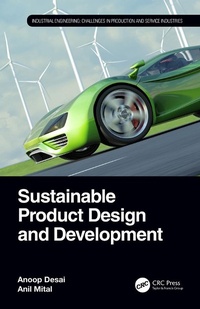
Sustainable Product Design and Development
1st Edition
Published on 3. December 2020
284 pages
978-1-000-24618-6 (ISBN)
Description

This book outlines the process of sustainable product design and development. It presents design guidelines that help prolong the life of a product and minimize its environmental impact. These guidelines specifically enable product design for end-of-life (EoL) objectives such as reuse, recycling and remanufacturing. Sustainable Product Design and Development also presents mathematical models that will help the designer determine the cost of designing sustainable products. This cost can be computed early during the design stage of a product.
Sustainable Product Design and Development presents different ways and means by which a product can address all three pillars of sustainability-environmental conservation, social sustainability, and economic sustainability. Various case studies are incorporated in different chapters. Case studies on designing products for assembly, disassembly and remanufacturing have been presented in their respective chapters. The book also provides an overview of global environmental legislation to help the reader grasp the importance of waste management and sustainable product design.
This book is aimed at professionals, engineering students, environmental scientists, and those in the business environment.
Sustainable Product Design and Development presents different ways and means by which a product can address all three pillars of sustainability-environmental conservation, social sustainability, and economic sustainability. Various case studies are incorporated in different chapters. Case studies on designing products for assembly, disassembly and remanufacturing have been presented in their respective chapters. The book also provides an overview of global environmental legislation to help the reader grasp the importance of waste management and sustainable product design.
This book is aimed at professionals, engineering students, environmental scientists, and those in the business environment.
More details
Series
Edition
1. Auflage
Language
English
Place of publication
London
United Kingdom
Publishing group
Taylor & Francis Ltd
Target group
Professional and scholarly
Illustrations
88 Tables, black and white; 42 Line drawings, black and white; 5 Halftones, black and white; 47 Illustrations, black and white
ISBN-13
978-1-000-24618-6 (9781000246186)
Copyright in bibliographic data and cover images is held by Nielsen Book Services Limited or by the publishers or by their respective licensors: all rights reserved.
Schweitzer Classification
Other editions
Additional editions
Anoop Desai | Anil Mital
Sustainable Product Design and Development
Book
10/2024
1st Edition
CRC Press
€73.70
Shipment within 15-20 days
Anoop Desai | Anil Mital
Sustainable Product Design and Development
Book
12/2020
1st Edition
CRC Press
€186.40
Shipment within 15-20 days
Anoop Desai
Sustainable Product Design and Development
Book
12/2020
CRC Press
Unfortunately, price unknown
Available (delivery time upon request)
Persons
Anoop Desai is an Associate Professor of Mechanical Engineering at Georgia Southern University. He received his PhD in Industrial Engineering from the University of Cincinnati in 2006. His areas of research interest include Product Development, Design for Manufacturing, Six Sigma and Quality control and Engineering Economic analysis.
Dr. Desai is the author of "Production Economics: Evaluating Costs of Operations in Manufacturing and Service Industries", "Product Development: A Structured Approach to Consumer Product Design, Development and Manufacture", "Fundamentals of Work measurement: What Every Engineer Should Know" and "Global Sustainability and Innovation (Edited)."
Dr. Desai is also the author of thirty journal papers mainly focusing on the area of Design for X, environment conscious design and manufacturing and the economics of production processes. He is one of Elsevier Science's most cited authors.
Anil Mital is a retired Professor of Manufacturing Design and Engineering at the University of Cincinnati. He was also the former Professor and Director of Industrial Engineering and a Professor of Physical Medicine and Rehabilitation at the University of Cincinnati. Dr. Mital is the founding Editor-in- Chief Emeritus of Elsevier's International Journal of Industrial Ergonomics and is the founding Editor-in-Chief Emeritus of the International Journal of Industrial Engineering - Theory, Applications, and Practice. Dr. Mital has authored and coauthored nearly 500 publications, including 200 journal articles and 23 books. He has made over 200 technical presentations in various parts of the world. He frequently conducted seminars in different countries on a wide range of topics, such as work design, engineering economy, facilities planning, human-centered manufacturing, ergo- nomics, and product design. Dr. Mital is a Fellow of the Institute of Industrial Engineers (IIE) and the Human Factors and Ergonomics Society (HFES). He also is a recipient of IIE's David F. Baker Distinguished Research Award, HFES's Paul M. Fitts Educational Award, and the Society of Automotive Engineers' Ralph Teetor Educational Award. Dr. Mital has been recognized by the Engineering Economy Division of IIE through its Eugene Grant Award and by the Society of Work Sciences through its M. M. Ayoub Award.
Dr. Desai is the author of "Production Economics: Evaluating Costs of Operations in Manufacturing and Service Industries", "Product Development: A Structured Approach to Consumer Product Design, Development and Manufacture", "Fundamentals of Work measurement: What Every Engineer Should Know" and "Global Sustainability and Innovation (Edited)."
Dr. Desai is also the author of thirty journal papers mainly focusing on the area of Design for X, environment conscious design and manufacturing and the economics of production processes. He is one of Elsevier Science's most cited authors.
Anil Mital is a retired Professor of Manufacturing Design and Engineering at the University of Cincinnati. He was also the former Professor and Director of Industrial Engineering and a Professor of Physical Medicine and Rehabilitation at the University of Cincinnati. Dr. Mital is the founding Editor-in- Chief Emeritus of Elsevier's International Journal of Industrial Ergonomics and is the founding Editor-in-Chief Emeritus of the International Journal of Industrial Engineering - Theory, Applications, and Practice. Dr. Mital has authored and coauthored nearly 500 publications, including 200 journal articles and 23 books. He has made over 200 technical presentations in various parts of the world. He frequently conducted seminars in different countries on a wide range of topics, such as work design, engineering economy, facilities planning, human-centered manufacturing, ergo- nomics, and product design. Dr. Mital is a Fellow of the Institute of Industrial Engineers (IIE) and the Human Factors and Ergonomics Society (HFES). He also is a recipient of IIE's David F. Baker Distinguished Research Award, HFES's Paul M. Fitts Educational Award, and the Society of Automotive Engineers' Ralph Teetor Educational Award. Dr. Mital has been recognized by the Engineering Economy Division of IIE through its Eugene Grant Award and by the Society of Work Sciences through its M. M. Ayoub Award.
Content
1. Introduction.
2. Environmental Legislations.
3. Design for Disassembly.
4. Design for Assembly.
5. Design for Maintenance.
6. Consideration of Reuse, Recycling and Remanufacturing.
7. Costing for Sustainable Product Design.
2. Environmental Legislations.
3. Design for Disassembly.
4. Design for Assembly.
5. Design for Maintenance.
6. Consideration of Reuse, Recycling and Remanufacturing.
7. Costing for Sustainable Product Design.
