

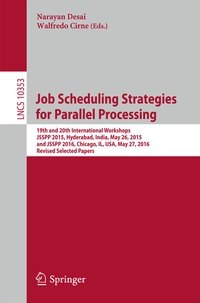
Job Scheduling Strategies for Parallel Processing
Description

This book constitutes the thoroughly refereed post-conference proceedings of the 19th and 20th International Workshop on Job Scheduling Strategies for Parallel Processing, JSSPP 2015 and 2016, held respectively in Hyderabad, India, on May 26, 2015 and in Chicago, IL, USA, on May 27, 2016. The 14 revised full papers presented (7 papers in 2015 and 7 papers in 2016) were carefully reviewed and selected from 28 submissions (14 in 2015 and 14 in 2016).
The papers cover the following topics: parallel scheduling raising challenges multiple levels of abstractions; node level parallelism; minimization of energy consumption in task migration within a many-core chip; task replication in real-time scheduling context; data-driven approach to schedule GPU load; the use of lock-free data structures in OS scheduler; the influence between user behaviour (think time, more precisely) and parallel scheduling; Evalix, a predictor for job resource consumption; sophisticated and realistic simulation; space-filling curves leading to better scheduling of large-scale computers; discussion of real-life production experiences.
More details
Other editions
Additional editions
Persons
Content
Parallel scheduling challenges raising at multiple levels of abstractions.- node level parallelism.- Minimization of energy consumption in task migration within a many-core chip;.- Task replication in real-time scheduling context.- Data-driven approach to schedule GPU load.- The use of lock-free data structures in OS scheduler.- The influence between user behaviour (think time, more precisely) and parallel scheduling.- Evalix, a predictor for job resource consumption.- Sophisticated and realistic simulation.- Space-filling curves leading to better scheduling of large-scale computers.- Discussion of real-life production experiences.
