

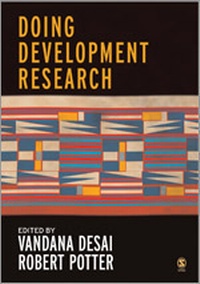
Doing Development Research
1st Edition
Published on 15. March 2006
336 pages
978-1-84787-782-6 (ISBN)
Description

Doing Development Research is a comprehensive introduction to research in development studies, that provides thorough training for anyone carrying out research in developing countries. It brings together experts with extensive experience of overseas research, presenting an interdisciplinary guide to the core methodologies.
Informed by years of research experience, Doing Development Research draws together many strands of action research and participatory methods, demonstrating their diverse applications and showing how they interrelate. The text provides:
? an account of the theoretical approaches that underlie development work
? an explanation of the practical issues involved in planning development research
? a systematic overview of information and data collecting methods in three sub-sections:
? methods of social research and associated forms of analysis
? using existing knowledge and records
? disseminating findings/research
Using clear and uncomplicated language - illustrated with appropriate learning features throughout - the text guides the researcher through the choice of appropriate methods, the implementation of the research, and the communication of the findings to a range of audiences. This is the essential A-Z of development research.
Informed by years of research experience, Doing Development Research draws together many strands of action research and participatory methods, demonstrating their diverse applications and showing how they interrelate. The text provides:
? an account of the theoretical approaches that underlie development work
? an explanation of the practical issues involved in planning development research
? a systematic overview of information and data collecting methods in three sub-sections:
? methods of social research and associated forms of analysis
? using existing knowledge and records
? disseminating findings/research
Using clear and uncomplicated language - illustrated with appropriate learning features throughout - the text guides the researcher through the choice of appropriate methods, the implementation of the research, and the communication of the findings to a range of audiences. This is the essential A-Z of development research.
Reviews / Votes
"The collection is a tight volume containing the diverse insight of the many years of collective experience of a range of academics." -- Lauren Siegman and Jessica DartAll prices
More details
Language
English
Place of publication
London
United Kingdom
Target group
College/higher education
ISBN-13
978-1-84787-782-6 (9781847877826)
Copyright in bibliographic data and cover images is held by Nielsen Book Services Limited or by the publishers or by their respective licensors: all rights reserved.
Schweitzer Classification
Other editions
Additional editions
Vandana Desai | Rob Potter
Doing Development Research
Book
03/2006
1st Edition
SAGE Publications Inc
€120.60
Shipment within 10-20 days
Vandana Desai | Rob Potter
Doing Development Research
Book
03/2006
1st Edition
SAGE Publications Inc
€286.72
Shipment within 10-20 days
Persons
My research involves an integrated strategy of cross disciplinary research collaboration combining my own background in development with the work of academics from geography, sociology, social policy, gerontology and international NGOs such as Practical Action and WaterAid in seeking to influence international policy making - focussing on theoretical and implementation issues in development policy, urban governance, and North-South donor relations in areas of low-income housing and infrastructural development (water and sanitation), ageing and gender issues.
My work is organised in four particular themes. First, improved infrastructure and services and the threat that it creates for security of tenure for slum dwellers in Ghana and Bangladesh with Dr. Alex Loftus (Geography, Royal Holloway), Dr. Mansoor Ali (Practical Action) and Mr. Nick Bundle (WaterAid UK). Secondly, on ageing strategies among the urban poor in Mumbai. Thirdly, on ageing strategies, transnationalism and global health care with Dr. Deborah Price (Institute of Gerontology, Kings College). Fourthly, on cultural transformation and gender issues in India and Indonesia, in collaboration with the Dr. Shruti Tambe, University of Pune (India), and Dr. Harriot Beazley in Queensland University, Australia.
Funded by DFID (UK) and a grant from the British Academy, I have carried out research on NGOs and development. The research was the first of its kind in focusing on a sample of 67 urban NGOs in one city i.e. Mumbai. This research led theoretical debates on how NGOs are increasingly called upon to fill the gap between the needs of vulnerable urban groups and the partial service delivery of the public sector.
I have been a member of the Editorial Advisory Board of the journal Progress in Development Studies for the last eleven years. I was appointed a member of the editorial board "The Urban World" a quarterly journal of the Regional Centre for Urban and Environmental Studies (RCUES), All India Institute of Local Self Government, Mumbai in May 2009. I also hold external positions of responsibilities such as gender adviser to the Diversity Unit of the British Council, elected member of the advisory council of Global Think (Development Education Association - DEA) and research associate with Equality Research and Consulting Ltd
I have co-edited two of the leading development text books. I teach on the undergraduate and Master's programme and supervise PhD postgraduate and post-doctoral researchers.
I did my Masters at Liverpool University and achieved a Wingate scholarship at Oxford University to do my DPhil supervised by Prof. Ceri Peach (Geography) and Prof. Marcus Banks (Social Anthropology). My thesis on Community participation and slum housing (Sage Publications, 1995) was awarded the Eileen Younghusband Memorial Award from the London School of Economics and Political Science. On completion in 1992, I was appointed as a Research Fellow for three years at the Institute of Development Studies, University of Sussex and in 1996 moved to a Lectureship to the Geography Department at Royal Holloway. Professor Rob Potter is Professor of Human Geography at the University of Reading. His research and teaching interests span development geography and development studies; urban geography; return migration; transnationality and issues of identity. He is author of the texts Key Concepts in Development Geography (Sage, 2012), Geographies of Development (Pearson-Prentice Hall, 2008), The Companion to Development Studies (Hodder, 2008), Doing Development Research (Sage, 2006) and The Contemporary Caribbean, Pearson-Prentice Hall, 2005). He is the founding Editor-in-Chief of the interdisciplinary journal Progress in Development Studies and is currently a member of the International Editorial Boards of the journals Third World Quarterly, Journal of Eastern Caribbean Studies, and Blackwell Geography Compass. Rob Potter was elected to the Academy of Social Sciences in 2006 and in 2007 was awarded the degree of Doctor of Science (DSc) by the University of Reading, in recognition of his contributions to the fields of Geographies of Development and Urban Geography.
My work is organised in four particular themes. First, improved infrastructure and services and the threat that it creates for security of tenure for slum dwellers in Ghana and Bangladesh with Dr. Alex Loftus (Geography, Royal Holloway), Dr. Mansoor Ali (Practical Action) and Mr. Nick Bundle (WaterAid UK). Secondly, on ageing strategies among the urban poor in Mumbai. Thirdly, on ageing strategies, transnationalism and global health care with Dr. Deborah Price (Institute of Gerontology, Kings College). Fourthly, on cultural transformation and gender issues in India and Indonesia, in collaboration with the Dr. Shruti Tambe, University of Pune (India), and Dr. Harriot Beazley in Queensland University, Australia.
Funded by DFID (UK) and a grant from the British Academy, I have carried out research on NGOs and development. The research was the first of its kind in focusing on a sample of 67 urban NGOs in one city i.e. Mumbai. This research led theoretical debates on how NGOs are increasingly called upon to fill the gap between the needs of vulnerable urban groups and the partial service delivery of the public sector.
I have been a member of the Editorial Advisory Board of the journal Progress in Development Studies for the last eleven years. I was appointed a member of the editorial board "The Urban World" a quarterly journal of the Regional Centre for Urban and Environmental Studies (RCUES), All India Institute of Local Self Government, Mumbai in May 2009. I also hold external positions of responsibilities such as gender adviser to the Diversity Unit of the British Council, elected member of the advisory council of Global Think (Development Education Association - DEA) and research associate with Equality Research and Consulting Ltd
I have co-edited two of the leading development text books. I teach on the undergraduate and Master's programme and supervise PhD postgraduate and post-doctoral researchers.
I did my Masters at Liverpool University and achieved a Wingate scholarship at Oxford University to do my DPhil supervised by Prof. Ceri Peach (Geography) and Prof. Marcus Banks (Social Anthropology). My thesis on Community participation and slum housing (Sage Publications, 1995) was awarded the Eileen Younghusband Memorial Award from the London School of Economics and Political Science. On completion in 1992, I was appointed as a Research Fellow for three years at the Institute of Development Studies, University of Sussex and in 1996 moved to a Lectureship to the Geography Department at Royal Holloway. Professor Rob Potter is Professor of Human Geography at the University of Reading. His research and teaching interests span development geography and development studies; urban geography; return migration; transnationality and issues of identity. He is author of the texts Key Concepts in Development Geography (Sage, 2012), Geographies of Development (Pearson-Prentice Hall, 2008), The Companion to Development Studies (Hodder, 2008), Doing Development Research (Sage, 2006) and The Contemporary Caribbean, Pearson-Prentice Hall, 2005). He is the founding Editor-in-Chief of the interdisciplinary journal Progress in Development Studies and is currently a member of the International Editorial Boards of the journals Third World Quarterly, Journal of Eastern Caribbean Studies, and Blackwell Geography Compass. Rob Potter was elected to the Academy of Social Sciences in 2006 and in 2007 was awarded the degree of Doctor of Science (DSc) by the University of Reading, in recognition of his contributions to the fields of Geographies of Development and Urban Geography.
Content
PART ONE: INTRODUCTION
The Raison d'etre of Doing Development Research
PART TWO: STRATEGIC ISSUES IN PLANNING SOUND RESEARCH
Doing Fieldwork in Developing Countries - Tony Binns
Planning and Logistics
Ethical Practices in Doing Development Research - Lynne Brydon
Working in Different Cultures - Caesar R A Apentiik and Jane L Parpart
Issues of Race, Ethnicity and Identity
Women, Men and Fieldwork - Janet Henshall Momsen
Gender Relations and Power Structures
Working with Children in Development - Lorraine van Blerk
Collecting Sensitive and Contentious Information - Margaret E Harrison
Dealing with Conflicts and Emergency Situations - Morten Boas, Kathleen M Jennings and Timothy M Shaw
Working with Partners - Bill Gould
Educational Institutions
Working with Partners - Mansoor Ali and Andrew Cotton
Government Ministries
Working with Partners - Claire Mercer
NGOs and CBOs
Doing Development Studies 'At Home' - Tim Unwin
PART THREE: INFORMATION AND DATA COLLECTION METHODS
METHODS OF SOCIAL RESEARCH AND ASSOCIATED FORMS OF ANALYSIS
Quantitative, Qualitative or Participatory - Linda Mayoux
Which Method, for What and When?
Field Surveys and Inventories - David Barker
Interviewing - Katie Willis
Focus Groups - Sally Lloyd-Evans
Your Questions Answered: Conducting Questionnnaire Surveys - David Simon
Lost in Translation? The Use of Interpreters in Fieldwork - Janet Bujra
Ethnographic and Participant Observation - Jan Kees van Donge
Participatory Methods and Approaches - Harriot Beazley and Judith Ennew
Tackling the Two Tyrannies
Diaries and Case Studies - JoAnn McGregor
USING EXISTING KNOWLEDGE AND RECORDS
Literature Reviews and Bibliographic Searches - Paula Meth and Glyn Williams
Using the Indigenous Local Knowledge and Literature - Cathy McIlwaine
Using Images, Films and Photography - Cheryl McEwan
Using Archives - Michael Jennings
Remote Sensing, GIS and Ground Truthing - Denis Conway and Shanon Donnelly
The Importance of Census and Other Secondary Data in Development Studies - Allan M Findlay
Using the World Wide Web for Development Research - Emma Mawdsley
Data from International Agencies - Jonathan Rigg
DISSEMINATING FINDINGS/RESEARCH
Writing an Effective Research Report or Dissertation - Steve Morse
How is Research Communicated Professionally? - Sally Gainsbury and Cheryl Brown
The Raison d'etre of Doing Development Research
PART TWO: STRATEGIC ISSUES IN PLANNING SOUND RESEARCH
Doing Fieldwork in Developing Countries - Tony Binns
Planning and Logistics
Ethical Practices in Doing Development Research - Lynne Brydon
Working in Different Cultures - Caesar R A Apentiik and Jane L Parpart
Issues of Race, Ethnicity and Identity
Women, Men and Fieldwork - Janet Henshall Momsen
Gender Relations and Power Structures
Working with Children in Development - Lorraine van Blerk
Collecting Sensitive and Contentious Information - Margaret E Harrison
Dealing with Conflicts and Emergency Situations - Morten Boas, Kathleen M Jennings and Timothy M Shaw
Working with Partners - Bill Gould
Educational Institutions
Working with Partners - Mansoor Ali and Andrew Cotton
Government Ministries
Working with Partners - Claire Mercer
NGOs and CBOs
Doing Development Studies 'At Home' - Tim Unwin
PART THREE: INFORMATION AND DATA COLLECTION METHODS
METHODS OF SOCIAL RESEARCH AND ASSOCIATED FORMS OF ANALYSIS
Quantitative, Qualitative or Participatory - Linda Mayoux
Which Method, for What and When?
Field Surveys and Inventories - David Barker
Interviewing - Katie Willis
Focus Groups - Sally Lloyd-Evans
Your Questions Answered: Conducting Questionnnaire Surveys - David Simon
Lost in Translation? The Use of Interpreters in Fieldwork - Janet Bujra
Ethnographic and Participant Observation - Jan Kees van Donge
Participatory Methods and Approaches - Harriot Beazley and Judith Ennew
Tackling the Two Tyrannies
Diaries and Case Studies - JoAnn McGregor
USING EXISTING KNOWLEDGE AND RECORDS
Literature Reviews and Bibliographic Searches - Paula Meth and Glyn Williams
Using the Indigenous Local Knowledge and Literature - Cathy McIlwaine
Using Images, Films and Photography - Cheryl McEwan
Using Archives - Michael Jennings
Remote Sensing, GIS and Ground Truthing - Denis Conway and Shanon Donnelly
The Importance of Census and Other Secondary Data in Development Studies - Allan M Findlay
Using the World Wide Web for Development Research - Emma Mawdsley
Data from International Agencies - Jonathan Rigg
DISSEMINATING FINDINGS/RESEARCH
Writing an Effective Research Report or Dissertation - Steve Morse
How is Research Communicated Professionally? - Sally Gainsbury and Cheryl Brown
