

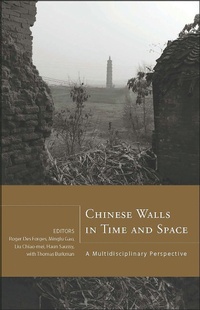
Chinese Walls in Time and Space
Description

Are walls remnants of ancient and medieval societies, destined to become anachronistic in modern and post-modern times? Or will they persist, shaping as well as adjusting to new conditions? Do walls necessarily constrain and even isolate those who live within them, or can they act as a medium of support and communication for people on both sides? This volume addresses these questions. Authors from six disciplines-history, art, law, medicine, communication, and film-provide multiple perspectives on various kinds of walls: material ones around and within states, cities, and towns, as well as virtual ones regulating the administration of justice, the flow of pathogens, and the transmission of information.
More details
Other editions
Additional editions
Persons
Roger Des Forges is Professor of History at the State University of New York at Buffalo.
Minglu Gao is a curator and scholar of contemporary Chinese art at University of Pittsburgh.
Liu Chiao-mei is in the Department of History at Taiwan University.
Haun Saussy is Bird White Housum Professor of Comparative Literature and East Asian Languages at Yale University.
Thomas W. Burkman is Director of Asian Studies at the State University of New York at Buffalo.
Content
- Chinese Walls in Time and Space
- Contents
- List of Illustrations
- List of Major Chinese Polities
- Preface
- Introduction
- Part One. The Building and Unbuilding of Walls
- Chapter One. Long Walls: The "Great Wall of China": An Author's Reflections after Twenty Years
- Chapter Two. City Walls: Tales of Three City Walls in China's Central Plain
- Chapter Three. Town Walls: Chinese County Walls between the Central State and Local Society: Evidence from Henan Province during the Ming Dynasty
- Part Two. Walls Within Cities
- Chapter Four. Ward Walls: The Ward Walls and Gates of Tang Chang'an as Seen in "The Tale of Li Wa"
- Chapter Five. Legal Walls: A Maze of Jurisdictional Walls: Conflict and Cooperation Among the Courts in Republican-Era Shanghai
- Part Three. Containment and Breaches
- Chapter Six. Cartoons: Walls as Multivalent Icons in the Early People's Republican Political Cartoons, 1946-1951
- Chapter Seven. Quarantines: Pathogen Traffic: Walls and Apertures
- Chapter Eight. Firewalls: Realizing the Four Modernizations with a New "Long Wall": China's Effort to Use a "Big Fire Wall" to Control the Internet
- Part Four. China in the World
- Chapter Nine. Poetry: Breaking Down the Wall between East and West in the "Daoist Poetics" of Wai-lim Yip
- Chapter Ten. Art: Near Far: The Dispersion, Relocation, and Mobility of Contemporary Chinese Artists
- Chapter Eleven. Historiography: Confronting the Walls: Efforts at Reconstructing World History in China at the Turn of the Twenty-First Century
- Part Five. Walls in Cinema and Painting
- Chapter Twelve. Film: Amid Crumbling Chinese Walls: The Changing Roles of Family and Women as Revealed in Wang Chao's Anyang Orphan
- Chapter Thirteen. Paintings: Writing on the Wall: Brice Marden's Chinese Work and Modernism
- Conclusion: Bricks and Tiles
- Glossary
- Contributors
- Index
- A
- B
- C
- D
- E
- F
- G
- H
- I
- J
- K
- L
- M
- N
- O
- P
- Q
- R
- S
- T
- U
- V
- W
- X
- Y
- Z
