

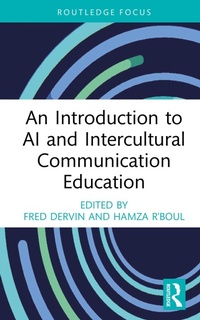
An Introduction to AI and Intercultural Communication Education
1st Edition
Published on 17. September 2025
150 pages
978-1-040-44705-5 (ISBN)
Description

An Introduction to AI and Intercultural Communication Education is the first, historic volume to explore the intersection of AI and intercultural communication education, interrogating both the transformative possibilities and ethical dilemmas posed by emerging technologies.
Through diverse scholarly perspectives, the book examines how AI tools, ranging from language models such as ChatGPT and DeepSeek to generative image systems, could reshape the way we teach, research and conceptualise interculturality. While AI offers innovative opportunities for virtual exchanges, automated translation and accessible learning, it also risks reinforcing stereotypes, Western-centric epistemologies and reductive narratives if used uncritically. The contributors address pressing questions: Can AI facilitate decolonial and reflexive approaches to intercultural communication education, or does it inevitably reproduce dominant paradigms? How can educators harness the potential of AI while safeguarding against its pitfalls, such as algorithmic bias and the erasure of indigenous knowledge systems? Combining theoretical critique with case studies, the volume highlights the need for ethical frameworks that prioritise epistemic justice, pluralistic perspectives and human agency in AI-assisted intercultural communication and education.
This book is an indispensable resource for students, researchers and educators interested in the complexities of technology-mediated learning, as well as the broader fields of higher education, intercultural studies and internationalisation and globalisation.
Through diverse scholarly perspectives, the book examines how AI tools, ranging from language models such as ChatGPT and DeepSeek to generative image systems, could reshape the way we teach, research and conceptualise interculturality. While AI offers innovative opportunities for virtual exchanges, automated translation and accessible learning, it also risks reinforcing stereotypes, Western-centric epistemologies and reductive narratives if used uncritically. The contributors address pressing questions: Can AI facilitate decolonial and reflexive approaches to intercultural communication education, or does it inevitably reproduce dominant paradigms? How can educators harness the potential of AI while safeguarding against its pitfalls, such as algorithmic bias and the erasure of indigenous knowledge systems? Combining theoretical critique with case studies, the volume highlights the need for ethical frameworks that prioritise epistemic justice, pluralistic perspectives and human agency in AI-assisted intercultural communication and education.
This book is an indispensable resource for students, researchers and educators interested in the complexities of technology-mediated learning, as well as the broader fields of higher education, intercultural studies and internationalisation and globalisation.
More details
Series
Edition
1. Auflage
Language
English
Place of publication
London
United Kingdom
Publishing group
Taylor & Francis Ltd
Target group
Professional and scholarly
College/higher education
Illustrations
2 Tables, black and white; 3 Line drawings, black and white; 3 Illustrations, black and white
File size
1,21 MB
ISBN-13
978-1-040-44705-5 (9781040447055)
Copyright in bibliographic data and cover images is held by Nielsen Book Services Limited or by the publishers or by their respective licensors: all rights reserved.
Schweitzer Classification
Other editions
Additional editions
Fred Dervin | Hamza R'boul
An Introduction to AI and Intercultural Communication Education
Book
09/2025
1st Edition
Routledge
€80.00
Shipment within 15-20 days
Persons
Fred Dervin is a world-renowned interculturalist who has made a strong impact on Intercultural Communication Education and Research over the past 25 years. A Full Professor at the University of Helsinki (Finland), Dervin proposes original and refreshing approaches to understanding the politics of global interactions by challenging conventional paradigms and blending interdisciplinary insights. His work aims to inspire practitioners, researchers and students to rethink and reshape the notion of interculturality. With over 300 publications, Dervin is included in the Stanford Elsevier List of the world's best scientists (Top 2%).
Hamza R'boul is a fellow at the Centre for Higher Education Leadership and Policy Studies (CHELPS), The Education University of Hong Kong, Hong Kong.
Hamza R'boul is a fellow at the Centre for Higher Education Leadership and Policy Studies (CHELPS), The Education University of Hong Kong, Hong Kong.
Content
1. Decoding AI in intercultural communication education: Promises, pitfalls and possibilities? Part I. Foundations and Critical Perspectives 2. ChatGPT as naive but knowledgeably responsive research assistant 3. On AI generated answers to questions on interculturality Part II. AI in Pedagogy and Dialogue 4. Cautious excitement, hopeful skepticism: An 'imagined' interview with AI 5. Generative AI in the intercultural learning process: An exploration of its usefulness in university virtual exchange programs 6. A "Cultural Machine"? The AI-human intercultural butterfly takes flight Part III. Ethics, Equity and Renewed Futures? 7. AI for interculturality in higher education: A critical engagement with conceptual framing and methodology 8. Ancestral Seeds in a Digital Garden: Reviving and Preserving the Indigenous Heritage of the Canary Islands through Artificial Intelligence
