

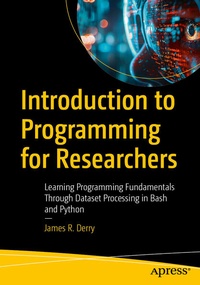
Introduction to Programming for Researchers
Description

Enhance your computational and programming skills using Bash and Python to improve productivity and efficiency in research projects. This book is an essential guide for STEM researchers. Structured into several parts, each builds on the previous ones to ensure a solid foundation in programming.
You'll begin with the basics of digital computation and operating systems, then write pipelines and scripts in Bash, focusing on tools for working with datasets in text files. After introducing algorithms and floating-point numbers, the book transitions to Python, emphasizing SciPy libraries and built-in features like type hints and f-strings. IPython and Jupyter notebooks are integrated into the lessons throughout. Programming best practices are taught, alongside programming basics. These include documentation and unit testing. As the target audience is STEM students and professionals, examples make heavy use of datasets and the SciPy software stack, especially NumPy, Matplotlib, Pandas, and SymPy.
Introduction to Programming for Researchers will foster a deeper understanding of computational tools and critical programming skills, empowering you to tackle complex datasets and enhance their research capabilities.
What You Will Learn
- Apply programming skills to enhance research productivity and efficiency.
- Write Bash pipelines and executable scripts.
- Implement basic algorithms in Python, focusing on time efficiency and structured programming.
Who This Book Is For
Experienced researchers looking to improve their computational skills; students in the natural sciences and engineering; scientists and engineers from various fields, seeking to integrate programming skills into their research methodologies.
More details
Other editions
Additional editions
Person
James Derry is a seasoned professional with 32 years of experience at UT-Austin, where he has served as a Senior Systems Administrator. For the past 14 years, he has also been an educator, teaching the course "Introduction to Programming for Researchers." His extensive background in both systems administration and programming education uniquely positions him to impart valuable computational skills to researchers in natural sciences and engineering, enhancing their productivity and efficiency in handling complex datasets.
Content
1. Introduction.- 2. Digital Computation.- 3. Operating Systems.- 4. Introduction to Bash.- 5. Bash: Combining Commands & Variables To Make Pipelines & Scripts To Process Data.- 6. Algorithms & Coding.- 7. Floating-Point Numbers.- 8. Introduction to Python.- 9. Using Python As A Calculator.- 10. Programming.- 11. Functions.- 12. Software Design.- 13. Working with Datasets.- 14. Programming Efficiency.- 15. Other Subjects.- 16. SciPy.- 17. Odds & Ends.- 18. Writing A Large Project.- Reference List.
