

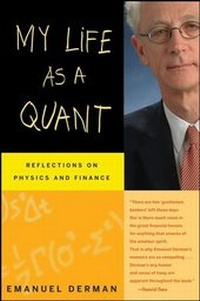
My Life as a Quant
Description

Reviews / Votes
"There are few "gentlemen bankers" left these days. Nor is theremuch room in the great financial houses for anything that smacks ofthe amateur spirit. That is why Emanuel Derman's memoirs are socompelling...Derman's wry humour and sense of irony areapparent throughout the book." - Financial Times "That sense of being an intruder in outlaw territory lends anintriguing mood to Derman's My Life As a Quant, a literateand entertaining memoir." -Business Week "engaging" --(CFO Europe, October 2005) "Not only a delightful memoir, but one full of information, bothabout people and their enterprise. I never thought that I would beinterested in quantitative financial analysis, but reading thisbook has been a fascinating education." -Jeremy Bernstein,author of Oppenheimer: Portrait of an Enigma "This wonderful autobiography takes place in that special timewhen scientists discovered Wall Street and Wall Street discoveredthem. It is elegantly written by a gifted observer who was apioneering member of the new profession of financial engineering,with an evident affection both for finance as a science and for thescientists who practice it. Derman's portrait of how theacademics brought their new financial science to the world ofbusiness and forever changed it and, especially, his descriptionsof the late and extraordinary genius Fischer Black who became hismentor, reveal a surprising humanity where it might be leastexpected. Who should read this book? Anyone with a serious interestin finance and everyone who simply wants to enjoy a goodread."-Stephen Ross, Franco Modigliani Professor of Financeand Economics, Sloan School, MITMore details
Other editions
Additional editions

Person
Content
Prologue
The Two Cultures
Physics and finance
What quants do
The Black-Scholes model
Quants and traders
Pure thought and beautiful mathematics can divine the laws of physics
Can they do the same for finance?
MODELING THE WORLD
If mathematics is the Queen of Sciences, as the great mathematician Karl Friedrich Gauss christened it in the nineteenth century, then physics is king. From the mid-seventeenth century to the end of the nineteenth, Newton’s Law of Gravitation, his three Laws of Motion, and his differential calculus described with apparent perfection the mechanical motion of objects in our world and the solar system.
In 1864, two hundred years after Newton, the Scottish physicist James Clerk Maxwell formulated the compact and elegant differential equations that described with similarly astounding precision the propagation of light, X-rays, and radio waves. Maxwell’s equations showed that electricity and magnetism, formerly separate phenomena, were part of the same unified electromagnetic field.
We cannot simply look at the world around us and deduce Newton’s Laws or Maxwell’s equations. Data on its own does not speak. These equations were triumphs of the mind, abstracted from the world in some miraculous confluence of hard thinking and deep intuition. Their success confirmed that pure thought and beautiful mathematics have the power to discover the most profound laws of the universe.
At the start of the twentieth century, the pace accelerated. Einstein, pondering the conflicts between the Newtonian and Maxwellian views of the world, proposed his Theory of Special Relativity that amended Newton’s mechanics and made them consistent with Maxwell’s equations. Fifteen years later Einstein trumped Newton again with his proposal of the General Theory; it corrected the Law of Gravitation and described gravity as a large-scale wave in space and time. At almost the same time, Bohr, Schrödinger, and Heisenberg, with help from the ever-prodigious Einstein, developed the quantum mechanical theory of the small-scale behavior of molecules, atoms, and subatomic particles.
It was Einstein who perfected this mental approach to discovering the laws of the universe. His method wasn’t based on observation or empiricism; he tried to perceive and then enunciate the very principles that constrained the way things should work. In a 1918 speech on the principles of research given in honor of Max Planck, the discoverer of the quantum, Einstein captured the magus-like appeal of trying to see through a glass, darkly, when he said: “There is no logical path to these laws; only intuition, resting on a sympathetic understanding of experience, can reach them.”
What is the purpose behind the search for scientific laws, in any field? Clearly, it’s divination—foretelling the future, and controlling it. Most of the modern technologies we enjoy, rely on, detest, or fear—cell phones, electric power grids, CAT scans, and nuclear weapons, for example—have been developed by using the basic principles of quantum mechanics, electromagnetic theory, and relativity, all of which were discovered by cerebration. The classic tools of twentieth-century divination have indeed been those of physics. More recently, physicists have begun to employ the same tools in finance.
For the past twenty years, throughout Wall Street and the City of London, in most major and many minor financial institutions, small groups of ex-physicists and applied mathematicians have tried to apply their skills to securities markets. Formerly called “rocket scientists” by those who mistakenly thought that rocketry was the most advanced branch of science, they are now commonly called “quants.”
Quants and their cohorts practice “financial engineering”—an awkward neologism coined to describe the jumble of activities that would better be termed quantitative finance. The subject is an interdisciplinary mix of physics-inspired models, mathematical techniques, and computer science, all aimed at the valuation of financial securities. The best quantitative finance brings real insight into the relation between value and uncertainty, and it approaches the quality of real science; the worst is a pseudoscientific hodgepodge of complex mathematics used with obscure justification.
Until recently, financial engineering wasn’t really a subject at all—when I entered the field in 1985, it didn’t have a name and was something one learned on the job at an investment bank. Now you can get a master’s degree in the subject at scores of institutions—the Courant Institute at New York University, the University of Michigan at Ann Arbor, and the University of Oregon in Eugene, to name a few. Since July 2003 I have been a professor of the subject at Columbia University. Engineering schools, statistics and mathematics departments, and business schools organize these one- to two-year programs; they promise to transform students, in exchange for about $30,000 per year, into employable financial engineers. So popular are these degrees that some universities run several similar programs in distinct departments.
Nowadays, managers on Wall Street receive daily calls and emailed résumés from PhDs seeking jobs in finance. Physics journals publish increasing numbers of papers on financial economics. And increasingly, physicists and mathematicians working on the quantitative side of banking have been joined by PhDs and faculty members from finance departments and business schools. Two of the best graduate finance departments in the country, the Sloan School at MIT and the Haas School of the University of California at Berkeley, have each lost several of their best young finance faculty to the banking and trading worlds.
Part of the reason for the influx of physicists to other fields was the 1970s collapse of their traditional job market: academia. Thirty years earlier during World War II, the invention of radar and the construction of the atomic bomb confirmed the usefulness of physics to postwar governments. Shocked by the successful voyage of Sputnik, the Departments of Defense and Energy began to fund pure research more copiously, and physicists seeking grants to do such research weren’t above playing up the spin-off benefits of their work. Physics departments in the 1960s grew and academic posts multiplied. Inspired by the subject and supported by scholarships, a wave of ardent graduate students entered the field.
The good times didn’t last. By the end of the Vietnam War a deteriorating economy and a public revulsion with science in the service of war put a large dent in research funds. During the 1970s and 1980s, many theoretical physicists who had once hoped to devote their lives to fundamental research were forced to become migratory laborers if they wanted to remain in academia, taking temporary short-term positions in universities and national laboratories wherever they became available. Many of us eventually gave up the struggle to find even a low-paying semipermanent academic job and turned to other areas. We sought physics-related jobs in a variety of fields—in energy research or telecommunications, for example. Former colleagues of mine began to work on alternate power sources at the Solar Energy Research Institute in Golden, Colorado, or on the mathematics of oil retrieval at Schlumberger in Ridgefield, Connecticut. Others helped develop advanced switching systems at AT&T’s Bell Laboratories in New Jersey.
Coincidentally, some of the same forces that compelled physicists to move out of academia made Wall Street begin to embrace them. The Arab oil embargo of 1973 caused fuel prices to soar and interest rates to climb; soon the fear of inflation propelled gold prices above $800 an ounce. Suddenly, financial markets seemed to become more volatile. Bonds, a traditionally conservative investment, were suddenly seen as much riskier than anyone had imagined. The old rules of thumb no longer applied. Understanding the motion of interest rates and stock prices became more important than ever for financial institutions. Risk management and hedging were the new imperative and, in the face of so much freshly perceived risk, complex new financial products that provided protection from change proliferated.
How could one describe and understand the movement of prices? Physics has always been concerned with dynamics, the way things change with time. It was the tried-and-true exemplar of successful theories and models. And physicists and engineers were jacks-of-all-trades, simultaneously skilled mathematicians, modelers, and computer programmers who prided themselves on their ability to adapt to new fields and put their knowledge into practice. Wall Street began to beckon to them. In the 1980s, so many physicists flocked to investment banks that one head-hunter I know referred to them as “POWs”—physicists on Wall Street.
THE MOST SUCCESSFUL THEORY
What is it that physicists do on Wall Street? Mostly, they build models to determine the value of securities. Buried in investment banks, at hedge funds, or at financial software companies such as Bloomberg or SunGard, they tinker with old models and develop new ones. And by far the most famous and ubiquitous model in the entire financial world is the Black-Scholes options pricing model. Steve Ross, a famous financial economist, options theorist, and now a chaired professor at MIT, wrote in the Palgrave Dictionary of Economics that “. . . options pricing...
