

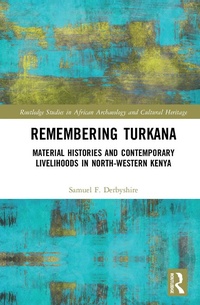
Remembering Turkana
Material Histories and Contemporary Livelihoods in North-Western Kenya
1st Edition
Published on 30. July 2020
254 pages
978-1-000-09408-4 (ISBN)
Description

This book explores aspects of the socio-economic and political history of the Turkana of northern Kenya, examining the making and remaking of the regional economy via the trajectories of socio-material interaction that have structured key practices, relationships and livelihoods over the past century.
Traversing Turkana's constituent livelihoods and examining the historical relationships between them in relation to shifting economic, ecological and political factors, the book asks what perspective emerges from an in-depth understanding of the everyday things that have taken part in processes of substantial socio-cultural transformation. By setting out a series of new examples established through long-term research in the region, it offers a characterisation of Turkana's iterative transformation as the articulation of a set of long-term continuities. Investigating quotidian personal and community histories, it argues that Turkana's complex network of livelihood interactions has, on the whole, strengthened over time through its continual reformulation, as identities, livelihood practices and social institutions have been re-imagined and reshaped with each new generation in order to reconstruct accumulated memory and knowledges.
Remembering Turkana provides a wide-ranging socio-historical overview of the Turkana region and people, situating critical contemporary issues within diverse bodies of literature. The characterisation of long-term change and continuity, as articulated and enacted via material culture production, use and exchange, that it offers will be of significance to a broad array of scholarly disciplines, including archaeology, history, anthropology and political science.
Traversing Turkana's constituent livelihoods and examining the historical relationships between them in relation to shifting economic, ecological and political factors, the book asks what perspective emerges from an in-depth understanding of the everyday things that have taken part in processes of substantial socio-cultural transformation. By setting out a series of new examples established through long-term research in the region, it offers a characterisation of Turkana's iterative transformation as the articulation of a set of long-term continuities. Investigating quotidian personal and community histories, it argues that Turkana's complex network of livelihood interactions has, on the whole, strengthened over time through its continual reformulation, as identities, livelihood practices and social institutions have been re-imagined and reshaped with each new generation in order to reconstruct accumulated memory and knowledges.
Remembering Turkana provides a wide-ranging socio-historical overview of the Turkana region and people, situating critical contemporary issues within diverse bodies of literature. The characterisation of long-term change and continuity, as articulated and enacted via material culture production, use and exchange, that it offers will be of significance to a broad array of scholarly disciplines, including archaeology, history, anthropology and political science.
Reviews / Votes
"Samuel Derbyshire gifts us a refreshing book about the Turkana drylands in northern Kenya, about the complexity of pastoral societies, and about memory, history and change." - Greta Semplici and J. Terrence McCabe, Nomadic Peoples"The book presents a picture of Turkana history and social change that manages to weave together the different pieces of knowledge that archaeologists, anthropologists, historians, political ecologists and others have so far produced... Derbyshire utilises a wide range of literature, making the book particularly interesting to development and historical anthropologists, historical archaeologists, material culture researchers, researchers working on sustainability issues and political scientists alike. I would especially recommend it as one of the first books to read for researchers just starting out in the region." - Nik Petek-Sargeant, AZANIA: ARCHAEOLOGICAL RESEARCH IN AFRICA
More details
Series
Edition
1. Auflage
Language
English
Place of publication
London
United Kingdom
Publishing group
Taylor & Francis Ltd
Target group
College/higher education
Product notice
Reflowable
Illustrations
7 Tables, black and white; 2 Line drawings, black and white; 50 Halftones, black and white; 52 Illustrations, black and white
ISBN-13
978-1-000-09408-4 (9781000094084)
Copyright in bibliographic data and cover images is held by Nielsen Book Services Limited or by the publishers or by their respective licensors: all rights reserved.
Schweitzer Classification
Other editions
Additional editions
Samuel F. Derbyshire
Remembering Turkana
Material Histories and Contemporary Livelihoods in North-Western Kenya
Book
04/2022
1st Edition
Routledge
€57.03
Shipment within 15-20 days
Samuel F. Derbyshire
Remembering Turkana
Material Histories and Contemporary Livelihoods in North-Western Kenya
Book
07/2020
1st Edition
Routledge
€148.80
Shipment within 15-20 days
Samuel F. Derbyshire
Remembering Turkana
Material Histories and Contemporary Livelihoods in North-Western Kenya
Book
06/2020
Taylor & Francis
Unfortunately, price unknown
Available (delivery time upon request)
Person
Samuel F. Derbyshire is a Junior Research Fellow in Anthropology at St John's College, University of Oxford.
Content
Part I: Situating Turkana
Chapter 1. Remembering Turkana: an introduction
Chapter 2. Turkana in historical and ethnographic perspective
Chapter 3. The fieldwork: theoretical and methodological reflections
Part II: Akichem (fishing)
Chapter 4. Hippopotamus hide shoes, colonial taxes and cotton blankets
Chapter 5. Fishing nets, fibreglass boats and the NORAD scheme
Chapter 6. Fish bone ornaments, ngakoroumwa and marriage
Part III: Akitare (cultivation)
Chapter 7. Mobility, seasonal exchange and atap: cultivation before Ekaru a Atchaka Ekipul (the Year of the Lost Padlock)
Chapter 8. Cars, relief food and irrigation canals: the 1980-1982 famine and the Turkana Rehabilitation Project
Chapter 9. Sugar sacks, maize flour and the establishment of commercial markets
Part IV Akiyok ka Aremor (Herding and Raiding)
Chapter 10. Livestock, divination and the era of the abuzibuzi headdress
Chapter 11. Spears, shields and colonial conquest
Chapter 12. Guns, cloth ngapukoto and Ekaru a Ngatuk a Nakirionok (the Year of Black Cows)
Chapter 13. Synthetic fibre hats, plastic spoons and ngoroko: herding and raiding in the years after Ekaru Asur (the Fleeing Year)
Part V: Tracing Change and Facing the Future
Chapter 14. A dilemma of perspectives
Chapter 15. The nature of change
Chapter 1. Remembering Turkana: an introduction
Chapter 2. Turkana in historical and ethnographic perspective
Chapter 3. The fieldwork: theoretical and methodological reflections
Part II: Akichem (fishing)
Chapter 4. Hippopotamus hide shoes, colonial taxes and cotton blankets
Chapter 5. Fishing nets, fibreglass boats and the NORAD scheme
Chapter 6. Fish bone ornaments, ngakoroumwa and marriage
Part III: Akitare (cultivation)
Chapter 7. Mobility, seasonal exchange and atap: cultivation before Ekaru a Atchaka Ekipul (the Year of the Lost Padlock)
Chapter 8. Cars, relief food and irrigation canals: the 1980-1982 famine and the Turkana Rehabilitation Project
Chapter 9. Sugar sacks, maize flour and the establishment of commercial markets
Part IV Akiyok ka Aremor (Herding and Raiding)
Chapter 10. Livestock, divination and the era of the abuzibuzi headdress
Chapter 11. Spears, shields and colonial conquest
Chapter 12. Guns, cloth ngapukoto and Ekaru a Ngatuk a Nakirionok (the Year of Black Cows)
Chapter 13. Synthetic fibre hats, plastic spoons and ngoroko: herding and raiding in the years after Ekaru Asur (the Fleeing Year)
Part V: Tracing Change and Facing the Future
Chapter 14. A dilemma of perspectives
Chapter 15. The nature of change
