

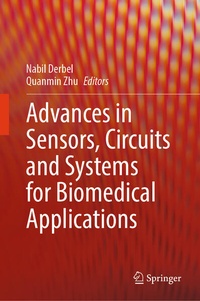
Advances in Sensors, Circuits and Systems for Biomedical Applications
Description

This book presents recent applications and developments in the field of sensors, wireless, circuits, systems, medical signals and medical imaging, covering a wide range of applications for monitoring, treatment and assistance in biomedical applications. This book provides insights into the theory, applications and perspectives relevant to the field of sensors, wireless, circuits and systems, as well as the general algorithms and methodologies behind them. Each chapter provides an enriched understanding of a research topic along with a balanced treatment of the relevant theories, methods or applications. It reports on the latest advances in the field. This book is a good reference for graduate students, researchers, educators, engineers and scientists and contains more than 10 chapters divided into four parts as follows. The first part of the book focuses on wireless sensors. It consists of three chapters. The second part is dedicated to circuits and systems and includes three chapters. The third part deals with research on optimization techniques and consists of three chapters. The fourth part describes several approaches applied to biomedical applications and consists of four chapters.
More details
Other editions
Additional editions
Persons
Nabil Derbel was born in Sfax (Tunisia) in April 1962. He received his engineering diploma from the Ecole Nationale d'Ingénieurs de Sfax in 1986, the Diplôme d'Etudes Approfondies in automatic control from the Institut National des Sciences Appliquées de Toulouse in 1986, the Doctorat d'Université degree from the Laboratoire d'Automatique et d'Analyse des Systèmes de Toulouse in 1989, and the Doctorat d'Etat degree from the Ecole Nationale d'Ingénieurs de Tunis. He joined the Tunisian University in 1989, where he held different positions involved in research and education. Currently, he is Full Professor (first class) of automatic control at the Ecole Nationale d'Ingénieurs de Sfax. His current interests include: optimal control, complex systems, robotic systems, power systems.
Quanmin Zhu is Professor in control systems at the School of Engineering, University of the West of England, Bristol, UK. He obtained his M.Sc. in Harbin Institute of Technology, China, in 1983, and Ph.D. in Faculty of Engineering, University of Warwick, UK, in 1989, and worked as Postdoctoral Research Associate at the Department of Automatic Control and Systems Engineering, University of Sheffield, UK, between 1989 and 2994. His main research interest is in nonlinear system modeling, identification and control. He has published over 300 papers on these topics, edited various books with Springer, Elsevier and the other publishers and provided consultancy to various industries. Currently, Professor Zhu is acting as Editor of Elsevier book series of emerging methodologies and applications in modelling, identification and control.
Content
Wireless Sensor Networks for Factory Automation Monitoring and Control.- Advanced Machine Learning Based Strategy for Indoor Human Identification.- Software Sensor Design for Forecasting and Recovery of ECG Data.- Resonant Inductive Coupling for Wirelessly Powering Active Implants.- On-Chip Integrated Planar Spiral Stacked Transformer in Ferrite-Based Technology.- A low voltage and low power multiple output OTAs using Bulk-Driven Technique and applications.- Performance Extraction and Processing Circuitry Development of a Single-Mass 6-DOF Piezoelectric Inertial Measurement Unit.- Energy Aware Disjoint Dominating Sets Algorithms for Monitoring Applications based Heterogeneous Wireless Sensor Networks.- An Efficient Multi Objective Task Offloading based on Sparrow Search Algorithm in fog computing systems.- Human Exon and Intron Classification based on Convolutional Neural Network.- Deep early identification of intestinal cancer based on SNP protein mutations of the tumor suppressor genes APC and TP53.- etc.
