

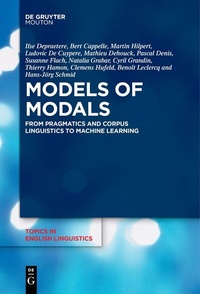
Models of Modals
Description

Modal verbs in English communicate delicate shades of meaning, there being a large range of verbs both on the necessity side ( must , have to , should , ought to , need , need to ) and the possibility side ( can , may , could , might , be able to ). They therefore constitute excellent test ground to apply and compare different methodologies that can lay bare the factors that drive the speaker's choice of modal verb. This book is not merely concerned with a purely grammatical description of the use of modal verbs, but aims at advancing our understanding of lexical and grammatical units in general and of linguistic methodologies to explore these. It thus involves a genuine effort to compare, assess and combine a variety of approaches. It complements the leading descriptive qualitative work on modal verbs by testing a diverse range of quantitative methods, while not ignoring qualitative issues pertaining to the semantics-pragmatics interface. Starting from a critical assessment of what constitutes the meaning of modal verbs, different types of empirical studies (usage-based, data-driven and experimental), drawing considerably on the same data sets, shows how method triangulation can contribute to an enhanced understanding. Due attention is also given to individual variation as well as the degree to which modals can predict L2 proficiency level.
Reviews / Votes
"The new monograph [.] contributes to a better understanding of EMs [English modals] by appropriately combining linguistic theories and applying advanced rigorous quantitative methods. Consequently, this book is definitely a most cutting-edge one in studying EMs in terms of its theoretical and methodological significance and thus is strongly recommended to graduates and researchers interested in English grammar, corpus linguistics, construction grammar and related fields."
Ziheng Zhou & Deliang Wang, 2023, in Corpus Pragmatics 7, 297-302
"Models of Modals represents a valuable contribution to the fields of corpus linguistics and pragmatics, demonstrating the benefits of interdisciplinary collaboration and the use of diverse empirical methods in the study of English modal verbs."
Yubin Quian, September 30, 2024, in SSR , http://dx.doi.org/10.2139/ssrn.4971253
"Models of Modals is a welcome addition to the existing literature on modality and the English modal auxiliaries. The volume provides a rich sample of the advantages of many recent methods and statistical procedures for corpus analysis, and also shows the potential for improvement of automatic classification of the meanings of the modals by means of NLP's increasingly sophisticated techniques."
Marta Carretero, 2025, in English Language and Linguistics , 1-7, doi:10.1017/S1360674324000480
More details
Other editions
Additional editions
Persons
Ilse Depraetere (Université de Lille), Bert Cappelle (Université de Lille), Martin Hilpert (Université de Neuch?tel),
Ludovic De Cuypere (UGent, VUB), Mathieu Dehouck (CNRS, Lattice), Pascal Denis (Inria, MAGNET), Susanne Flach (Zürich), Natalia Grabar (CNRS, STL), Cyril Grandin, Thierry Hamon (Paris 13, LISN), Clemens Hufeld (LMU München), Benoît Leclercq (Paris 8), Hans-Jörg Schmid (LMU München)
Content
- Intro
- Preface
- Contents
- Introduction
- 1 English modals: An outline of their forms, meanings and uses
- 2 Modality revisited: Combining insights from Construction Grammar and Relevance Theory
- 3 Possibility modals: Which conditions make them possible?
- 4 Necessity modals and the role of source as a predictive factor
- 5 You must/have to choose: Experimenting with choices between near-synonymous modals
- 6 Does the intersubjectivity of modal verbs boost inter-individual differences?
- 7 Modals as a predictive factor for L2 proficiency level
- 8 Revisiting modal sense classification with contextual word embeddings
- 9 Modals in the network model of Construction Grammar
- Index
