

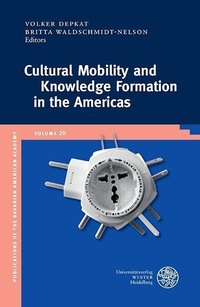
Cultural Mobility and Knowledge Formation in the Americas
Published on 7. August 2019
VI, 232 pages
978-3-8253-7844-8 (ISBN)
Description

This volume collects original contributions discussing aspects, dimensions, and major problems of cultural mobility and knowledge formation in the Americas from an interdisciplinary and comparative perspective. Looking at the Americas as a site of multi-directional entanglement and interaction, the chapters highlight the non-English and non-European contexts of the United States from the sixteenth to the twentieth century. They focus on processes of cultural hybridity resulting from the encounter of European, Native American, African, and Asian cultures in the Americas.
Contributions to this volume come from the fields of history, political science, geography, literary criticism, and cultural studies. Besides investigating the intellectual construction of the Americas, the texts analyze the history of slavery and emancipation, trace African Diasporas in Colombia and Brazil, critically assess the problem of democracy in Latin America, and scrutinize phenomena of literary entanglements in the Western hemisphere.
Contributions to this volume come from the fields of history, political science, geography, literary criticism, and cultural studies. Besides investigating the intellectual construction of the Americas, the texts analyze the history of slavery and emancipation, trace African Diasporas in Colombia and Brazil, critically assess the problem of democracy in Latin America, and scrutinize phenomena of literary entanglements in the Western hemisphere.
More details
Other editions
Additional editions
Volker Depkat | Britta Waldschmidt-Nelson
Cultural Mobility and Knowledge Formation in the Americas
Book
08/2019
1st Edition
Universitätsverlag Winter
€36.00
No shipping information available
Content
- Cover
- Titel
- Imprint
- Table of Contents
- Framing the Discourse
- Volker Depkat, Heike Paul, and Britta Waldschmidt-Nelson: Cultural Mobility and Knowledge Formation in the Americas: An Introduction
- Part 1: The Intellectural Construction of 'the Americas'
- Susanne Lachenicht: How the Americas Came to Be Known as 'the Americas': A Historical Approach to the Western Hemisphere
- Markus Heide: The Idea of the Western Hemisphere: Imperial Knowledge Production on the Americas in Travel Writing of the Early Nineteenth Century
- Part 2: Slavery, Emancipation and African Heritage in 'the Americas'
- Christian Pinnen: The Cultural Transfer of Racial and Legal Traditions: The Natchez District During the Age of Revolutions
- Ursula Prutsch: Slave Emancipation in Brazil and Cuba and Its Inter-American Dimension
- Part 3: Space and Identity - Politics in Latin America
- Valerie V.V. Gruber: Relational Geographies of Afro-Brazilian Identities: What Can We Learn from the Candeal Neighborhood in Salvador Da Bahia (Brazil)?
- Gilma Mosquera Torres and Ángela María Franco Calderón: The Value of Collectivism: Property Rights, Urban Patterns, and Traditional Housing on the Colombian Pacific Coast
- Part 4: Pan-American Literary Imaginations
- Jobst Welge: The Boundaries of Reason: The Legacy of E.A. Poe in Latin America
- Stephen M. Park: NAFTA and the Literary Imagination
- Florian Tatschner: Literary Performance as Border Thinking: A Comparison of Theresa Hak Kyung Cha's "Dictée" and Norma Elia Cantú's Canícula
- Part 5: Successes and Challenges of Democracy in the Americas
- Rainer Schmidt: Alternatives to Liberal Democracy - Revisited: Lessons from Latin America
- Alan Siaroff: The Political Regimes of the Americas, 2000-2018, and Their Historical Origins
- Notes on Contributors
- Backcover
