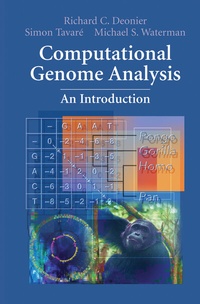
Computational Genome Analysis
Description

Computational Genome Analysis: An Introduction presents the foundations of key problems in computational molecular biology and bioinformatics. It focuses on computational and statistical principles applied to genomes, and introduces the mathematics and statistics that are crucial for understanding these applications. The book is appropriate for a one-semester course for advanced undergraduate or beginning graduate students, and it can also introduce computational biology to computer scientists, mathematicians, or biologists who are extending their interests into this exciting field.
This book features:
- Topics organized around biological problems, such as sequence alignment and assembly, DNA signals, analysis of gene expression, and human genetic variation
- Presentation of fundamentals of probability, statistics, and algorithms
- Implementation of computational methods with numerous examples based upon the R statistics package
- Extensive descriptions and explanations to complement the analytical development
- More than 100 illustrations and diagrams (some in color) to reinforce concepts and present key results from the primary literature
- Exercises at the end of chapters
From the reviews:
"The book is useful for its breadth. An impressive variety of topics are surveyed...." Short Book Reviews of the ISI, June 2006
"It is a very good book indeed and I would strongly recommend it both to the student hoping to take this study further and to the general reader who wants to know what computational genome analysis is all about." Mark Bloom for the JRSS, Series A, Volume 169, p. 1006, October 2006
"Richard C. Deonier, Simon Tavare and Michael S. Waterman provide us wtih a 'roll up your sleeves and get dirty' (as the authors phrase it in their preface) introduction to the field of computational genome analysis...The book is carefully written and carefully edited..." Ralf Schmid for Genetic Research, Volume 87, p. 218, 2006
Reviews / Votes
From the reviews:
"The book is useful for its breadth. An impressive variety of topics are surveyed...." Short Book Reviews of the ISI, June 2006
"It is a very good book indeed and I would strongly recommend it both to the student hoping to take this study further and to the general reader who wants to know what computational genome analysis is all about." Mark Bloom for the JRSS, Series A, Volume 169, p. 1006, October 2006
"Richard C. Deonier, Simon Tavare and Michael S. Waterman provide us wtih a 'roll up your sleeves and get dirty' (as the authors phrase it in their preface) introduction to the field of computational genome analysis...The book is carefully written and carefully edited..." Ralf Schmid for Genetic Research, Volume 87, p. 218, 2006
"This book provides an introduction to a broad spectrum of the biological and computation background required for genome analysis. Topics are illustrated with examples and exercises. . The computational problems encourage the reader to investigate concepts using R. The book is very useful for its breadth. An impressive variety of topics are surveyed . . This book is a useful starting point." (D. F. Andrews, Short Book Reviews, Vol. 26 (1), 2006)
"This book provides a practical introduction to computational molecular biology and bioinformatics. One of the strengths of the text is the breadth of the material . . The mathematical and statistical concepts . are presented clearly with the necessary detail. The book is nicely organized with a useful glossary and many informative tables and figures. The text is highly recommended for a course for upper level undergraduates or beginning graduate students, or as a reference for researchers . ." (Sharon M. Crook, Mathematical Reviews, Issue 2006 i)
"This book is broad and deep in its coverage, with chapters on genome assembly and comparative genomics (including gene prediction) aswell as more common topics. ...Overall, this book and the book by Jones and Pevzner (2004) are the best texts that I have seen in the area..." (Paul Havlak, Journal of the American Statistical Association, Vol. 102, No. 477, 2007)
"'Computational Genome Analysis: an introduction' is a new teaching book aimed at master and PhD students. . As stated in its preface, this book is an introduction to the computational side of genomics and bioinformatics. In my opinion the authors largely succeed in providing just that. . the book should help physicists and computational scientists to simultaneously learn what type of computational problems are addressed in bioinformatics and what the biology behind these problem is." (Berend Snel, Mathematical Biosciences, Vol. 208, 2007)
"The goal of computational genomics is the understanding and interpretation of information encoded and expressed from the entire genetic complement of biological organisms: the genome. This book provides an introduction to the subject, on the level of a senior or first-year graduate-level course, to students from a variety of backgrounds. It is addressed to biologists, applied mathematicians, computer scientists, and persons working in the biotechnology industry." (Quarterly of Applied Mathematics, Vol. 66 (2), 2008)
More details
Other editions
Additional editions