

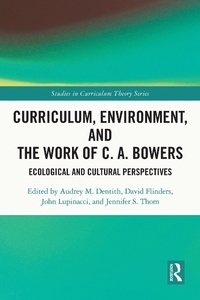
Curriculum, Environment, and the Work of C. A. Bowers
Ecological and Cultural Perspectives
1st Edition
Published on 28. June 2021
242 pages
978-1-000-41707-4 (ISBN)
Description

This edited volume extends ecological approaches to curriculum theory by recognizing and building on the contributions of the late Chet A. Bowers to curriculum and ecological studies globally.
Chapters provide in-depth explanation of Bowers' central contributions to the field, including his identification of the linguistic roots of ecological degradation; the need for school curricula to support sustainability; and the principles of cultural commons, eco-justice, and ecological intelligence. Building on these ideas and emphasizing the links between curriculum studies, social justice, and environmental education, the text illustrates how Bowers' ideas must now inform future approaches to schooling, teacher education, research, and Indigenous communities to guard against the global ecological crises we now face.
This text will benefit researchers, academics, and educators with an interest in curriculum studies, sustainability education, and environmental studies in particular. Those interested in the sociology of education, educational change, and school reform will also benefit from the book.
Chapters provide in-depth explanation of Bowers' central contributions to the field, including his identification of the linguistic roots of ecological degradation; the need for school curricula to support sustainability; and the principles of cultural commons, eco-justice, and ecological intelligence. Building on these ideas and emphasizing the links between curriculum studies, social justice, and environmental education, the text illustrates how Bowers' ideas must now inform future approaches to schooling, teacher education, research, and Indigenous communities to guard against the global ecological crises we now face.
This text will benefit researchers, academics, and educators with an interest in curriculum studies, sustainability education, and environmental studies in particular. Those interested in the sociology of education, educational change, and school reform will also benefit from the book.
More details
Series
Edition
1. Auflage
Language
English
Place of publication
London
United Kingdom
Publishing group
Taylor & Francis Ltd
Target group
College/higher education
Product notice
Reflowable
Illustrations
3 Line drawings, black and white; 2 Halftones, black and white; 5 Illustrations, black and white
ISBN-13
978-1-000-41707-4 (9781000417074)
Copyright in bibliographic data and cover images is held by Nielsen Book Services Limited or by the publishers or by their respective licensors: all rights reserved.
Schweitzer Classification
Other editions
Additional editions
Audrey Dentith | David Flinders | John Lupinacci
Curriculum, Environment, and the Work of C. A. Bowers
Ecological and Cultural Perspectives
Book
01/2023
1st Edition
Routledge
€60.20
Shipment within 10-20 days
Audrey Dentith | David Flinders | John Lupinacci
Curriculum, Environment, and the Work of C. A. Bowers
Ecological and Cultural Perspectives
Book
07/2021
1st Edition
Routledge
€207.60
Shipment within 15-20 days
Persons
Audrey M. Dentith is Professor of Leadership Studies and Adult Education and Director of the Center for Teaching Excellence at North Carolina A&T State University, USA.
David Flinders is Professor of Education at Indiana University, USA.
John Lupinacci is Associate Professor of Cultural Studies and Social Thought in Education at Washington State University, USA.
Jennifer S. Thom is Associate Professor of Curriculum Studies and Mathematics Education at the University of Victoria, Canada.
David Flinders is Professor of Education at Indiana University, USA.
John Lupinacci is Associate Professor of Cultural Studies and Social Thought in Education at Washington State University, USA.
Jennifer S. Thom is Associate Professor of Curriculum Studies and Mathematics Education at the University of Victoria, Canada.
Content
Chapter 1. An Introduction to the Curriculum and Environmental Scholarship of C.A. (Chet) Bowers
David J. Flinders
Part I: Ecological Approaches to Curriculum Discourse
Excerpt for Part I from: Bowers, C. A. (1996). The cultural dimensions of ecological literacy. Journal of Environmental Education, 27(2).
Chapter 2. Co/inspiriting Ecological Conversations with Chet A. Bowers (1935-2017) and Ted T. Aoki (1919-2012)
Jennifer S. Thom
Chapter 3. Reconceptualizing 'Experience' for the Anthropocene
Kathleen Kesson
Chapter 4. Beyond the Binary of Bowers
Jeff Edmundson
Chapter 5. Steps to an Ecology of Mindful Teaching in Friluftsliv (Outdoor Life) Education: Revisiting the Works of C.A. Bowers and Arne Naess for a Deep Ecocultural Approach
Per Ingvar Haukeland
Part II: Curriculum of the Commons
Excerpt from: Bowers, C. (2016). Reforming higher education in an era of ecological crisis and growing digital insecurity. Anoka, MN: Process Century Press.
Chapter 6. On Traditions and the Commons: A Material Feminist Analysis
Audrey M. Dentith
Chapter 7. A Curriculum of the Commons: Learning in Detroit and Beyond
Rebecca A. Martusewicz
Chapter 8. Lessons from a Pandemic: Can We Reclaim Our Cultural and Environmental Commons?
Susan Huddleston Edgerton
Part III: Eco-Justice Curriculum
Excerpt for Part III from: Bowers, C. A. (2002). Toward an eco-justice pedagogy. Environmental Education Research, 8(1), 21-34.
Chapter 9. Developing Ecological Literacy as a Habit of Mind in Teacher Education through
Ecojustice Progressive Curricula
Kelly Young
Chapter 10. Coyote and Raven Encounter Chet Bowers in Conceptual Time-Space: Ecojustice
Pedagogies of the Land
Peter Cole and Pat O'Riley
Chapter 11. Developing Literacies through Place-based Poetic Inquiry: A Curriculum of Movement, Travel, and Writing
Andrejs Kulnieks
Chapter 12. Ecocritical Pedagogies: (Re)Imagining Education for Diversity, Democracy
and Sustainability as Eco-Justice Curriculum
Johnny Lupinacci
David J. Flinders
Part I: Ecological Approaches to Curriculum Discourse
Excerpt for Part I from: Bowers, C. A. (1996). The cultural dimensions of ecological literacy. Journal of Environmental Education, 27(2).
Chapter 2. Co/inspiriting Ecological Conversations with Chet A. Bowers (1935-2017) and Ted T. Aoki (1919-2012)
Jennifer S. Thom
Chapter 3. Reconceptualizing 'Experience' for the Anthropocene
Kathleen Kesson
Chapter 4. Beyond the Binary of Bowers
Jeff Edmundson
Chapter 5. Steps to an Ecology of Mindful Teaching in Friluftsliv (Outdoor Life) Education: Revisiting the Works of C.A. Bowers and Arne Naess for a Deep Ecocultural Approach
Per Ingvar Haukeland
Part II: Curriculum of the Commons
Excerpt from: Bowers, C. (2016). Reforming higher education in an era of ecological crisis and growing digital insecurity. Anoka, MN: Process Century Press.
Chapter 6. On Traditions and the Commons: A Material Feminist Analysis
Audrey M. Dentith
Chapter 7. A Curriculum of the Commons: Learning in Detroit and Beyond
Rebecca A. Martusewicz
Chapter 8. Lessons from a Pandemic: Can We Reclaim Our Cultural and Environmental Commons?
Susan Huddleston Edgerton
Part III: Eco-Justice Curriculum
Excerpt for Part III from: Bowers, C. A. (2002). Toward an eco-justice pedagogy. Environmental Education Research, 8(1), 21-34.
Chapter 9. Developing Ecological Literacy as a Habit of Mind in Teacher Education through
Ecojustice Progressive Curricula
Kelly Young
Chapter 10. Coyote and Raven Encounter Chet Bowers in Conceptual Time-Space: Ecojustice
Pedagogies of the Land
Peter Cole and Pat O'Riley
Chapter 11. Developing Literacies through Place-based Poetic Inquiry: A Curriculum of Movement, Travel, and Writing
Andrejs Kulnieks
Chapter 12. Ecocritical Pedagogies: (Re)Imagining Education for Diversity, Democracy
and Sustainability as Eco-Justice Curriculum
Johnny Lupinacci
