

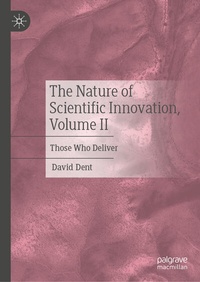
The Nature of Scientific Innovation, Volume II
Description

Innovation is a major driver of social, economic and environmental change and is researched extensively by academics from disciplines as diverse as, business, engineering, economics, sociology and psychology. On the whole, each discipline pursues its own pathway to understanding without an interdisciplinary framework that links diverse research outputs. This partite structure creates a remove from the practical realities of entrepreneurship, and the innovators who operate and perceive innovation in its entirety. This book delivers insights and creates a different framework, one that includes terminologies and typologies, greater understanding of paradigmatic influences in science, needs vs wants and demand, impact and value of knowledge, publications and patents and economic benefits. It challenges current approaches to education, research, creativity and skills development, infrastructure, investment and policy.
This book addresses changes needed to better deliver innovation at a time when the world is desperate for solutions to global problems. It will be of interest to scholars and students of innovation from multiple disciplines, as well as practitioners, policymakers and all those with an interest in scientific innovation.
The second volume focuses on those individuals who actually deliver innovation; the nature, traits, skills and behaviours that characterise inventors, intrapreneurs and entrepreneurs. How does a nation generate sufficient innovators to positively impact on the economy, and how can systems and organisations at all levels be best geared to meet their needs? The conundrum posed in providing a supportive leadership and organisational culture for innovators who naturally challenge prevailing orthodoxies and approaches, is addressed; along with the means to unleash and resource disruptive entrepreneurs to do what they do best - to innovate and underpin economic, social and environmental progress.
More details
Other editions
Additional editions
Person
David Dent is a scientist, inventor and entrepreneur having patented and commercialised inventions, a founder of businesses and charitable enterprises, an advisor to governments, a former Managing Director of CABI Bioscience, a former 'Royal Society Entrepreneur in Residence' at the University of East Anglia, and a Visiting Professor at the University of Surrey Business School, UK.
Content
Introduction.- Inventors, Innovators and Entrepreneurs.- Creating and Crafting Inventors and Innovators.- Invention and Innovation Organisations.- Connectivity, Culture and Capabilities.- Limits to Investment in Research.- Re-envisioning Investment Priorities.- Innovation Policy and National Innovation Systems.- To Conclude.
