

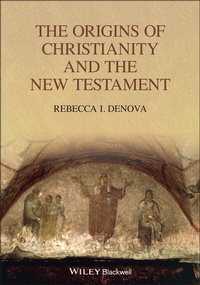
The Origins of Christianity and the New Testament
Description

Approaching the subject from the multidisciplinary perspective of Religious Studies, the author addresses topics including the ethnic and religious background of "Jesus the Jew," the New Testament's different portraits of Jesus, the genesis of Christian concepts such as the divine incarnation and "second coming" of Jesus, Paul the Apostle's contributions to Christian dogma, how ancient Judaism, Greco-Roman culture, and early philosophy was incorporated into the Christian tradition, and more.
Containing maps, timelines, figures of archaeological sites, a brief history of ancient Judaism, and a wealth of pedagogical features, The Origins of Christianity and the New Testament is an excellent textbook for all undergraduate and graduate courses in the study of ancient Christianity, as well as lay readers with interest in tracing the roots of the Christian faith.
More details
Other editions
Additional editions
Person
REBECCA I. DENOVA is Senior Lecturer Emeritus in the Early History of Christianity at the University of Pittsburgh, where she has taught in the Department of Religious Studies for more than 25 years. Her area of expertise is in the historical exploration of the origins of Christianity within Hellenistic Judaism.
Dr Denova has travelled widely in the Mediterranean Basin, exploring archaeological sites as part of her research of the ancient world. She is the author of several books including Greek and Roman Religions.
Content
Acknowledgments vii
Preface ix
I Studying the Historical Jesus 1
II The History of Israel 17
Excursus I Introduction to the Gospels 45
III The Gospel of Mark (The Apocalyptic Jesus) 51
IV The Gospel of Matthew ("The New Moses") 71
V The Gospel of Luke (The Compassionate Jesus) 93
VI The Acts of the Apostles 109
VII The Gospel of John ("The Stranger from Heaven") 129
Excursus II Historical Anomalies in the Trial(s) and Crucifixion in the Gospels 143
Excursus III Jesus and Women in the Gospels 153
VIII Paul, the "Apostle to the Gentiles" 161
IX Paul and the First Christians 181
Excursus IV Women in the Pauline Communities 197
X Other New Testament Documents 201
XI The Book of Revelation 213
Epilog 231
Excursus V The Legacy of Jewish-Christian Relations 235
Glossary 239
Index 259
PREFACE
The phrase "the Quest for the Historical Jesus" has become popular through hundreds of new books. If you subscribe to cable you will find documentaries on History, Discovery, Smithsonian, and National Geographic Channels. New archaeological discoveries often make headlines (especially those in the Galilee), and "deconstructionist histories" are often designed to shock.
For many lay Christians, a new fascination with the study of Jesus is confusing. We have the gospels, the letters of Paul, and the rest of the New Testament that told the story. And these stories are re-enacted in the liturgy at Christmas and Easter. Priests and ministers are trained in Seminaries to elucidate the "meaning" of the texts, updating them for modern Christians. Why does any of this need "revision?" And what is meant by "the historical Jesus?" Is he different from the Jesus of the New Testament?
The simple answer is "yes," if we mean that the Jesus who was an apocalyptic prophet in the first century is different from the "Christ" of the churches (divine) and eventually the second member of "The Trinity," co-equal with God (325 ce). Centuries of later Christian Theology and traditions are constantly read back into the gospels, where they are historically out of place. For example, Jesus was not the founder of Christianity; all our evidence demonstrates that he and his early followers were not interested in starting a new religion. Jesus was not "the first Christian."
This surprises most people. In the first century, there was no such thing as "Christianity" as a separate religious system. It was only formulated in the second century when Christian leaders known as the Church Fathers argued for a different system from Judaism. The term "Christian" (a follower of Christ) only appears a few times in Luke's Acts of the Apostles, written toward the end of the first century. It is not his preferred term. He most often refers to believers as "followers of the way," or "brothers" (as does Paul in his letters). Scholars of the New Testament refer to these people as "Christians" to distinguish them from other Jewish groups at the time (and it is simply convenient).
The other surprising aspect of the gospels is that they all present four different portraits of Jesus and what he was doing. We combine Matthew and Luke together under the Christmas tree although the two nativity stories are vastly different. The great Hollywood productions of the 1950s and 1960s of "Jesus" movies did the same by picking and choosing various parts of the gospels and presenting one huge epic. Most Hollywood productions preferred Luke's Jesus, but often added John's speeches.
As we will see, each of the four gospels has a defined historical context. As events and issues in the communities of his followers changed over time, their "story" of Jesus changed as well.
Jesus the Jew
There is probably no other element that motivates newer approaches to the study of Jesus more than the rediscovery of "Jesus the Jew" that occurred in the past 100 years or so. We say "rediscovery," because everyone in the first century knew this. The ethnic and religious background of Jesus became buried in the centuries of Christian tradition and teaching. The rediscovery has resulted in a newfound importance for understanding Jews and Judaism in the time of Jesus. This period was known for the emergence of various sects of Jews. What kind of Jew was Jesus?
At the same time, "Jesus the Jew" remains the focus of post-Holocaust studies. A central tenet of Christianity is found in Mark's story of the trial and crucifixion of Jesus. The origins of centuries of Christian anti-Semitism began with this story (blaming the Jews for the crucifixion), and it still resonates in the modern world.
Origins
The purpose of this book is to introduce lay readers (whether Christians or participants in other religious and nonreligious systems) to the origins of the movement that became Christianity. It can also serve as a secondary text for academic courses in the origins of Christianity. The study of "origins" is crucially important, not only to study the past, but to understand what gave rise to concepts and beliefs that remain a major aspect of our modern heritage. Many Christians learn the ritual formulas, but without the historical background of what gave rise to those formulas.
Although some Christians believe that Christianity was simply "revealed," it did not arise in a vacuum. The immediate historical context is Second Temple Judaism (c. 450 bce - 70 ce) in the province of Judea in the Roman Empire with its cultural inclusion of Greco-Roman society. An exploration of the people and societies at that time elucidates the contribution of both in the origins of the movement.
The analysis of the ancient world relies on primary documents when available - the literature that was produced at the time. In the study of the origins of Christianity, the primary documents are what became the New Testament. The final version of the New Testament contains four gospels (Mark, Matthew, Luke, John), a history of the missions (the Acts of the Apostles), fourteen letters assigned to Paul, seven letters assigned to others, and one apocalyptic text known as the Book of Revelation.
Scholars debate the dates of some of the texts (some in the second century), but they all demonstrate teachings of various communities in the first century. Learning to read these texts in relation to the people and the societies that produced them is the goal of this book.
The Academic Discipline of Religious Studies
Religious Studies is a relatively new discipline in the academy (in the past seventy years). It is important to recognize the differences between Theology (the study of God) and Religious Studies. Theology involves the study of the nature of God and the way in which God and humans interact. Theologians address such issues from a preconceived faith conviction. There are thousands of books and articles on the theological study of Jesus and the New Testament.
Religious Studies (often referred to as "the academic study of religion") focuses on the origins of religious authority (institutions), beliefs, rituals, sacred texts, and ethics. Absent value judgments of which religions are "right" or "wrong," Religious Studies analyzes the people and societies who created religious traditions and the way in which they function.
Religious Studies utilizes a "multidisciplinary" approach and methodology that incorporates all the liberal arts and social sciences: classics, history, literature, anthropology, archaeology, sociology, philosophy, and psychology. In addition, the study of religion analyzes economics, politics, ethnic studies, ritual, gender studies, the arts, global studies, and cross-cultural approaches. Religious Studies explores the human experience of religion in specific cultures over time, as a "system of meaning." This is the approach that is utilized in the following chapters. Working in tandem, a Religious Studies approach also sheds light on theological issues.
Features of this Textbook
Chapter I summarizes the post-Enlightenment approach to the study of the Bible and the three phases of "The Quest for the Historical Jesus" in the last century. The chapter also includes shared terminology and methodology in the study of ancient religions. Modern criteria for uncovering the "historical Jesus" are outlined in the first chapter.
Chapter II, "The History of Israel," is a short history of Jews and Judaism, as revealed in the Jewish Scriptures. This history is crucial for positioning Jesus as a Jew in the first century. The gospels consistently call upon this history to frame the teachings of Jesus. Israel underwent a major paradigm shift after the conquests of Alexander the Great (330 bce). The cultural changes in this period are collectively known as "Hellenism" (after Hellas, the eponymous founder of Greece). These cultural elements are also incorporated into the New Testament.
The earliest texts of the New Testament are Paul's letters, which were written in the 50s and 60s of the first century. Chronologically they should be placed prior to the gospels. However, most readers prefer to cover the story of Jesus in the gospels first; Paul provides very little information about the ministry. The second reason to examine Paul's letters after the gospels is that he laid the groundwork for the later letters in the New Testament and what eventually became Christian dogma by the end of the first century.
After reviewing the history of Judaism up to the first century, Chapter III examines the first gospel in "The Gospel of Mark" ("The Apocalyptic Jesus"). We examine the way in which Mark structured his story in alignment with the Scriptures and the events of the Jewish Revolt (66-73 ce).
"The Gospel of Matthew" (The "New Moses"), Chapter IV, is perhaps the best-known of the gospels (particularly through the translation of the King James Bible in 1601). This chapter includes an exposition on the "nativity stories" of both Matthew and Luke (to avoid repetition later). Matthew also has the most "kingdom parables," and we will examine these as they relate to Matthew's...
