

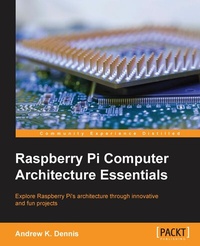
Raspberry Pi Computer Architecture Essentials
Click here to enter text.
Published on 8. July 2025
232 pages
978-1-78439-860-6 (ISBN)
Description

Explore Raspberry Pi\'s architecture through innovative and fun projects
Key Features
[*] Explore Raspberry Pi 2's hardware through the Assembly, C/C++, and Python programming languages
[*] Experiment with connecting electronics up to your Raspberry Pi 2 and interacting with them through software
[*] Learn about the Raspberry Pi 2 architecture and Raspbian operating system through innovative projects
Book DescriptionWith the release of the Raspberry Pi 2, a new series of the popular compact computer is available for you to build cheap, exciting projects and learn about programming. In this book, we explore Raspberry Pi 2's hardware through a number of projects in a variety of programming languages. We will start by exploring the various hardware components in detail, which will provide a base for the programming projects and guide you through setting up the tools for Assembler, C/C++, and Python. We will then learn how to write multi-threaded applications and Raspberry Pi 2's multi-core processor. Moving on, you'll get hands on by expanding the storage options of the Raspberry Pi beyond the SD card and interacting with the graphics hardware. Furthermore, you will be introduced to the basics of sound programming while expanding upon your knowledge of Python to build a web server. Finally, you will learn to interact with the third-party microcontrollers. From writing your first Assembly Language application to programming graphics, this title guides you through the essentials. What you will learn
[*] Set up your Raspberry Pi 2 and learn about its hardware
[*] Write basic programs in Assembly Language to learn about the ARM architecture
[*] Use C and C++ to interact with electronic components
[*] Find out about the Python language and how to use it to build web applications
[*] Interact with third-party microcontrollers
[*] Experiment with graphics and audio programming
[*] Expand Raspberry Pi 2's storage mechanism by using external devices
[*] Discover Raspberry Pi 2's GPIO pins and how to interact with them
Who this book is forRaspberry Pi Computer Architecture Essentials is for those who are new and those who are familiar with the Raspberry Pi. Each topic builds upon earlier ones to provide you with a guide to Raspberry Pi's architecture. From the novice to the expert, there is something for everyone. A basic knowledge of programming and Linux would be helpful but is not required.
Key Features
[*] Explore Raspberry Pi 2's hardware through the Assembly, C/C++, and Python programming languages
[*] Experiment with connecting electronics up to your Raspberry Pi 2 and interacting with them through software
[*] Learn about the Raspberry Pi 2 architecture and Raspbian operating system through innovative projects
Book DescriptionWith the release of the Raspberry Pi 2, a new series of the popular compact computer is available for you to build cheap, exciting projects and learn about programming. In this book, we explore Raspberry Pi 2's hardware through a number of projects in a variety of programming languages. We will start by exploring the various hardware components in detail, which will provide a base for the programming projects and guide you through setting up the tools for Assembler, C/C++, and Python. We will then learn how to write multi-threaded applications and Raspberry Pi 2's multi-core processor. Moving on, you'll get hands on by expanding the storage options of the Raspberry Pi beyond the SD card and interacting with the graphics hardware. Furthermore, you will be introduced to the basics of sound programming while expanding upon your knowledge of Python to build a web server. Finally, you will learn to interact with the third-party microcontrollers. From writing your first Assembly Language application to programming graphics, this title guides you through the essentials. What you will learn
[*] Set up your Raspberry Pi 2 and learn about its hardware
[*] Write basic programs in Assembly Language to learn about the ARM architecture
[*] Use C and C++ to interact with electronic components
[*] Find out about the Python language and how to use it to build web applications
[*] Interact with third-party microcontrollers
[*] Experiment with graphics and audio programming
[*] Expand Raspberry Pi 2's storage mechanism by using external devices
[*] Discover Raspberry Pi 2's GPIO pins and how to interact with them
Who this book is forRaspberry Pi Computer Architecture Essentials is for those who are new and those who are familiar with the Raspberry Pi. Each topic builds upon earlier ones to provide you with a guide to Raspberry Pi's architecture. From the novice to the expert, there is something for everyone. A basic knowledge of programming and Linux would be helpful but is not required.
All prices
More details
Edition
Digital original
Language
English
Place of publication
Birmingham
United Kingdom
Target group
Professional and scholarly
US School Grade: College Graduate Student
Edition type
Digital original
File size
2,77 MB
ISBN-13
978-1-78439-860-6 (9781784398606)
Copyright in bibliographic data and cover images is held by Nielsen Book Services Limited or by the publishers or by their respective licensors: all rights reserved.
Schweitzer Classification
Other editions
Additional editions
Andrew K. Dennis
Raspberry Pi Computer Architecture Essentials
Book
03/2016
Packt Publishing
€50.40
Shipment within 3-4 weeks
Person
Dennis Andrew K. :
Andrew K. Dennis is a full stack and cybersecurity architect with over 17 years' experience who currently works for Modus Create in Reston, VA. He holds two undergraduate degrees in software engineering and creative computing and a master's degree in information security. Andy has worked in the US, Canada, and the UK in software engineering, e-learning, data science, and cybersecurity across his career, and has written four books on IoT, the Raspberry Pi, and supercomputing. His interests range from the application of pataphysics in computing to security threat modeling. Andy lives in New England and is an organizer of Security BSides CT.
Andrew K. Dennis is a full stack and cybersecurity architect with over 17 years' experience who currently works for Modus Create in Reston, VA. He holds two undergraduate degrees in software engineering and creative computing and a master's degree in information security. Andy has worked in the US, Canada, and the UK in software engineering, e-learning, data science, and cybersecurity across his career, and has written four books on IoT, the Raspberry Pi, and supercomputing. His interests range from the application of pataphysics in computing to security threat modeling. Andy lives in New England and is an organizer of Security BSides CT.
Content
Table of Contents
Introduction to the Raspberry Pi
Programming on Raspbian
Low Level development with Assembler
Multi-threaded applications with C/C++
Expanding on storage options
Low level graphics programming
Exploring the Raspberry Pi
Exploring sound with the Raspberry Pi
Building a Web Server
Integrating with third party Microcontrollers
Final Project
Introduction to the Raspberry Pi
Programming on Raspbian
Low Level development with Assembler
Multi-threaded applications with C/C++
Expanding on storage options
Low level graphics programming
Exploring the Raspberry Pi
Exploring sound with the Raspberry Pi
Building a Web Server
Integrating with third party Microcontrollers
Final Project

