

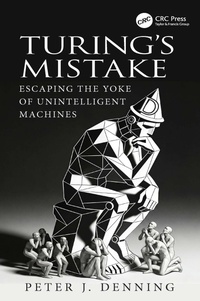
Turing's Mistake
Escaping the Yoke of Unintelligent Machines
Will be published approx. on 28. July 2026
146 pages
978-1-040-95368-6 (ISBN)
Description

AI is sweeping away familiar cultures and we have no idea where it is taking us. The older generation tends to stick up for humanity and the younger generation for post-humanity. It is a serious tension. Everywhere there is a mood of unsettlement at not knowing where the unstoppable momentum of AI will go and whether we will like the outcome. For the first time in the history of humanity, we do not really have a good grip on what the role of humans is on the planet.
This predicament can be traced to widespread acceptance of two assumptions proposed by Alan Turing in 1950 when he asked, "Can computers think?": that intelligence is disembodied and its presence can be determined by the Turing test. The AI field has been obsessed by a quest for Artificial General Intelligence, abbreviated AGI, in fulfillment of Turing's proposals. This book argues that AI has ignored a gaping hole: the issue of tacit knowledge, which is essential for human intelligence and can never be known by machines. The seekers of AGI have a long wait ahead.
For the rest of us, non-human machine intelligence is already emerging in AI agentic networks and is well on its way to dragging us into an unwanted and unwelcome world where not-very-intelligent machines force conformity to their goals. We can escape this yoke by renouncing the idea that we are a form of machine. We can celebrate and reawaken the powers we have, such as care, understanding, and respect, that no machine can have.
This predicament can be traced to widespread acceptance of two assumptions proposed by Alan Turing in 1950 when he asked, "Can computers think?": that intelligence is disembodied and its presence can be determined by the Turing test. The AI field has been obsessed by a quest for Artificial General Intelligence, abbreviated AGI, in fulfillment of Turing's proposals. This book argues that AI has ignored a gaping hole: the issue of tacit knowledge, which is essential for human intelligence and can never be known by machines. The seekers of AGI have a long wait ahead.
For the rest of us, non-human machine intelligence is already emerging in AI agentic networks and is well on its way to dragging us into an unwanted and unwelcome world where not-very-intelligent machines force conformity to their goals. We can escape this yoke by renouncing the idea that we are a form of machine. We can celebrate and reawaken the powers we have, such as care, understanding, and respect, that no machine can have.
Reviews / Votes
"A breakthrough book with fresh thinking about our evolving relationship with knowledge, knowing, intelligence, and machines."Ron Kaufman, New York Times bestselling author of Uplifting Service
"A provocative contribution to the ongoing discussion in artificial intelligence and the role humans play in it."
George West, retired World Bank Executive
"A powerful contribution to the emerging conversations on the challenges and possibilities of artificial intelligence and the nature of human identity."
Fred Disque, retired Oral & Maxillofacial surgeon
More details
Language
English
Place of publication
London
United Kingdom
Publishing group
Taylor & Francis Ltd
Target group
Professional and scholarly
Illustrations
6 Tables, black and white; 1 Halftones, black and white; 1 Illustrations, black and white
File size
6,74 MB
ISBN-13
978-1-040-95368-6 (9781040953686)
Copyright in bibliographic data and cover images is held by Nielsen Book Services Limited or by the publishers or by their respective licensors: all rights reserved.
Schweitzer Classification
Other editions
Additional editions
Book
approx. 07/2026
1st Edition
CRC Press
€25.00
Not yet published
Book
approx. 07/2026
1st Edition
CRC Press
€148.50
Not yet published
Person
Peter James Denning is an American computer scientist and writer. He is best known for pioneering work in virtual memory, especially for inventing the working-set model for program behavior, which addressed thrashing in operating systems and became the reference standard for all memory management policies. He is also known for his works on principles of operating systems, operational analysis of queueing network systems, design and implementation of CSNET, the ACM digital library, codifying the great principles of computing, and innovation leadership. He has written numerous influential articles and books, including an overview of fundamental computer science principles, computational thinking, and his thoughts on innovation as a set of learnable practices.
Content
1. Putting Intelligence to the Test 2. Machines and Intelligence 3. Technologies of AI 4. Big Ideas in the AI Game 5. Models and Trust 6. Limits on Language Machines 7. The AGI Illusion 8 Machines and Mastery 9. Agentic Intelligence 10. Escaping the Yoke
