

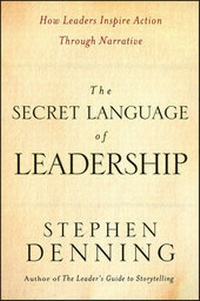
The Secret Language of Leadership
How Leaders Inspire Action Through Narrative
Published on 11. June 2008
304 pages
978-0-470-18440-0 (ISBN)
Description

The book introduces the concept of narrative intelligence--an ability to understand and act and react agilely in the quicksilver world of interacting narratives. It shows why this is key to the central task of leadership, what its dimensions are, and how you can measure it. The book's lucid explanations, vivid examples and practical tips are essential reading for CEOs, managers, change agents, marketers, salespersons, brand managers, politicians, teachers, parents--anyone who is setting out to the change the world.
Reviews / Votes
Named one of the "Best Business Books of the Year" (2007) byFinancial Times: "Leaders don't just executestrategy, they must inspire others to follow...This book explainshow." (Financial Times, December 8, 2007) "Denning cohesively links the importance of narrativeintelligence and telling stories to leadership success."(Library Journal, December 2007) "...if there's one person who knows more than anyone else aboutthe power of business narrative it's...Steve Denning." (MyCustomer.com, Friday 7th December 2007) "This book's lucid explanations, vivid examples and practicaltips are essential reading..." (PublicNet.co.uk,Tuesday 4th December 2007) "...an array of glowing testimonials from truly famouspeople. Definitely one for those interested intransformational change." (Strategic CommunicationManagement, December 2007) "...an educational and informative book that can beeffortlessly read from cover to cover." (InsideKnowledge, September 2007)"If business leaders do not immediately grasp the vital insightsoffered by this book, both they and their organisations aredoomed."--Stefan Stern, Financial Times "Steve Denning is the Warren Buffett of business communication.He sees things others don't and is able to explain them so the restof us can understand."--Chip Heath, co-author of Made to Stick,Professor of Organizational Behavior, Graduate School of Business,Stanford University "I highly recommend you get it today and read it tonight.Tomorrow will be an entirely different kind of day if youdo."---Jim Kouzes, Co-author of the best-selling, The LeadershipChallenge, and A Leader's Legacy "The Secret Language of Leadership has been instrumental inhelping me overcome the challenges of rapid growth and intensecompetition. It's all about the story."--Reed Hastings, CEO,Netflix Inc. "I don't think I have ever read a more compelling preface. Andbest of all, the advice Denning gives to the reader about speakingand writing is exemplified in the way he has written thisimpressive book."--James MacGregor Burns, distinguished seniorscholar, James MacGregor Burns Academy of Leadership, University ofMaryland, and author of Leadership "The Secret Language of Leadership is not only the best analysisI have seen of how and why leaders succeed or fail, it's highlyreadable, as well as downright practical. It should be mandatoryreading for anyone interested in engaging a company with big ideaswho understands that leaders live and die by the quality of whatthey say."--Richard Stone, story analytics master, i.d.e.a.sMore details
Other editions
Additional editions
Book
10/2007
Jossey-Bass
€28.50
Shipment within 10-20 days
Person
The Author
Stephen Denning is senior fellow at the James MacGregor Burns Leadership Academy at the University of Maryland and the author of The Leader's Guide to Storytelling and Squirrel Inc. from Jossey-Bass. He is former program director, knowledge management, at the World Bank. In 2003 he was named as one of the world's Top Two Hundred Business Gurus. His articles have appeared in leading business publications such as Harvard Business Review and Strategy & Leadership.
Content
Preface: My Leadership Journey.
Part One: What Is Transformational Leadership?
Introduction: Ten Mistakes Transformational Leaders Make.
1 The Secret Language of Leadership.
Part Two: The Language of Leadership: Key Enablers.
2 Articulating a Clear, Inspiring Goal.
3 The Leader's Own Story: Committing to the Goal.
4 Mastering the Audience's Story.
5 Cultivating Narrative Intelligence.
6 Telling Truthful Stories.
7 Leadership Presence: The Body Language of Leadership.
Part Three: The Language of Leadership: Key Steps.
8 Getting People's Attention.
9 Stimulating Desire.
10 Reinforcing with Reasons.
11 Continuing the Conversation.
12 Epilogue.
Appendix 1: Presentation to the Change Management Committee ofthe World Bank: April 1996.
Appendix 2: Templates and Exercises.
Appendix 3:What's Your Narrative Intelligence?
Notes.
Acknowledgments.
About the Author.
Index.
PREFACE MY LEADERSHIP JOURNEY My own leadership journey began abruptly late on Monday afternoon, February 5, 1996. That day, I'd asked for a meeting with one of the managing directors of the World Bank-one of the three people who reported to the president of the bank and were charged with running its operations. As the director of the Africa Region, I needed to see him because that curious thing known as "my career" had just then taken a turn for the worse. The World Bank is an international lending organization located in Washington, D.C., and aimed at relieving global poverty. For several decades, I had held a number of positions and functions, including programming and budgeting, the West Africa riverblindness program, population, health and nutrition programs, and the quality control of operations. In the early 1990s, I had been director of the Southern Africa Department, where I had overseen the work of several hundred people working in ten countries. Now, as director of the Africa Region, I was responsible for the operations of more than a thousand staff working in forty-three countries. After that much experience as an executive, I believed that I understood management, although I was about to discover that I had much to learn about leadership. Large organizations may look stable, but appearances are deceptive. In the past year, the president had unexpectedly died. Last month, my boss had decided to retire. Now someone else had just been named to my post. The office of managing director is just two grade levels above director. To an outsider, those two grade levels might not seem like much, but from the inside, the difference was an abyss. Like most organizations, the World Bank has a hierarchical management style. It's the same "look-up-and-yell-down" style as in the private sector. At the beginning of the interview, I told the managing director that I'd heard the announcement that someone else was to fill my position. Did they have anything in mind for me? "Not really," he replied with a smile. I wasn't surprised. There had been inklings of trouble afoot. Just one month before, I'd been asked in the street if it was true that I was being pushed aside. My boss had confirmed that the scene was turbulent: his own decision to retire exposed me to the vagaries of the clan warfare that pervades large organizations. The managing director quickly explained to me the diminishing range of my career options. The organization had no plans for me. There were no specific positions available. There weren't even any lists of possible positions on which I might figure. He spoke to me dismissively, as though I had had no prior reputation, no credit for anything I had done over several decades, and no prospects. His world was a personnel chessboard and I was no longer a player. I had become a nobody. When I pressed him, he said finally, "Why don't you look into information?" Information? In February 1996, information in the World Bank had all the prestige of the garage or the cafeteria-a wasteland from which no traveler had ever returned. The message was unmistakable: I was being sent to Siberia. Although the interview was bad news, the imperial style of delivery was something else. The managing director gazed on me as though he'd just swatted a fly. At the time, I had no way of knowing that his own vast power was a facade. He had been chosen precisely because he was a loyal staff officer. I had no idea then that he, like all the new bank president's close associates, would be cast aside within a few years, when, in the inevitable custom of authoritarian contexts, the executioner becomes the victim.
The loss of my job hit me as a grave personal setback. Yet in retrospect, it's clear that there was nothing personal in it at all. The president, as it emerged in due course, planned to ditch everyone at my level, including the managing directors. He seemed to believe that if he appointed people himself, they would be more loyal and dedicated to his objectives. When this turned out not to be the case, he canned them with the same indifference that he dispatched the senior managers on hand at the time of his arrival. For those slated for elimination, the president's technique was simple. He refrained from dismissing them outright. Instead he appointed them to posts with lesser responsibilities or status, or left them with no position at all. The idea was that they would resign to avoid the public humiliation of being treated so demeaningly. In most cases, his judgment proved correct: they left without a protest, slipping quietly into the night. My case was different: I wasn't quite ready to leave.
I remained optimistic. Surely, I thought, there must have been a mistake. Surely my record counted for something. Surely, when lines of communication opened, my career would be back on track. I set about looking into information, since I was interested in the topic, having been an early computer enthusiast. I saw that if I combined my knowledge of World Bank operations with my interest in computers, I could make a unique contribution. The issues were immediately obvious-systems that weren't compatible with each other so that every question had multiple answers, a huge and growing duplication of effort, utter unresponsiveness to operations on the ground, antiquated, paper-bound relations with clients, and inexcusable delays in doing even the simplest thing. I began putting together a plan for what I would do if I were to be offered a position in information. It became steadily more apparent that cleaning up information was a necessary but largely menial task. It would save the organization money but it wouldn't fix the fundamental strategic issue: a lending organization-even if it became more agile-could never solve the problem of global poverty. Global poverty would only be solved when people in poor countries themselves knew how to solve their own problems. Money could facilitate the relief of poverty, but it could never be the solution, unless combined with knowledge. In 1996, the World Bank had a great deal of knowledge relevant to solving the problems of global poverty. We had world-class experts in a wide array of fields-agriculture, banking, finance, health, education, you name it-but access to this knowledge was problematic. If you were involved in a lending operation with the World Bank, you might discover some of this expertise, but otherwise you were out of luck. I began to think: suppose we were to generate quick and easy global access to our knowledge for everyone, wherever they were? Then we could become a pretty interesting organization, even an exciting organization. Why not become a knowledge-sharing organization? I thought this was not just a good idea: once you thought about it, it was breathtakingly obvious. There was just one problem. In the World Bank of early 1996, no one was willing to listen.
Eventually, in April 1996, after weeks of buttonholing anyone I could find, I managed to get a few people's attention. As a result, I was offered ten minutes in front of the Change Management Committee of the World Bank to explain my ideas on sharing knowledge. This committee comprised the managing directors as well as a few vice presidents and some senior advisers to the president. It had been set up to "orchestrate change" in the World Bank. It wasn't obvious to anyone that this was what it was up to, but clearly I needed its support. To be offered even a few minutes before it was a major breakthrough. So now I had ten minutes in which to persuade a group of skeptical, change-resistant senior managers that we should embark on a new strategy to make sharing knowledge a central preoccupation of the organization. My presentation, which is included in Appendix 1, was quite simple in structure. It talked about the problems the organization was facing in sharing its knowledge. It included a brief anecdote from Zambia, which suggested what the future might look like. And it gave a couple of simple road maps as to how we might get from here to there. After I gave my presentation, I was taken aback by the overwhelmingly enthusiastic reaction. One of the vice presidents, Jean-François Rischard, raced up to me very excitedly. "Why don't we do it?" he asked. "What's the next step? Why isn't it being implemented? What's the blockage?" At the time, my first thought was that this was a very strange conversation. Until ten minutes ago, vice presidents had hardly been willing to give me the time of day. And now it was as if I wasn't doing enough to implement Rischard's idea. Then it dawned on me. How wonderful! The idea of sharing knowledge with the world was no longer just my idea. Now it was also his idea. And indeed it was Rischard who shortly afterward played a key role in communicating the idea of knowledge sharing to the bank president and sponsoring its implementation across the entire organization. These were among the first inklings that there was something remarkable in that simple ten-minute presentation. And yet if I had been asked at the time why it was effective, I would have answered that the underlying idea was a good one and people recognized a good idea for its merits. At the time, I was only dimly aware that in most organizations good ideas go nowhere, because they aren't compellingly communicated. I had no notion then that I had, almost by accident, stumbled on a...
The loss of my job hit me as a grave personal setback. Yet in retrospect, it's clear that there was nothing personal in it at all. The president, as it emerged in due course, planned to ditch everyone at my level, including the managing directors. He seemed to believe that if he appointed people himself, they would be more loyal and dedicated to his objectives. When this turned out not to be the case, he canned them with the same indifference that he dispatched the senior managers on hand at the time of his arrival. For those slated for elimination, the president's technique was simple. He refrained from dismissing them outright. Instead he appointed them to posts with lesser responsibilities or status, or left them with no position at all. The idea was that they would resign to avoid the public humiliation of being treated so demeaningly. In most cases, his judgment proved correct: they left without a protest, slipping quietly into the night. My case was different: I wasn't quite ready to leave.
I remained optimistic. Surely, I thought, there must have been a mistake. Surely my record counted for something. Surely, when lines of communication opened, my career would be back on track. I set about looking into information, since I was interested in the topic, having been an early computer enthusiast. I saw that if I combined my knowledge of World Bank operations with my interest in computers, I could make a unique contribution. The issues were immediately obvious-systems that weren't compatible with each other so that every question had multiple answers, a huge and growing duplication of effort, utter unresponsiveness to operations on the ground, antiquated, paper-bound relations with clients, and inexcusable delays in doing even the simplest thing. I began putting together a plan for what I would do if I were to be offered a position in information. It became steadily more apparent that cleaning up information was a necessary but largely menial task. It would save the organization money but it wouldn't fix the fundamental strategic issue: a lending organization-even if it became more agile-could never solve the problem of global poverty. Global poverty would only be solved when people in poor countries themselves knew how to solve their own problems. Money could facilitate the relief of poverty, but it could never be the solution, unless combined with knowledge. In 1996, the World Bank had a great deal of knowledge relevant to solving the problems of global poverty. We had world-class experts in a wide array of fields-agriculture, banking, finance, health, education, you name it-but access to this knowledge was problematic. If you were involved in a lending operation with the World Bank, you might discover some of this expertise, but otherwise you were out of luck. I began to think: suppose we were to generate quick and easy global access to our knowledge for everyone, wherever they were? Then we could become a pretty interesting organization, even an exciting organization. Why not become a knowledge-sharing organization? I thought this was not just a good idea: once you thought about it, it was breathtakingly obvious. There was just one problem. In the World Bank of early 1996, no one was willing to listen.
Eventually, in April 1996, after weeks of buttonholing anyone I could find, I managed to get a few people's attention. As a result, I was offered ten minutes in front of the Change Management Committee of the World Bank to explain my ideas on sharing knowledge. This committee comprised the managing directors as well as a few vice presidents and some senior advisers to the president. It had been set up to "orchestrate change" in the World Bank. It wasn't obvious to anyone that this was what it was up to, but clearly I needed its support. To be offered even a few minutes before it was a major breakthrough. So now I had ten minutes in which to persuade a group of skeptical, change-resistant senior managers that we should embark on a new strategy to make sharing knowledge a central preoccupation of the organization. My presentation, which is included in Appendix 1, was quite simple in structure. It talked about the problems the organization was facing in sharing its knowledge. It included a brief anecdote from Zambia, which suggested what the future might look like. And it gave a couple of simple road maps as to how we might get from here to there. After I gave my presentation, I was taken aback by the overwhelmingly enthusiastic reaction. One of the vice presidents, Jean-François Rischard, raced up to me very excitedly. "Why don't we do it?" he asked. "What's the next step? Why isn't it being implemented? What's the blockage?" At the time, my first thought was that this was a very strange conversation. Until ten minutes ago, vice presidents had hardly been willing to give me the time of day. And now it was as if I wasn't doing enough to implement Rischard's idea. Then it dawned on me. How wonderful! The idea of sharing knowledge with the world was no longer just my idea. Now it was also his idea. And indeed it was Rischard who shortly afterward played a key role in communicating the idea of knowledge sharing to the bank president and sponsoring its implementation across the entire organization. These were among the first inklings that there was something remarkable in that simple ten-minute presentation. And yet if I had been asked at the time why it was effective, I would have answered that the underlying idea was a good one and people recognized a good idea for its merits. At the time, I was only dimly aware that in most organizations good ideas go nowhere, because they aren't compellingly communicated. I had no notion then that I had, almost by accident, stumbled on a...
