

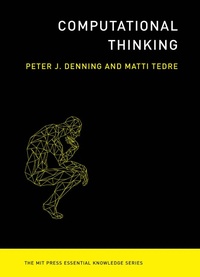
Computational Thinking
Description

A few decades into the digital era, scientists discovered that thinking in terms of computation made possible an entirely new way of organizing scientific investigation; eventually, every field had a computational branch: computational physics, computational biology, computational sociology. More recently, "computational thinking” has become part of the K-12 curriculum. But what is computational thinking? This volume in the MIT Press Essential Knowledge series offers an accessible overview, tracing a genealogy that begins centuries before digital computers and portraying computational thinking as pioneers of computing have described it.
The authors explain that computational thinking (CT) is not a set of concepts for programming; it is a way of thinking that is honed through practice: the mental skills for designing computations to do jobs for us, and for explaining and interpreting the world as a complex of information processes. Mathematically trained experts (known as "computers”) who performed complex calculations as teams engaged in CT long before electronic computers. The authors identify six dimensions of today's highly developed CT—methods, machines, computing education, software engineering, computational science, and design—and cover each in a chapter. Along the way, they debunk inflated claims for CT and computation while making clear the power of CT in all its complexity and multiplicity.
More details
Other editions
Additional editions
Persons
Matti Tedre is a Professor in the School of Computing at the University of Eastern Finland, Associate Professor in the Department of Computer and Systems Science at Stockholm University, and the author of The Science of Computing: Shaping a Discipline.
