

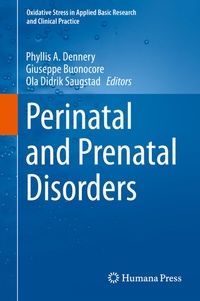
Perinatal and Prenatal Disorders
Description

This authoritative volume describes the role of free radicals and antioxidants in prenatal and perinatal disorders currently explored in clinical and pre-clinical trials. In twenty-two inclusive chapters, the book covers the gamut of oxidative stress and its relation to a variety of factors, including fertility, metabolism, redox biomarkers, antioxidant defense and protection, gene polymorphisms, angiogenesis, cell signaling, mutations and oxidative damage involving lipids, proteins and nucleic acids, membrane trafficking, inflammation, mitochondrial dysfunction, alterations in immunological function, hypoxia, and post-natal stressors. This comprehensive source will keep clinicians and research scientists up-to-date on translational research into medical applications. Perinatal and Prenatal Disorders is a significant addition to the well-known Oxidative Stress in Applied Basic Research and Clinical Practice series.
Reviews / Votes
"This is a compilation of 22 relatively independent reviews of topics in the field of oxidative stress during the perinatal period. . The audience is both researchers and sophisticated clinicians in the area of perinatal medicine. . It editors and authors are well-known researchers and this book should help focus new research into the toxic effects of oxygen radical species on the fragile fetus and neonate as well as the care of this vulnerable population." (Jay P. Goldsmith, Doody's Book Reviews, March, 2015)
"This volume reviews in 22 chapters the role of oxidative injury to early embryonic development and possible consequences. . A useful book for neonatologists." (Pediatric Endocrinology Reviews (PER), Vol. 12 (4), 2015)
More details
Other editions
Additional editions
Persons
Phyllis A. Dennery, MD, FAAP is a professor of pediatrics at the University of Pennsylvania School of Medicine in Philadelphia, Pennsylvania. She holds the Werner and Gertrude Henle endowed chair in pediatrics at The Children's Hospital of Philadelphia (CHOP). She is chief of the Division of Neonatology and Newborn Services at CHOP and the University of Pennsylvania Health System. Dr. Dennery obtained her medical degree from Howard University in Washington, D.C., and completed a residency in pediatrics at Children's Hospital National Medical Center in Washington, D.C., and a fellowship in neonatology at Case Western Reserve University (Rainbow Babies and Children's Hospital) in Cleveland, Ohio. Dr. Dennery's research interests are in neonatal oxidative stress, lung chronobiology, and circadian gene regulation; her clinical interests are in neonatal jaundice, bronchopulmonary dysplasia, and the long-term consequences of prematurity.
Professor Giuseppe Buonocore is professor and chairman of the School of Specialization in Pediatrics & Neonatology in the Department of Molecular and Developmental Medicine, University of Siena, Tuscany. He is internationally recognized for his research on hyperbilirubinemia, biomarkers of oxidative stress, free radical-related diseases of the newborn, and the early identification of the fetus and newborn at high risk of brain damage. He is the president of the Union of European Neonatal Perinatal Societies (UENPS), presi
dent of the international research foundation Europe Against Infant Brain Injury (EURAIBI), and president of the Tuscan Section of the Italian Society of Neonatology.Dr. Ola Didrik Saugstad is professor of pediatrics, and director of research in the Department of Pediatrics at the University of Oslo in Norway. He is a consultant of neonatology at Oslo University Hospital, Rikshospitalet. Dr. Saugstad obtained his MD and PhD from University of Oslo. He completed research fellowships in neonatology from the University of Oslo and the University of Uppsala in Sweden, and he carried out a postdoctoral fellowship from the University of California San Diego. His main research interests are asphyxia, oxidative stress in premature infants, reoxygenation, and resuscitation of newborn infants. He holds an Honorary Doctorate from the University of Athens in Greece and is a member of several editorial boards of pediatric and perinatal journals.
Content
1. Impact of oxidative stress on development.- 2. Chorioamnionitis and oxidative stress: New ideas from experimental models.- 3. Oxidative stress in the pathophysiology of gestational diabetes mellitus.- 4. Tobacco smoking and oxidative stress in pregnancy.- 5. Preterm labor and oxidative stress.- 6. Developmental origins of disease: The role of oxidative stress.- 7. Down Syndrome as a special case of oxidatively induced developmental dysregulation.- 8. Retinopathy of prematurity and oxidative signaling.- 9. Necrotizing enterocolitis and oxidative stress.- 10. Oxidative stress and the perinatal circulation.- 11. Use of oxygen in the resuscitation of neonates.- 12. Antioxidant properties of commercial surfactants.- 13. Oxidative stress and Glutathione synthesis rates in postnatal life.- 14. Oxygen vulnerability of the immature brain.- 15. Hyperbilirubinemia and antioxidant defenses in the neonate.- 16. Neonatal pain and oxidative stress.- 17. Ontogeny of antioxidant systems.- 18. Antioxidant therapies in the neonates.- 19. Postnatal stress including nutrition.- 20. Oxidative stress in epilepsy.- 21. The oxidative stress in the fetus and newborn.- 22. New promising antioxidant drugs.
