

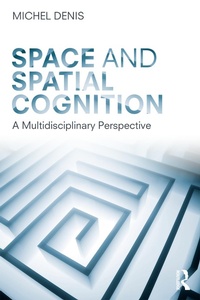
Space and Spatial Cognition
A Multidisciplinary Perspective
Published on 13. November 2017
258 pages
978-1-351-59618-3 (ISBN)
Description

All living creatures inscribe their activity in space. Human beings acquire knowledge of this space by traversing it, listening to verbal descriptions, and looking at maps, atlases, and digital media. We memorize routes, compare distances mentally, and retrieve our starting place after a long journey. Space and Spatial Cognition provides an up-to-date introduction to the elements of human navigation and the mental representation of our environment.
This book explores the mental capacities which enable us to create shortcuts, imagine new pathways, and thus demonstrate our adaptation to the environment. Using a multidisciplinary approach which draws on psychology, neuroscience, geography, architecture and the visual arts, the author presents answers to a number of questions. Which mental capacities do people mobilize when confronted with space? Which brain functions do they implement? How do digital technologies extend these capacities? By presenting space at the crossroads of a number of disciplines, this volume reveals how each of them enhances our understanding of human behaviour in space.
Space and Spatial Cognition provides a unique insight into all facets of spatial cognition, including spatial behaviour, language, and future technologies. It will be the ideal companion for all students and researchers in the field.
This book explores the mental capacities which enable us to create shortcuts, imagine new pathways, and thus demonstrate our adaptation to the environment. Using a multidisciplinary approach which draws on psychology, neuroscience, geography, architecture and the visual arts, the author presents answers to a number of questions. Which mental capacities do people mobilize when confronted with space? Which brain functions do they implement? How do digital technologies extend these capacities? By presenting space at the crossroads of a number of disciplines, this volume reveals how each of them enhances our understanding of human behaviour in space.
Space and Spatial Cognition provides a unique insight into all facets of spatial cognition, including spatial behaviour, language, and future technologies. It will be the ideal companion for all students and researchers in the field.
Reviews / Votes
'Michel Denis takes us on a journey to the fascinating empire of space and spatial cognition. His book offers an insightful up-to-date account of topics that researchers and practitioners have been struggling with over centuries. Philosophy, geography, architecture, psychology, linguistics, and computer science have made considerable progress in the field over the past fifty years. A single outstanding mind describes the perspectives on space from all these disciplines. The author excellently masters the task of bringing them together in a joint and very well written story. The book is highly inspiring for experts and novices in the field alike.' - Christian Freksa, University of Bremen, Germany'Our lives are spent interacting in space, and spatial thinking pervades imagery in the mind. This engaging volume explains how that happens, how the neural processes underlying navigation in space allow marvelous feats of the imagination. The sources for these insights and their implications are as broad as they are deep: neuroscience, geography, human-computer interaction, architecture, and the arts. Space and Spatial Cognition is a must-read for anyone interested in the workings of the human mind.'- Barbara Tversky, Stanford University & Columbia Teachers College
'Taken together, the apt presentation of topics like cognitive maps and the broad coverageof this book make Space and Spatial Cognition: A Multidisciplinary Perspective a valuable contribution and a very pleasant read.' - Ranxiao Frances Wang, Spatial Cognition & Computation
More details
Language
English
Place of publication
London
United Kingdom
Publishing group
Taylor & Francis Ltd
Target group
College/higher education
Illustrations
12 s/w Photographien bzw. Rasterbilder, 35 s/w Zeichnungen
35 Line drawings, black and white; 12 Halftones, black and white
File size
4,98 MB
ISBN-13
978-1-351-59618-3 (9781351596183)
Copyright in bibliographic data and cover images is held by Nielsen Book Services Limited or by the publishers or by their respective licensors: all rights reserved.
Schweitzer Classification
Other editions
Additional editions
Book
11/2017
1st Edition
Routledge
€69.90
Shipment within 10-20 days
Book
11/2017
1st Edition
Routledge
€193.50
Shipment within 10-20 days
Person
Michel Denis is emeritus senior research scientist at the French National Center for Scientific Research and a member of the Laboratory of Computer Science for Mechanics and Engineer Sciences (LIMSI-CNRS) in Orsay (France). As a researcher in cognitive psychology, he mainly studied the processes of mental representation involved in visual imagery and spatial cognition. He is the author of about 200 scientific publications in international journals and books.
Content
Foreword, 1. The area, 2. The book. Part I Space as object of knowledge and object of practice, Chapter 1. Philosophical approaches to space 1. From absolute to relative space, 2. Poincare, space and geometry, 3. Merleau-Ponty and phenomenology of space, 4. Genetic epistemology of spatial representation, 5. Universality of geometric intuition?, 6. Numbers and space. Chapter 2. Geographic space, 1. Geographers' objects, 2. Spatial analysis and the concept of territory, 3. Maps, 4. Cartographic truth and intelligibility, 5. Very distant spaces. Chapter 3. Space-related practices, 1. Architectural and urban spaces, 2. Staging space, 3. Museum space, 4. Pictorial space and the issue of perspective, 5. Labyrinths and mazes, 6. Sacred spaces, 7. Space of poetry and literature. Part II Spatial behavior and spatial representations. Chapter 4. Classifications, 1. Spaces (plural), 2. Unity of spatial cognition?, 3. Wayfinding. Chapter 5. Frames of reference and cognitive maps, 1. Frames of reference, 2. Interactions, 3. Imagined perspectives, 4. Cognitive maps, 5. The acquisition of cognitive maps. Chapter 6. Measurements, 1. Places, 2. Distances, 3. Distortions, 4. Angles and directions, 5. Spatial updating and path integration. Part III Brain and sensorimotor systems: Functions and dysfunctions. Chapter 7. The spatial brain, 1. The hippocampus, 2. The parahippocampal cortex, 3. The parietal cortex, 4. Interactions, 5. Cognitive maps and the brain. Chapter 8. Weaknesses, 1. Topographical disorientation, 2. Disorientation and cognitive ageing, 3. Neurodegenerative diseases, 4. Spatial neglect, 5. Spatial anxiety. Chapter 9. Spatial challenges, 1. Cognitive and locomotor impairments, 2. Space without vision, 3. The nature of spatial representations, 4. Navigational assistance to the blind. Part IV Space and language. Chapter 10. Spatial terminology, 1. Spatial language, 2. The language of spatial prepositions, 3. Linguistic diversity in the use of prepositions, 4. Spatial perspective and frames of reference, 5. Comparative approaches and linguistic relativity. Chapter 11. Spatial descriptions, 1. Literary challenges, 2. Linearization, 3. Selecting a perspective, 4. "Moving" through a mental spatial model, 5. Equivalences?. Chapter 12. Routes and route directions, 1. Route directions, 2. Models, 3. Validations, 4. Landmarks, 5. Mental imagery, 6. Children's route directions. Part V Computation and technologies. Chapter 13. Space and computer sciences, 1. The emergence of artificial intelligence models, 2. Qualitative reasoning, 3. Wayfinding choremes, 4. Robotic challenges, 5. Biomimetic implementations. Chapter 14. Assistance, 1. Spatial syntax, 2. Navigation aids, 3. On the risks of cognitive disengagement, 4. Reliability?. Chapter 15. Virtual spaces, 1. A tool for studying spatial representations and behaviors, 2. Validations, 3. Differentiations, 4. Beyond the substitution model, 5. Ergonomics of virtual interfaces. Epilogue. Spatial thinking, 1. Space, from all perspectives, 2. Virtues of spatial thinking, 3. "There are no lost steps", 4. Eulogy of detour. References. Index
