

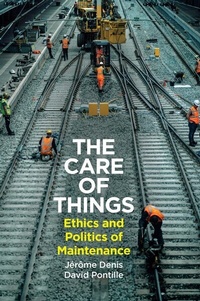
The Care of Things
Description

This book disrupts our dominant narratives by putting those individuals skilled in the art of maintenance front and centre. Jérôme Denis and David Pontille shine a spotlight on the subtle aspects of caring for things, tracing the stories of those involved and, with them, the ethical challenges raised and political lessons learned. These people demonstrate a sensitivity and attentiveness to fragility; they encourage us to cultivate a material diplomacy in which wear is accepted and our relation to things becomes a matter of negotiation and compromise - a far cry from the frenetic rhythm of planned obsolescence inherent in hyper-consumerism. Maintenance demarcates the contours of a world in which we have relinquished the human longing for unlimited power and technological autonomy, a world where our attachment to things is more profound than we ever imagined.
More details
Other editions
Additional editions
Persons
Jérôme Denis is Professor of Sociology at Mines Paris-PSL.
David Pontille is Director of Research at CNRS.
Content
Introduction
The art of making things last
A transfer of attention
The vocabulary of humans and things
Pathways
Chapter 1: Maintaining
Beyond innovation
Repair and breakdown
A daily pulsation
Neither heroes nor heroines
Reassigning attention
Chapter 2: Fragilities
Societies repopulated with objects
The diplomacy of wear and tear
Care and things
Chapter 3: Attention
Displacements
Multisensoriality
Expertise
Vigilance
Attachments
Chapter 4: Encounters
Recalcitrance
Disassembly
Transformations
Worries
The dance of maintenance
Chapter 5: Time
Prolongation
Permanence
Slowing down
Stubbornness
From time to thing
Chapter 6: Tact
Adjustments
Surprises
Heritage diplomacies
Pathways inspired by environmental ethics
Ethics and the care of things
Chapter 7: Conflicts
Shortening the life of goods
The values of duration
The emancipation of use
Redistributed knowledge
The people of things
Responsibilities
Conclusion
Notes
Index
1
Maintaining
On 20 July 1973, Mierle Laderman Ukeles was invited to the Wadworth Atheneum in Hartford, Connecticut, to stage her very first performance, entitled Transfer: The Maintenance of the Art Object: Mummy Maintenance: With the Maintenance Man, the Maintenance Artist, and the Museum Conservator. As the title suggests, Ukeles was not alone. Inaugurating a long series of collaborative works, she invited one of the institution's curators as well as one of its maintenance staff. At the centre of the performance was a work already on exhibition in the museum - an Egyptian mummy on loan from the Metropolitan Museum of Art - around which the three protagonists played their parts. Less than the mummy itself, it was its display case which was at the heart of the operation, with spectators being encouraged to pay attention to the special care it received. The performance was organized in three distinct moments. It began with the cleaning of the display case by the maintenance worker, who carried it out as he had done every day since the work had entered the museum. A maintenance task like any other - quite routine. Secondly, the worker's gestures were repeated identically by Ukeles, who had carefully observed them. This second phase ended with the affixing of a stamp to the display case, inscribing the expression 'Maintenance Art Work' in ink. In a gesture directly inspired by the work of Marcel Duchamp, the operation transformed the impeccably clean surfaces of the display case into proof that the work of cleaning was itself a work of art. The curator was then obliged to authenticate it and write a 'condition report' for the display case. Above all, he became the only person authorized to carry out future cleaning operations. Now handled by a curator, the actions carried out by the maintenance worker, and then by Ukeles, had thus changed their status. Maintenance had shifted into the realm of art.
The performance, a first opportunity for Ukeles to put to the test the principles of her manifesto for maintenance art,1 had a considerable impact and marked a time of profound upheaval in conceptual art. What was she doing, exactly? How did she help to transform the gaze of the spectators, but also that of artistic institutions themselves? The implications of this 'transfer' are numerous, but one central point in Ukeles' work is particularly salient here, and deserves our attention. By making maintenance an art, Ukeles strives to highlight the 'reproductive work' that is usually left aside, remaining in the shadows of exhibitions, reserved for spaces and times from which the public is absent. Simultaneously, she seeks to unravel the obviousness of the creative gesture and to undermine the separation between the two forms of action, one highlighted in the name of originality, the other devalued because it is ordinary, a matter of mere continuity.
She has also explained on several occasions that her conceptual work was particularly inspired by her husband's experience in the urban planning department of New York City. In the official planning documents, she had in fact discovered that the management of the city, in particular its financing, was organized around a very clear differentiation between what fell under 'development' on the one hand, being valued and encouraged, and what related to maintenance on the other, generally reserved for professions that had little prestige in terms either of salary or of public recognition. This difference still largely structures the life of private and public institutions nowadays, right down to their accounting systems, which separate investment expenditure (strongly encouraged) from operating expenditure (subject to significant constraints). It was by identifying the parallel between this accountancy-based distinction and the obvious hierarchy at work in her own professional world that Ukeles decided to systematize the critique and practical deconstruction of the latter. How can we make art by moving away from the model of the individual inventor and his or her disruptive act? How can we make the actions of those who safeguard the material conditions of art a form of art in themselves, in a world where only what 'makes a difference' seems to matter?
Beyond innovation
Initiated in the early 1970s, this radical de-centring of the gaze is still relevant today. It seems even more urgent. In a world saturated with hymns to novelty and inspiration, where innovation is elevated to the level of a quasi-religion, claiming to have an interest in the multitude of interventions that simply aim to make things last is almost a militant act. In the United States, it is precisely in this respect that interdisciplinary reflection in and on the community of 'Maintainers' has been organized for several years. Its initiators, Andrew Russell and Lee Vinsel, two specialists in the history of computing, have published a series of columns in which they directly associate the need to worry about maintenance and maintainers with a questioning of the obsession with innovation and innovators, an obsession found both in the general press and in specialized publications and a large proportion of academic studies relating to different technologies. The title of their recent book on this issue - The Innovation Delusion - could not be more explicit: recognition of the importance of maintenance activities fuels a head-on critique of the political and economic positions that lead to innovation becoming the sole driving force of contemporary societies.2
At a time when the vocabulary of disruption has become essential in capitalist morality, directing our gaze towards maintenance thus consists of reversing the hierarchy of themes and foregrounding what constitutes continuity. As in art, where a vast series of maintenance activities makes possible the very existence of a creative gesture valued as individual and unique, the disruptive effects attributed to the geniuses of innovation could not see the light of day unless a considerable number of things remained unchanged, first and foremost the complex infrastructures that provide a reliable basis for mobility, telecommunications and the production and distribution of energy. The ability of these things to last, and the fact that everyone (including 'innovators') can rely on their stability, depends on countless operations dedicated to preventing other forms of undesirable disruption from occurring.
Refusing to establish creation and innovation as overarching moral values also changes the situation in terms of the type of objects in which we may be interested. By considering the cleaning activity of the museum maintenance worker, we realize, for example, that the display case, an essential element in the refined presentation of modern artistic institutions, plays an important role in the very existence of the mummy as exhibited to the public eye. It also becomes clear that the cleanliness of this display case, and therefore its transparency, must not be taken for granted.
The operation can be generalized. As soon as we take an interest in the thousand maintenance operations that punctuate our ordinary lives, a multitude of artefacts appear on the surface of the world. Just as display cases were not present in art history books in 1973, those ordinary objects are absent from the frescoes of modernity which describe technical progress and extol the merits of innovation by focusing on a very small sample of exemplary artefacts. Perhaps even more than the quantity of objects to which maintenance encourages us to pay attention, it is their condition that matters. In a regime of permanent innovation, the material and technological world, as described even in the daily press, is populated by artefacts with ever more complex functionalities, with their refined design and perfect appearance; but garages, repair workshops, car parks, cellars and gardens where one form or another of maintenance is carried out on a daily basis are occupied by banal and sometimes frankly rudimentary objects that are often obsolete in technical terms. Above all, these places are full of worn-out objects which bear the traces of what has sometimes been an already long life. If there is one essential thing that maintenance teaches us, or rather reminds us of, it is that we live surrounded by old trinkets which we continue to use most of the time without this causing any problem. The technical environment in which we operate does not have the brightness of the modernist pictures painted by those who, all year round, harp on the virtues of innovative technologies. Many of the objects composing this environment are old, their surfaces tarnished and scratched, not all functioning properly. And there's nothing dramatic about all this - quite the contrary.
It is probably the historian David Edgerton who best described the consequences of this repopulation of artefacts, notably on the occasion of the 2006 publication of his book The Shock of the Old.3 The obsession with the idea of innovation is in fact much more than a bad habit adopted by suggestible journalists, or an abstruse stratagem repeated throughout PowerPoint presentations and posts on LinkedIn by self-proclaimed specialists. For years it has nourished the history of technology as such, most descriptions of which are guided by a sort of premium on novelty which marginalizes a myriad of objects whose material properties and uses are nevertheless crucial to understanding the contrasting evolution of the place of...
