

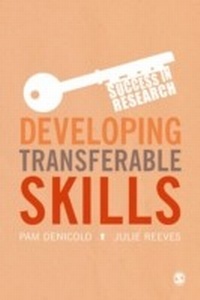
Developing Transferable Skills
Enhancing Your Research and Employment Potential
1st Edition
Published on 14. November 2013
184 pages
978-1-4462-9265-5 (ISBN)
Description

Succinct and supportive, this book provides doctoral and early career researchers with everything you need to know about developing marketable, transferrable skills-and how they can lead to getting that dream job.
It illustrates exactly how and when your doctoral degree can be used to build your employability skills in both academic and professional contexts and sets out the basics of acquiring these key transferable skills. Featuring easy-to-implement advice on constructing specialist and generic professional attributes, it gives you the tools, confidence, and active self-awareness needed to handle career challenges and convince prospective employers of your experience.
With coverage of project management, teamworking, communication, leadership and technical training, it is an essential guide for researchers who want to make the most of the skills you already have and to develop the skills you need.
About the series
The Success in Research series, from Cindy Becker and Pam Denicolo, provides short, authoritative and accessible guides on key areas of professional and research development.
Avoiding jargon and cutting to the chase of what you really need to know, these practical and supportive books cover a range of areas from presenting research to achieving impact, and from publishing journal articles to developing proposals. They are essential reading for any student or researcher interested in developing their skills and broadening their professional and methodological knowledge in an academic context.
It illustrates exactly how and when your doctoral degree can be used to build your employability skills in both academic and professional contexts and sets out the basics of acquiring these key transferable skills. Featuring easy-to-implement advice on constructing specialist and generic professional attributes, it gives you the tools, confidence, and active self-awareness needed to handle career challenges and convince prospective employers of your experience.
With coverage of project management, teamworking, communication, leadership and technical training, it is an essential guide for researchers who want to make the most of the skills you already have and to develop the skills you need.
About the series
The Success in Research series, from Cindy Becker and Pam Denicolo, provides short, authoritative and accessible guides on key areas of professional and research development.
Avoiding jargon and cutting to the chase of what you really need to know, these practical and supportive books cover a range of areas from presenting research to achieving impact, and from publishing journal articles to developing proposals. They are essential reading for any student or researcher interested in developing their skills and broadening their professional and methodological knowledge in an academic context.
Reviews / Votes
'PhD students and young researchers increasingly find employment outside the world of education. This book is an excellent guide to the skills they will need as they make that move.' -- Professor Nigel Vincent, FBA, Professor Emeritus of General & Romance Linguistics, The University of Manchester and Vice-President for Research & HE Policy, The British Academy 'Researchers are much more likely to focus on improving their research and research outputs, and not on improving their capabilities and performance as a researcher. This book encourages researchers to make this 'Gestalt' change in perspective. It takes researchers through the reflective process of identifying, developing, evaluating and understanding the transferability of their capabilities as a researcher.Researchers are usually effective in communicating their research to others - although less so to a 'lay' audience. All too often they are not skilled at articulating their capabilities as a researcher. The ability to do this is increasingly necessary, particularly to potential employers outside higher education where the majority of researchers will eventually work.
This is a highly-readable comprehensive book on transferable skills and speaks directly to individual researchers. Its content, layout and style encourages both full emersion and dipping into individual chapters and activities. Chapters four, five and six are particularly useful for readers new to the research process. The later chapters will be invaluable in helping researchers to reflect on their career development and employability. This book should be required reading for researchers embarking on a research career, particularly those on doctoral training programmes, and academics in their roles as supervisors or managers of researchers. Those responsible for providing development opportunities for researchers will also find much of value in the content of this book.' -- Dr Janet Metcalfe, Chair and Head 'The expertise and insights from experienced researchers contained in this book will encourage ECRs and PGRs to understand, reflect on and analyse the breadth and depth of the skills, attributes and behaviours they are acquiring. As a careers adviser this book will add to the resources I can use in my work with these two groups as they develop and manage careers inside and outside academia.' -- Clare Jones, Senior Careers Adviser
More details
Series
Edition
1. Auflage
Language
English
Place of publication
London
United Kingdom
Target group
College/higher education
Product notice
Reflowable
ISBN-13
978-1-4462-9265-5 (9781446292655)
Copyright in bibliographic data and cover images is held by Nielsen Book Services Limited or by the publishers or by their respective licensors: all rights reserved.
Schweitzer Classification
Other editions
Additional editions
Pam Denicolo | Julie Reeves
Developing Transferable Skills
Enhancing Your Research and Employment Potential
Book
11/2013
1st Edition
SAGE Publications Ltd
€62.10
Shipment within 15-20 days
Pam Denicolo | Julie Reeves
Developing Transferable Skills
Enhancing Your Research and Employment Potential
Book
11/2013
1st Edition
SAGE Publications Ltd
€144.10
Article exhausted; check different version
Persons
Working across a range of disciplines (Psychology, Health & Social Care and Pharmacy), Pam Denicolo, a Professor Emerita from the University of Reading, a Fellow of the Academy of Social Sciences, and an Honorary Member of the Royal Pharmaceutical Society, has wide-ranging experience both of using a range of research approaches and methods and of teaching how to use them well to a broad range of students and professionals world-wide. She has served on executive boards and committees of national and international learned societies and organisations devoted to research and teaching. She continues to publish widely student support materials, books, and journal articles on research because she remains passionately committed to mentoring and coaching newer researchers and academics.
Dr Julie Reeves is a Researcher Developer/Senior Teaching Fellow at the University of Southampton, and a Co-Investigator with a GCRF funded project, BRECcIA, leading the Capacity development work package. She has been involved in researcher development since 2002, working with the Civic Education Project in Belarus and Ukraine, and then as the Skills Training Manager, Faculty of Humanities, University of Manchester. She was a key researcher and contributor to the Vitae 'Researcher Development Statement and Framework' and is a Vitae Researcher Developer Senior Fellow. She is a member of the Chartered Institute of Personnel Development, a co-convenor of the Postgraduate Issues Network within the Society for Research into Higher Education, and currently facilitates the South East Researcher Developers network. She is a co-editor of the SAGE Success in Research series with Pam Denicolo, Dawn Duke and Alison Yeung.
Dr Julie Reeves is a Researcher Developer/Senior Teaching Fellow at the University of Southampton, and a Co-Investigator with a GCRF funded project, BRECcIA, leading the Capacity development work package. She has been involved in researcher development since 2002, working with the Civic Education Project in Belarus and Ukraine, and then as the Skills Training Manager, Faculty of Humanities, University of Manchester. She was a key researcher and contributor to the Vitae 'Researcher Development Statement and Framework' and is a Vitae Researcher Developer Senior Fellow. She is a member of the Chartered Institute of Personnel Development, a co-convenor of the Postgraduate Issues Network within the Society for Research into Higher Education, and currently facilitates the South East Researcher Developers network. She is a co-editor of the SAGE Success in Research series with Pam Denicolo, Dawn Duke and Alison Yeung.
Content
What Are Transferable Skills and Why They Are Needed?
How Can Researchers Identify Which Transferable Skills Are Needed?
How Can Transferable Skills Be Acquired?
What Are the Key Intellectual Skills Directly Related to Research?
What Skills Are Involved In Dealing With Information And With Maintaining Integrity As A Researcher?
What Are The Key Practical Research Project Skills?
What Are The Key People Skills And Personal Attributes?
How Can Skill Development Be Evidenced, Assessed And Evaluated?
How Can Transferable Skills Be Marketed Effectively To Enhance Employability? (Dawn Duke)
How Can Researchers Make A Successful Transition To Another Employment?
How Can Transferable Skills Become An Integral Part Of Life?
Appendix 1: Joint Statement Skills (JSS)
Appendix 2: Development Cycle Diagram
Appendix 3: Summary Diagram Of The Researcher Development Framework
Appendix 4: Employability Skills Questionnaire
Glossary Of Terms
Index
How Can Researchers Identify Which Transferable Skills Are Needed?
How Can Transferable Skills Be Acquired?
What Are the Key Intellectual Skills Directly Related to Research?
What Skills Are Involved In Dealing With Information And With Maintaining Integrity As A Researcher?
What Are The Key Practical Research Project Skills?
What Are The Key People Skills And Personal Attributes?
How Can Skill Development Be Evidenced, Assessed And Evaluated?
How Can Transferable Skills Be Marketed Effectively To Enhance Employability? (Dawn Duke)
How Can Researchers Make A Successful Transition To Another Employment?
How Can Transferable Skills Become An Integral Part Of Life?
Appendix 1: Joint Statement Skills (JSS)
Appendix 2: Development Cycle Diagram
Appendix 3: Summary Diagram Of The Researcher Development Framework
Appendix 4: Employability Skills Questionnaire
Glossary Of Terms
Index
