

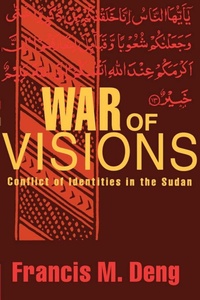
War of Visions
Conflict of Identities in the Sudan
1st Edition
Published on 1. October 2011
592 pages
978-0-8157-2369-1 (ISBN)
Description

The civil war that has intermittently raged in the Sudan since independence in 1956 is, according to Francis Deng, a conflict of contrasting and seemingly incompatible identities in the Northern and Southern parts of the country. Identity is seen as a function of how people identify themselves and are identified in racial, ethnic, cultural, linguistic, and religious terms. The identity question related to how such concepts determine or influence participation and distribution in the political, economic, social, and cultural life of the country.
War of Visions aims at shedding light on the anomalies of the identity conflict. The competing models in the Sudan are the Arab-Islamic mold of the North, representing two-thirds of the country in territory and population, and the remaining Southern third, which is indigenously African in race, ethnicity, culture, and religion, with an educated Christianized elite. But although the North is popularly defined as racially Arab, the people are a hybrid of Arab and African elements, with the African physical characteristics predominating in most tribal groups.
This configuration is the result of a historical process that stratified races, cultures, and religions, and fostered a ""passing"" into the Arab-Islamic mold that discriminated against the African race and cultures. The outcome of this process is a polarization that is based more on myth than on the realities of the situation. The identity crisis has been further complicated by the fact that Northerners want to fashion the country on the basis of their Arab- Islamic identity, while the South is decidedly resistant.
Francis Deng presents three alternative approaches to the identity crisis. First, he argues that by bringing to the surface the realities of the African elements of identity in the North-- thereby revealing characteristics shared by all Sudanese--a new basis for the creation of a common identity could be established that fosters equitable
More details
Edition
1. Auflage
Language
English
Place of publication
New York
United States
Publishing group
Bloomsbury Publishing Plc
ISBN-13
978-0-8157-2369-1 (9780815723691)
Copyright in bibliographic data and cover images is held by Nielsen Book Services Limited or by the publishers or by their respective licensors: all rights reserved.
Schweitzer Classification
Other editions
Additional editions
Book
08/1995
Brookings Institution
€52.50
Article exhausted; check different version
Person
Francis M. Deng is a nonresident senior fellow in the Foreign Policy Studies program at the Brookings Institution and co-director of the Brookings-SAIS Project on Internal Displacement. He has served as the Sudan's minister of state and foreign affairs; as its ambassador to Canada, the United States, and Scandinavia; and as special representative of the United Nations secretary-general for internally displaced persons.
Content
- Cover
- Contents
- Introduction
- Part One: Background
- 1 Overview of the Conflict
- Part Two: Evolution of Identities
- 2 Northern Identity: Assimilation
- 3 Southern Identity: Resistance
- Part Three: Quest for Nationhood
- 4 Genesis of Divided Nationalism
- 5 Northern Dominance: Colonialism Revisited
- 6 The Emerging Southern Identity
- Part Four: North-South Microcosm
- 7 The Ngok Dinka
- 8 Crisis at the Crossroads
- Part Five: External Dimension
- 9 Dilemmas of External Linkages
- Part Six: The Crisis in Perspective
- 10 Boundaries of Identity
- 11 Perceptions of the Crisis
- 12 Conclusions
- Notes
- Index
- A
- B
- C
- D
- E
- F
- G
- H
- I
- J
- K
- L
- M
- N
- O
- P
- Q
- R
- S
- T
- U
- V
- W
- Y
- Z
