

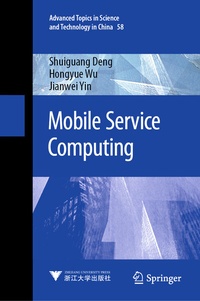
Mobile Service Computing
Description

This book introduces readers to the background and principles of mobile service computing. It discusses various aspects of service computing in mobile environments, including key methods and techniques for service selection, recommendation, composition, offloading, execution, deployment, and provision.
More details
Other editions
Additional editions
Persons
Shuiguang Deng is a Full Professor at the College of Computer Science and Technology, Zhejiang University. He received his B.S. and Ph.D. in Computer Science from Zhejiang University in 2002 and 2007, respectively. He was a Visiting Scholar at Massachusetts Institute of Technology (MIT) in 2014 and at Stanford University in 2015. His research interests include service computing, edge computing, and business process management. Prof. Deng has published more than 100 papers in journals such as IEEE TOC, TPDS, TSC, TCYB, and TNNLS and in peer-reviewed conference proceedings. He is an Associate Editor of the journals IET Cyber-Physical Systems: Theory & Applications and IEEE Access; a Fellow of the IET; and a Senior Member of the IEEE.
Hongyue Wu is an Assistant Professor at the College of Intelligence and Computing, Tianjin University. After having been a joint Ph.D. student at the University of Sydney from 2017 to 2018, he received his Ph.D. from Zhejiang University in 2018. His research interests include service computing, mobile edge computing, and cloud computing. He has published more than 10 papers and won the Best Paper Award at the ICSOC 2017.
Jianwei Yin holds a Ph.D. degree from Zhejiang University, China, where he is currently a Full Professor at the College of Computer Science and Technology. His current research interests include cloud computing, performance evaluation, service computing and middleware. He has published more than 120 research papers in major, peer-reviewed, international journals and conference proceedings, and is an Associate Editor of the journal IEEE Transactions on Services Computing.
Content
Chapter 1 Overview.- Chapter 2 Mobile Service Computing: Opportunities and Challenges.- Chapter 3 Mobile Service Selection.- Chapter 4 Mobile Service Recommendation.- Chapter 5 Mobile Service Composition.- Chapter 6 Mobile Service Deployment.- Chapter 7 Mobile Service Computation Offloading.- Chapter 8 Mobile Service Provisioning.
