

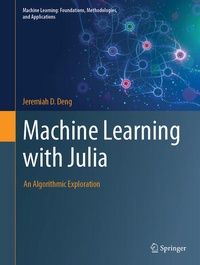
Machine Learning with Julia
Description

This textbook offers a comprehensive and accessible introduction to machine learning with the Julia programming language. It bridges mathematical theory and real-world practice, guiding readers through both foundational concepts and advanced algorithms. Covering topics from essential principles like Kullback-Leibler divergence and eigen-analysis to cutting-edge techniques such as deep transfer learning and differential privacy, each chapter delivers clear explanations and detailed algorithmic treatments. Sample code accompanies every major topic, enabling hands-on learning and faster implementation.
By leveraging Julia's powerful machine learning ecosystem-including libraries such as Flux.jl, MLJ.jl, and more-this book empowers readers to build robust, state-of-the-art machine learning models.
Ideal for students, researchers, and professionals alike, this textbook is designed for those seeking a solid theoretical foundation in machine learning, along with deep algorithmic insight and practical problem-solving inspiration.
More details
Other editions
Additional editions
Person
Jeremiah D. Deng is an associate professor in School of Computing at University of Otago, New Zealand. His research interests include pattern recognition, machine learning, and stochastic optimization. He has published at top-tier venues such as PR, NN, TC, TEC, TKDE, TBE, and IJCAI, and serves on the editorial boards of Pattern Analysis and Applications (Springer) and ICT Express (Elsevier) and on the program committees of various AI conferences. Dr. Deng completed his PhD in computer science at University of Hong Kong and South China University of Technology, and has held visiting and adjunct positions at University of Adelaide and South China University of Technology. He is a Senior Member of both IEEE and ACM.
Content
Introduction.- Metrics and Divergences.- Clustering.- Online Clustering.- Dimension Reduction.- Bayesian classification.- Support Vector Machines = Linear Machines + Kernels.- Tree and Forest: Divide-and-Conquer.- Regression and Model Selection.- Ensemble Methods.- Neural networks.- Convolutional neural networks.- Autoencoders.- Generative adversarial networks.- Transfer Learning.- Federated Learning.
