

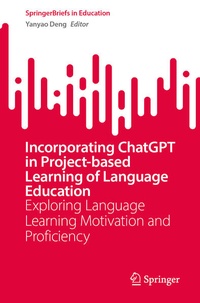
Incorporating ChatGPT in Project-Based Learning of Language Education
Description

This book explores the enhancement of motivation and proficiency in language teaching and learning by integrating ChatGPT into a project-based learning (PBL) method. It presents empirical evidence and case studies that demonstrate the benefits of, and challenges in, using ChatGPT in PBL methods in language education. This book serves as a valuable reference which provides educators, researchers, and policymakers with comprehensive insights into how integrating ChatGPT, an artificial intelligence (AI) language model, into project-based learning (PBL) teaching methodologies can enhance language education.
More details
Other editions
Additional editions
Person
Yanyao Deng, PhD, is a researcher and scholar with a diverse background spanning education, technology, and linguistics. Holding a master's degree and a PhD in Education from the University of Exeter (United Kingdom), she also obtained a master's degree in educational technology from Beijing Institute of Technology (China). Her research expertise lies in project-based learning and innovative technologies in engineering and language education, which has been showcased through academic publications and conference presentations. She is also passionate about exploring various technology applications such as ChatGPT and other Artificial Intelligence technologies to enhance education.
Content
Preface.- 1. Introduction of ChatGPT in project-based language education.- 1.1 Overview of PBL in Language Education.- 1.2 Introduction to ChatGPT: Capabilities and Applications in language education.- 1.3 Integration of ChatGPT in Project-Based language education.- 2. Designing Effective PBL Activities with ChatGPT.- 2.1 Teachers' Artificial Intelligence (AI) in PBL Designing in Language Education.- 2.2 Impacts on Students' Language Learning Motivation and strategies.- 2.3 Enhancing Language Proficiency through ChatGPT Integration.- 3. Real World Practice and Applications in multiple education phases.- 3.1 Cases in K-12 education.- 3.2 Cases in Higher education.- 4. Challenges and Solutions in Implementation.- 4.1 Existing challenges and possible solutions.- 4.2 Conclusion and limitations.- 5. Future trends and recommendations.- 5.1 Future Trends and Implications for Language Education.- 5.2 Summary of Key Findings and Recommendations.
