

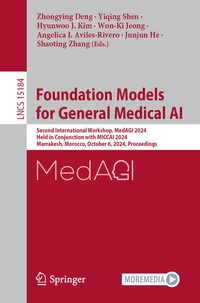
Foundation Models for General Medical AI
Description

This book constitutes the refereed proceedings from the Second International Workshop on Foundation Models for General Medical AI, MedAGI 2024, held in conjunction with the 27th International conference on Medical Image Computing and Computer Assisted Intervention, MICCAI 2024, in Marrakesh, Morocco in October 2024.
The 17 papers included in this book were carefully reviewed and selected from 26 submissions. These papers provide insights into the current landscape of medical AI and foundation models, that can pave the way for the evolution of task-specific medical AI systems into more generalized frameworks capable of tackling a diverse range of tasks, datasets, and domains.
More details
Other editions
Additional editions
Content
.- FastSAM-3DSlicer: A 3D-Slicer Extension for 3D Volumetric Segment Anything Model with Uncertainty Quantification.
.- The Importance of Downstream Networks in Digital Pathology Foundation Models.
.- Temporal-spatial Adaptation of Promptable SAM Enhance Accuracy and Generalizability of cine CMR Segmentation.
.- Navigating Data Scarcity using Foundation Models: A Benchmark of Few-Shot and Zero-Shot Learning Approaches in Medical Imaging.
.- AutoEncoder-Based Feature Transformation with Multiple Foundation Models in Computational Pathology.
.- OSATTA: One-Shot Automatic Test Time Augmentation for Domain Adaptation.
.- Automating MedSAM by Learning Prompts with Weak Few-Shot Supervision.
.- SAT-Morph: Unsupervised Deformable Medical Image Registration using Vision Foundation Models with Anatomically Aware Text Prompt.
.- Promptable Counterfactual Diffusion Model for Unified Brain Tumor Segmentation and Generation with MRIs.
.- D- Rax: Domain-specific Radiologic assistant leveraging multi-modal data and eXpert model predictions.
.- Optimal Prompting in SAM for Few-Shot and Weakly Supervised Medical Image Segmentation.
.- UniCrossAdapter: Multimodal Adaptation of CLIP for Radiology Report Generation.
.- TUMSyn: A Text-Guided Generalist model for Customized Multimodal MR Image Synthesis.
.- SAMU: An Efficient and Promptable Foundation Model for Medical Image Segmentation.
.- Anatomical Embedding-Based Training Method for Medical Image Segmentation Foundation Models.
.- Boosting Vision-Language Models for Histopathology Classification: Predict all at once.
.- MAGDA: Multi-agent guideline-driven diagnostic assistance.
