

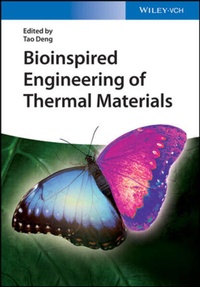
Bioinspired Engineering of Thermal Materials
Description

Following an introduction to different thermal materials and their effective heat transfer to other materials, the text discusses heat detection materials that are inspired by biological systems, such as fire beetles and butterflies. There then follow descriptions of materials with thermal management functionality, including those for evaporation and condensation, heat transfer and thermal insulation materials, as modeled on snake skins, polar bears and fire-resistant trees. A discussion of thermoresponsive materials with thermally switchable surfaces and controllable nanochannels as well as those with high thermal conductivity and piezoelectric sensors is rounded off by a look toward future trends in the bioinspired engineering of thermal materials.
Straightforward and well structured, this is an essential reference for newcomers as well as experienced researchers in this exciting field.
More details
Other editions
Additional editions
Person
Professor Deng has authored more than 50 external publications, 60 GE internal technical reports and holds 40 patents. He is the recipient of the Guo Moruo President award at the University of Science and Technology of China and numerous GE's technical and patent awards. In 2011, he was selected as one of the top 100 young engineers to participate in the US National Academy of Engineering's Frontiers of Engineering Symposium.
Content
Thermal Function of Materials
Thermal Function of Biological Systems
Bioinspired Thermal Materials
THERMAL DETECTION MATERIALS INSPIRED BY BIOLOGICAL SYSTEMS
Thermal Detection Inspired by Fire Beetles
Thermal Detection Inspired by Butterflies
Thermal Detection Inspired by Other Biological Systems
THERMAL MANAGEMENT MATERIALS INSPIRED BY BIOLOGICAL SYSTEMS
Materials for Evaporation Heat Transfer
Materials for Condensation Heat Transfer
Thermal Regulation Materials Inspired by Snake Skins
Bioinspired Thermal Regulation Materials for Smart Windows
THERMAL INSULATION MATERIALS INSPIRED BY BIOLOGICAL SYSTEMS
Thermal Insulation Materials Inspired by Polar Bears
Thermal Insulation Materials Inspired by Fire-Resistant Trees
Thermal Insulation Materials Inspired by Silkworm Cocoon
THERMALLY RESPONSIVE MATERIALS INSPIRED BY BIOLOGICAL SYSTEMS
Bioinpired Thermally Switchable Surfaces
Bioinspired Thermally Controllable Nanochannels
Thermally Triggered Bioinspired Drug Delivery Vessels
OTHER THERMAL MATERIALS INSPIRED BY BIOLOGICAL SYSTEMS
Bioinspired Materials with High Thermal Conductivity
Bioinspired Materials for Optical-Thermal Conversion
Bioinspired Thermal Fluid
Bioinspired Piezoelectric Sensors
CONCLUDING REMARKS AND FUTURE TRENDS IN BIOINSPIRED ENGINEERING OF THERMAL MATERIALS
Chapter 1
Introduction to Thermal Properties of Materials
Rui Feng and Chengyi Song
State Key Laboratory of Metal Matrix Composites, School of Materials Science and Engineering, Shanghai Jiao Tong University, 800 Dongchuan Road, Shanghai, 200240, P. R. China
This introductory chapter encompasses the basic principles and calculation methods for the heat transfer process and the advanced thermal properties. Various thermal applications of bioinspired functional materials will also be briefly discussed. To elucidate the basic principles of thermal theory, several analytical examples involving heat source and boundary conditions, uniform and nonuniform mesh structures, multiphase transfer, phase change, and convection in fluidic cases are also described. Noticing that micro/nanoscale materials exhibit unique thermal properties in modern materials scientific research, in this chapter the new developments in micro/nanoscale heat transfer theory are also discussed and some of the theoretic solutions drawn in calculating the thermal conductivity of micro/nanomaterials are shown. Biological systems set numerous examples in teaching humans how to collect, convert, and harness thermal energy from nature. In the last section of this chapter, practical approaches are discussed in an overview of bioinspired thermal materials. Typical thermal applications of functional materials (e.g., thermal nanofluids such as nanosuspension of colloidal particles in solution, the rapid charging of thermal energy storage, the phase change energy conversion by photothermal membrane, and the sensing of infrared radiation by bioinspired materials) are presented to show how the modern conventional and micro/nano heat transfer theory is related to advanced thermal functions of bioinspired materials.
1.1 Conventional Macroscale Heat Transfer
Heat transfer forms a vital kinetic force in the maintenance of the basic energy operation of the whole natural system for the activities of all the creatures on earth. As an engineering discipline, the inherent laws of heat transfer do not merely explain the way of energy transportation but also deal with the thermodynamics of both objects and the equilibrium principle under specified conditions. Fundamental learning of the equilibrium principle is provided by the first and second laws of thermodynamics, and follows the classic mechanics of conduction, convection, and radiation. In the following sections, the conduction, convection, and radiation of macroscale heat transfer problems will be shown and the working principles formulated by energy equations. In thermal physics and engineering problems, we use critical quantitative criteria to characterize the thermal properties of material. These thermal properties are modified as representations of thermal energy transportation and energy conservation models, and can be used to analytically or numerically solve problems in thermal engineering and nature. Therefore, in the following sections, the basic principles of thermal transfer will be introduced first through a discussion of the thermal energy transportation and energy conservation models.
1.1.1 Normalization
To describe the process of heat transfer based on quantitative criteria, the primary quantities involved in a thermal process are listed in Table 1.1 and the quantitative criteria of thermal process are derived by these basic units. For analyzing much more complicated situations, the units of some derived quantities in Table 1.2 are defined as scientific descriptions of thermal properties of materials. Especially in numerical calculations and study of material heat transfer models, these derived units such as specific heat capacity Cp, thermal conductivity ?, heat flux q and thermal diffusivity a in thermodynamics cases will facilitate the systematic learning and understanding of the details of heat transfer.
Table 1.1 Basic parameter units
Primary quantity Parameter Length L (m) Time t (s) Mass m (kg) Temperature T (°C or K) Current Je (A)Table 1.2 Parameter units driven by the primary quantities in Table 1.1
Driven quantity Parameter Specific heat capacity Cp (J/kg K) Energy E (J or N m) Force F (N m/s2) Electric charge C (coulomb or A s) Thermal conductivity k (W/m k) Pressure p (Pa or N/m2) Heat flux q (W/m2) Heat efficiency Q (W or J/s) Velocity V (m/s) Viscosity µ (Pa s) Density A ? (kg/m3) Potential F (V or W/A or J/C)In developing and judging thermal properties of new materials, normalizing the units of critical parameters may help us to better learn and understand different thermal properties.
1.1.2 Thermal Equilibrium and Nonequilibrium
Thermal equilibrium and nonequilibrium are the descriptions of the energy state of a thermal system. In an isolated steady thermal system, the state of thermal equilibrium will become stable without any external energy input. Once higher/lower temperature occurs at a specific point of the system, local thermal nonequilibrium exists. Meanwhile, the temperature difference will force the thermal energy to be transported from a region with higher temperature to a region with lower temperature. The system will eventually be in an equilibrium state after a spontaneous transformation process. The process of turning nonequilibrium into equilibrium is dominated by temperature difference. The gradient of temperature difference triggers heat diffusion, which can be ascribed to thermal conduction, thermal convection, and thermal radiation. However, temperature difference in a system does not always dominate thermal energy transportation. Thermal energy transportation can also occur in some cases of nonequilibrium heat transfer including phase change and chemical exothermic reaction or chemical endothermic reaction. The kinetic driving forces in these cases are latent heat and chemical energy. Therefore, the thermal nonequilibrium of a system should be described as the nonequilibrium of energy states to some extent rather than the internal temperature differences.
1.1.3 Integral Structural Heat Transfer
Heat transfer in different media that is induced by thermal nonequilibrium may have different characteristics. The numerical analysis of heat transfer in the integral structure with control surface A and control volume V as boundary is defined as
1.1With this definition, a schematic of the outward, normal unit vector pointing out a control volume V and control surface A is shown in Figure 1.1a. The dot sn represents location of the per unit energy state (surface normal vector) on a differential surface area. By integrating the entire surface A, when q is parallel to the surface, the dot product of q and sn will become zero, which means no heat flows across the control surface. And if q is perpendicular to normal surface sn, the dot product will be maximum.
1.2Figure 1.1 Schematic graphs of heat conductance and transfer.
(Adapted from Kaviany 2011 [1].)
In Eq. (1.2), when the integration of the dot product is a positive quantity, heat flux flows out of the control surface; when it is negative, heat flux flows into the control surface. When a unit control volume owns a higher/lower energy state than its surrounding medium, the region with higher temperature will transport the thermal energy to a region with lower temperature. The total energy in control volume Q represents the sum of the energy integration of the surface area.
The heat flow through the control surface and volume is shown in Figure 1.1b [1], where a rectangular matter in Cartesian coordinate system receives inward energy from an external medium. The heat energy flow into this rectangular matter implies an increase in total energy. The transport of the heat shows the directional quantity, which can be expressed as a product of thermal conductivity and temperature divergence.
1.1.4 Control Volume and Interface
The boundaries of thermal system in the aforementioned model of a control volume and interface heat conductance will be studied and defined as limitation condition. Heat is forced to diffuse from a high-temperature point to a low-temperature point by local temperature nonequilibrium, and passes through the control interface into another medium. The boundaries of control surface can be at the interface (gas-liquid or liquid-solid interface) between two...
