

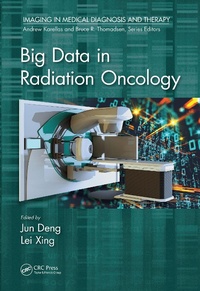
Big Data in Radiation Oncology
1st Edition
Published on 7. March 2019
310 pages
978-1-351-80112-6 (ISBN)
Description

Big Data in Radiation Oncology gives readers an in-depth look into how big data is having an impact on the clinical care of cancer patients. While basic principles and key analytical and processing techniques are introduced in the early chapters, the rest of the book turns to clinical applications, in particular for cancer registries, informatics, radiomics, radiogenomics, patient safety and quality of care, patient-reported outcomes, comparative effectiveness, treatment planning, and clinical decision-making. More features of the book are:
Offers the first focused treatment of the role of big data in the clinic and its impact on radiation therapy.
Covers applications in cancer registry, radiomics, patient safety, quality of care, treatment planning, decision making, and other key areas.
Discusses the fundamental principles and techniques for processing and analysis of big data.
Address the use of big data in cancer prevention, detection, prognosis, and management.
Provides practical guidance on implementation for clinicians and other stakeholders.
Dr. Jun Deng is a professor at the Department of Therapeutic Radiology of Yale University School of Medicine and an ABR board certified medical physicist at Yale-New Haven Hospital. He has received numerous honors and awards such as Fellow of Institute of Physics in 2004, AAPM Medical Physics Travel Grant in 2008, ASTRO IGRT Symposium Travel Grant in 2009, AAPM-IPEM Medical Physics Travel Grant in 2011, and Fellow of AAPM in 2013.
Lei Xing, Ph.D., is the Jacob Haimson Professor of Medical Physics and Director of Medical Physics Division of Radiation Oncology Department at Stanford University. His research has been focused on inverse treatment planning, tomographic image reconstruction, CT, optical and PET imaging instrumentations, image guided interventions, nanomedicine, and applications of molecular imaging in radiation oncology. Dr. Xing is on the editorial boards of a number of journals in radiation physics and medical imaging, and is recipient of numerous awards, including the American Cancer Society Research Scholar Award, The Whitaker Foundation Grant Award, and a Max Planck Institute Fellowship.
Offers the first focused treatment of the role of big data in the clinic and its impact on radiation therapy.
Covers applications in cancer registry, radiomics, patient safety, quality of care, treatment planning, decision making, and other key areas.
Discusses the fundamental principles and techniques for processing and analysis of big data.
Address the use of big data in cancer prevention, detection, prognosis, and management.
Provides practical guidance on implementation for clinicians and other stakeholders.
Dr. Jun Deng is a professor at the Department of Therapeutic Radiology of Yale University School of Medicine and an ABR board certified medical physicist at Yale-New Haven Hospital. He has received numerous honors and awards such as Fellow of Institute of Physics in 2004, AAPM Medical Physics Travel Grant in 2008, ASTRO IGRT Symposium Travel Grant in 2009, AAPM-IPEM Medical Physics Travel Grant in 2011, and Fellow of AAPM in 2013.
Lei Xing, Ph.D., is the Jacob Haimson Professor of Medical Physics and Director of Medical Physics Division of Radiation Oncology Department at Stanford University. His research has been focused on inverse treatment planning, tomographic image reconstruction, CT, optical and PET imaging instrumentations, image guided interventions, nanomedicine, and applications of molecular imaging in radiation oncology. Dr. Xing is on the editorial boards of a number of journals in radiation physics and medical imaging, and is recipient of numerous awards, including the American Cancer Society Research Scholar Award, The Whitaker Foundation Grant Award, and a Max Planck Institute Fellowship.
More details
Series
Edition
1. Auflage
Language
English
Place of publication
London
United Kingdom
Publishing group
Taylor & Francis Ltd
Target group
College/higher education
Illustrations
19 Tables, black and white; 70 Line drawings, black and white; 19 Halftones, black and white
File size
8,60 MB
ISBN-13
978-1-351-80112-6 (9781351801126)
Copyright in bibliographic data and cover images is held by Nielsen Book Services Limited or by the publishers or by their respective licensors: all rights reserved.
Schweitzer Classification
Other editions
Additional editions
Jun Deng | Lei Xing
Big Data in Radiation Oncology
Book
03/2021
1st Edition
CRC Press
€83.80
Shipment within 15-20 days
Jun Deng | Lei Xing
Big Data in Radiation Oncology
Book
03/2019
1st Edition
CRC Press
€250.60
Shipment within 10-20 days
Persons
Jun Deng, PhD, is a professor at the Department of Therapeutic Radiology of Yale University School of Medicine and an American Board of Radiology board-certified medical physicist at Yale New Haven Hospital. Dr. Deng obtained his PhD from the University of Virginia in 1998 and finished his postdoctoral fellowship at the Department of Radiation Oncology of Stanford University in 2001. Dr. Deng joined Yale University's Department of Therapeutic Radiology as a faculty physicist in 2001. Dr. Deng serves on the editorial boards of numerous peer-reviewed journals and has served on study sections of the NIH, DOD, ASTRO, and RSNA since 2005 and as a scientific reviewer for the European Science Foundation and the Dutch Cancer Society since 2015. Dr. Deng has received numerous honors and awards such as Fellow of Institute of Physics in 2004, AAPM Medical Physics Travel Grant in 2008, ASTRO IGRT Symposium Travel Grant in 2009, AAPM-IPEM Medical Physics Travel Grant in 2011, and Fellow of AAPM in 2013. At Yale, Dr. Deng's research has focused on big data, machine learning, artificial intelligence, and medical imaging for early cancer detection and prevention. In 2013, his group developed CT Gently (R), the world's first iPhone App that can be used to estimate organ doses and associated cancer risks from CT and CBCT scans. Recently, funded by an NIH R01 grant, his group has been developing a personal organ dose archive (PODA) system for personalized tracking of radiation doses in order to improve patient safety in radiation therapy.
Lei Xing, PhD, is currently the Jacob Haimson Professor of Medical Physics and Director of the Medical Physics Division of the Radiation Oncology Department of Stanford University. Dr. Xing obtained his PhD in Physics from the Johns Hopkins University in 1992 and received his Medical Physics training at the University of Chicago. He has been a member of the Radiation Oncology faculty at Stanford since 1997. He is also an affiliated faculty member in Stanford's Department of Electrical Engineering, the Biomedical Informatics Program, the Molecular Imaging Program at Stanford, and the Bio-X program. His research has focused on inverse treatment planning, tomographic image reconstruction, CT, optical and PET imaging instrumentations, image-guided interventions, nanomedicine, and applications of molecular imaging in radiation oncology. Dr. Xing is an author on more than 250 peer-reviewed publications, a co-inventor on many issued and pending patents, and a co-investigator or principal investigator on numerous NIH, DOD, NSF, and ACS grants and projects from other funding agencies and corporations. He and his lab members have received numerous awards from ACS, AAPM, ASTRO, WMIC, and RSNA in the past decade. Dr. Xing serves on the editorial boards of a number of journals in radiation physics and medical imaging and is a recipient of numerous awards, including the American Cancer Society Research Scholar Award, The Whitaker Foundation Grant Award, and a Max Planck Institute Fellowship.
Lei Xing, PhD, is currently the Jacob Haimson Professor of Medical Physics and Director of the Medical Physics Division of the Radiation Oncology Department of Stanford University. Dr. Xing obtained his PhD in Physics from the Johns Hopkins University in 1992 and received his Medical Physics training at the University of Chicago. He has been a member of the Radiation Oncology faculty at Stanford since 1997. He is also an affiliated faculty member in Stanford's Department of Electrical Engineering, the Biomedical Informatics Program, the Molecular Imaging Program at Stanford, and the Bio-X program. His research has focused on inverse treatment planning, tomographic image reconstruction, CT, optical and PET imaging instrumentations, image-guided interventions, nanomedicine, and applications of molecular imaging in radiation oncology. Dr. Xing is an author on more than 250 peer-reviewed publications, a co-inventor on many issued and pending patents, and a co-investigator or principal investigator on numerous NIH, DOD, NSF, and ACS grants and projects from other funding agencies and corporations. He and his lab members have received numerous awards from ACS, AAPM, ASTRO, WMIC, and RSNA in the past decade. Dr. Xing serves on the editorial boards of a number of journals in radiation physics and medical imaging and is a recipient of numerous awards, including the American Cancer Society Research Scholar Award, The Whitaker Foundation Grant Award, and a Max Planck Institute Fellowship.
Content
Series Preface
Preface
Acknowledgments
Editors
Contributors
1. Big data in radiation oncology: Opportunities and challenges
Jean-Emmanuel Bibault
2. Data standardization and informatics in radiation oncology
Charles S. Mayo
3. Storage and databases for big data
Tomas Skripcak, Uwe Just, Ida Schoenfeld, Esther G.C. Troost, and Mechthild Krause
4. Machine learning for radiation oncology
Yi Luo and Issam El Naqa
5. Cloud computing for big data
Sepideh Almasi and Guillem Pratx
6. Big data statistical methods for radiation oncology
Yu Jiang, Vojtech Huser, and Shuangge Ma
7. From model-driven to knowledge- and data-based treatment planning
Morteza Mardani, Yong Yang, Yinyi Ye, Stephen Boyd, and Lei Xing
8. Using big data to improve safety and quality in radiation oncology
Eric Ford, Alan Kalet, and Mark Phillips
9. Tracking organ doses for patient safety in radiation therapy
Wazir Muhammad, Ying Liang, Gregory R. Hart, Bradley J. Nartowt, David A. Roffman, and Jun Deng
10. Big data and comparative effectiveness research in radiation oncology
Sunil W. Dutta, Daniel M. Trifiletti, and Timothy N. Showalter
11. Cancer registry and big data exchange
Zhenwei Shi, Leonard Wee, and Andre Dekker
12. Clinical and cultural challenges of big data in radiation oncology
Brandon Dyer, Shyam Rao, Yi Rong, Chris Sherman, Mildred Cho, Cort Buchholz, and Stanley Benedict
13. Radiogenomics
Barry S. Rosenstein, Gaurav Pandey, Corey W. Speers, Jung Hun Oh, Catharine M.L. West, and Charles S. Mayo
14. Radiomics and quantitative imaging
Dennis Mackin and Laurence E. Court
15. Radiotherapy outcomes modeling in the big data era
Joseph O. Deasy, Aditya P. Apte, Maria Thor, Jeho Jeong, Aditi Iyer, Jung Hun Oh, and Andrew Jackson
16. Multi-parameterized models for early cancer detection and prevention
Gregory R. Hart, David A. Roffman, Ying Liang, Bradley J. Nartowt, Wazir Muhammad, and Jun Deng
Index
Preface
Acknowledgments
Editors
Contributors
1. Big data in radiation oncology: Opportunities and challenges
Jean-Emmanuel Bibault
2. Data standardization and informatics in radiation oncology
Charles S. Mayo
3. Storage and databases for big data
Tomas Skripcak, Uwe Just, Ida Schoenfeld, Esther G.C. Troost, and Mechthild Krause
4. Machine learning for radiation oncology
Yi Luo and Issam El Naqa
5. Cloud computing for big data
Sepideh Almasi and Guillem Pratx
6. Big data statistical methods for radiation oncology
Yu Jiang, Vojtech Huser, and Shuangge Ma
7. From model-driven to knowledge- and data-based treatment planning
Morteza Mardani, Yong Yang, Yinyi Ye, Stephen Boyd, and Lei Xing
8. Using big data to improve safety and quality in radiation oncology
Eric Ford, Alan Kalet, and Mark Phillips
9. Tracking organ doses for patient safety in radiation therapy
Wazir Muhammad, Ying Liang, Gregory R. Hart, Bradley J. Nartowt, David A. Roffman, and Jun Deng
10. Big data and comparative effectiveness research in radiation oncology
Sunil W. Dutta, Daniel M. Trifiletti, and Timothy N. Showalter
11. Cancer registry and big data exchange
Zhenwei Shi, Leonard Wee, and Andre Dekker
12. Clinical and cultural challenges of big data in radiation oncology
Brandon Dyer, Shyam Rao, Yi Rong, Chris Sherman, Mildred Cho, Cort Buchholz, and Stanley Benedict
13. Radiogenomics
Barry S. Rosenstein, Gaurav Pandey, Corey W. Speers, Jung Hun Oh, Catharine M.L. West, and Charles S. Mayo
14. Radiomics and quantitative imaging
Dennis Mackin and Laurence E. Court
15. Radiotherapy outcomes modeling in the big data era
Joseph O. Deasy, Aditya P. Apte, Maria Thor, Jeho Jeong, Aditi Iyer, Jung Hun Oh, and Andrew Jackson
16. Multi-parameterized models for early cancer detection and prevention
Gregory R. Hart, David A. Roffman, Ying Liang, Bradley J. Nartowt, Wazir Muhammad, and Jun Deng
Index
