
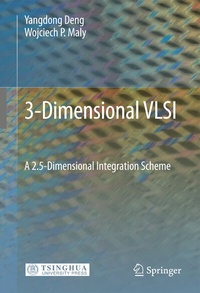
3-Dimensional VLSI
Description
Alles über E-Books | Antworten auf Fragen rund um E-Books, Kopierschutz und Dateiformate finden Sie in unserem Info- & Hilfebereich.
"3-Dimensional VLSI: A 2.5-Dimensional Integration Scheme"elaborates the concept and importance of 3-Dimensional (3-D) VLSI. The authors have developed a new 3-D IC integration paradigm, so-called 2.5-D integration, to address many problems that are hard to resolve using traditional non-monolithic integration schemes. The book also introduces major 3-D VLSI design issues that need to be solved by IC designers and Electronic Design Automation (EDA) developers. By treating 3-D integration in an integrated framework, the book provides important insights for semiconductor process engineers, IC designers, and those working in EDA R&D.
Dr. Yangdong Deng is an associate professor at the Institute of Microelectronics, Tsinghua University, China. Dr. Wojciech P. Maly is the U. A. and Helen Whitaker Professor at the Department of Electrical and Computer Engineering, Carnegie Mellon University, USA.
More details
Other editions
Additional editions

Content
System requirements
File format: PDF
Copy protection: Watermark-DRM (Digital Rights Management)
System requirements:
- Computer (Windows; MacOS X; Linux): Use the free software Adobe Reader, Adobe Digital Editions, or any other PDF viewer of your choice (see eBook Help).
- Tablet/Smartphone (Android; iOS): Install the free app Adobe Digital Editions or another reading app for eBooks, e.g., PocketBook (see eBook Help).
- E-reader: Bookeen, Kobo, Pocketbook, Sony, Tolino and many more (only limited: Kindle).
The file format PDF always displays a book page identically on any hardware. This makes PDF suitable for complex layouts such as those used in textbooks and reference books (images, tables, columns, footnotes). Unfortunately, on the small screens of e-readers or smartphones, PDFs are rather annoying, requiring too much scrolling.
This eBook uses Watermark-DRM, a „soft” copy protection. This means that there are no technical restrictions to prevent illegal distribution. However, there is a personalised watermark embedded in the eBook that can be used to identify the purchaser of the eBook in the event of misuse and to provide evidence for legal purposes.
For more information, see our eBook Help page.