

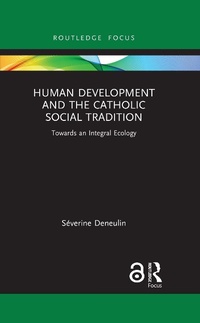
Human Development and the Catholic Social Tradition
Towards an Integral Ecology
1st Edition
Published on 20. May 2021
118 pages
978-1-000-42246-7 (ISBN)
Description

This book brings development theory and practice into dialogue with a religious tradition in order to construct a new, transdisciplinary vision of development with integral ecology at its heart.
It focuses on the Catholic social tradition and its conception of integral human development, on the one hand, and on the works of economist and philosopher Amartya Sen which underpin the human development approach, on the other. The book discusses how these two perspectives can mutually enrich each other around three areas: their views on the concept and meaning of development and progress; their understanding of what it is to be human - that is, their anthropological vision; and their analysis of transformational pathways for addressing social and environmental degradation. It also examines how both human development and the Catholic social tradition can function as complementary analytical lenses and mobilizing frames for embarking on the journey of structural and personal transformation to bring all life systems, human and non-human, back into balance.
This book is written for researchers and students in development studies, theology, and religious studies, as well as professional audiences in development organizations.
It focuses on the Catholic social tradition and its conception of integral human development, on the one hand, and on the works of economist and philosopher Amartya Sen which underpin the human development approach, on the other. The book discusses how these two perspectives can mutually enrich each other around three areas: their views on the concept and meaning of development and progress; their understanding of what it is to be human - that is, their anthropological vision; and their analysis of transformational pathways for addressing social and environmental degradation. It also examines how both human development and the Catholic social tradition can function as complementary analytical lenses and mobilizing frames for embarking on the journey of structural and personal transformation to bring all life systems, human and non-human, back into balance.
This book is written for researchers and students in development studies, theology, and religious studies, as well as professional audiences in development organizations.
Reviews / Votes
"This is a hugely valuable text that looks at a real opportunity to take development thinking and action forward through a dialogue between human development and the Catholic social tradition. Whilst it is written in a style that is very informative and suitable as an introductory text, it is conceptually rich and opens up important questions. Deneulin reminds us that there are no simple blueprints for the future, and shows how the two approaches encourage us to react to a complex, uncertain world thoughtfully. From a development studies perspective, the Catholic angle offers new avenues for thought regarding the place of solidarity and love in our schema, and provides new dimensions for our consideration of how public reasoning is supposed to bring about transformative change." -- Simon McGrath, UNESCO Chair in International Education and Development; and Professor, School of Education, University of Nottingham, UK"This book brilliantly transposes the thinking of Nobel-prize winning economist, Amartya Sen, with the theology of the Catholic Church on objectives of development, conditions needed for human flourishing, and the place of human beings in the natural world. It suggests many areas of broad agreement, and areas where one could learn from the other, with insightful indications of weaknesses in each approach. Catholic emphasis on seeing the world as integral, with people integrally connected to nature, the economy, and society, is contrasted with the individualism of Sen's writings; while Sen's emphasis on gender equality is contrasted with the marginalization of women in Catholic writings. Both secular students of development and those concerned with evolving Catholic doctrine have a great deal to learn from this excellent book." -- Frances Stewart, Professor Emeritus of Development Economics, University of Oxford, UK
"In her marvellous bridge-building venture, Severine Deneulin shows that Catholic social thought (CST) can be a mediator that both learns from and contributes to development theory. The two frameworks come together in the priority of society's most vulnerable members. Yet, on the one hand, Sen's capability approach repairs obvious shortcomings of CST, especially its premature arrival at universalistic proposals, and its huge blind spot regarding gender inequality. On the other hand, CST presents humanity's inherent relationality as an intrinsic good, and supplies a hope-inspiring language of transcendence, ultimacy, sin, and conversion that will be resonant across religious traditions. Few authors could be as well-prepared as Deneulin to treat these disparate approaches with understanding, balance, nuance, creativity and respect. Her analysis is admirably concise, to the point, and original. The result is a superb and persuasive synthesis of development theory and Catholic social ethics." -- Lisa Sowle Cahill, J. Donald Monan, S.J. Professor of Theology, Boston College, USA
More details
Series
Edition
1. Auflage
Language
English
Place of publication
London
United Kingdom
Publishing group
Taylor & Francis Ltd
Target group
College/higher education
Product notice
Reflowable
File size
0,77 MB
ISBN-13
978-1-000-42246-7 (9781000422467)
Copyright in bibliographic data and cover images is held by Nielsen Book Services Limited or by the publishers or by their respective licensors: all rights reserved.
Schweitzer Classification
Other editions
Additional editions
Book
05/2023
1st Edition
Routledge
€32.80
Shipment within 15-20 days
Book
08/2021
Routledge
Unfortunately, price unknown
Available (delivery time upon request)
Book
05/2021
1st Edition
Routledge
€76.70
Shipment within 15-20 days
Person
Severine Deneulin is Director of International Development at the Laudato Si' Research Institute, Campion Hall, University of Oxford, UK; and Associate Professor in International Development at the University of Bath, UK.
Content
Introduction, 1. The Concept of Development, 2. Anthropological Visions, 3. Transformational Pathways, Conclusion
