

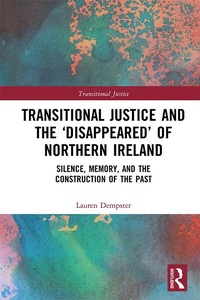
Transitional Justice and the 'Disappeared' of Northern Ireland
Silence, Memory, and the Construction of the Past
1st Edition
Published on 11. June 2019
291 pages
978-1-351-23937-0 (ISBN)
Description

This book employs a transitional justice lens to address the 'disappearances' that occurred during the Northern Ireland conflict - or 'Troubles' - and the post-conflict response to these 'disappearances.' Despite an extensive literature around 'dealing with the past' in Northern Ireland, as well as a substantial body of scholarship on 'disappearances' in other national contexts, there has been little scholarly scrutiny of 'disappearances' in post-conflict Northern Ireland. Although the Good Friday Agreement brought relative peace to Northern Ireland, no provision was made for the establishment of some form of overarching truth and reconciliation commission aimed at comprehensively addressing the legacy of violence. Nevertheless, a mechanism to recover the remains of the 'disappeared' - the Independent Commission for the Location of Victims' Remains (ICLVR) - was established, and has in fact proven to be quite effective. As a result, the reactions of key constituencies to the 'disappearances' can be used as a prism through which to comprehensively explore issues of relevance to transitional justice scholars and practitioners.
Pursuing an interdisciplinary approach, and based on extensive empirical research, this book provides a multifaceted exploration of the responses of these constituencies to the practice of 'disappearing.' It engages with transitional justice themes including silence, memory, truth, acknowledgement, and apology. Key issues examined include the mobilisation efforts of families of the 'disappeared,' efforts by a (former) non-state armed group to address its legacy of violence, the utility of a limited immunity mechanism to incentivise information provision, and the interplay between silence and memory in the shaping of a collective, societal understanding of the 'disappeared.'
Pursuing an interdisciplinary approach, and based on extensive empirical research, this book provides a multifaceted exploration of the responses of these constituencies to the practice of 'disappearing.' It engages with transitional justice themes including silence, memory, truth, acknowledgement, and apology. Key issues examined include the mobilisation efforts of families of the 'disappeared,' efforts by a (former) non-state armed group to address its legacy of violence, the utility of a limited immunity mechanism to incentivise information provision, and the interplay between silence and memory in the shaping of a collective, societal understanding of the 'disappeared.'
Reviews / Votes
'In her outstanding and richly researched book, Lauren Dempster narrates one of the most fascinating stories of transitional justice in Northern Ireland. At the heart of her story are the "disappeared" of the Troubles and the struggle of their families to uncover the truth about the whereabouts of their loved ones. In her masterful analysis, Dempster shows how selective immunity can contribute significantly towards the recovery of the truth for the disappeared, even under the most challenging conditions. Overall, this impeccably documented book is certain to become an important reference text for those interested in transitional justice in Northern Ireland and the politics of victimhood, broadly defined.' - Iosif Kovras, PhD, Reader (Associate Professor) in Comparative Politics, Department of International Politics, City University of London'A granular, nuanced look at the efforts to deal with the aftermath of the Troubles, focusing on efforts to recover the bodies of the disappeared. The author writes with authority and compassion, with attention to the shades of grey that accompany civil conflicts, and the importance of trust and time in successful efforts to deal with the past. She shows how the effort to deal with one aspect of the past - finding the bodies of the disappeared - served to shape the larger discussion on transitional justice, for good and ill. A very useful book.'
- Professor Naomi Roht-Arriaza, Albert Abramson '54 Distinguished Professor of Law, University of California, Hastings College of the Law
'Dempster presents, in a meticulously researched book, the most extensive study of its kind on disappearances in Northern Ireland. Through the prism of "the disappeared," wider lessons for the dealing with the past are cogently explored. More broadly, the book takes on many transitional justice tropes, for example, issues such as "innocence" and "guilt," "complicity" and "perpetration." New ideas are introduced such as "quiet" transitional justice, opening novel avenues for reflection and scholarship. All this challenges the reader morally and intellectually, while reshaping the theory and practice of transitional justice more broadly.'
- Professor Brandon Hamber, John Hume and Thomas P. O'Neill Chair in Peace, Ulster University
More details
Series
Edition
1. Auflage
Language
English
Place of publication
London
United Kingdom
Publishing group
Taylor & Francis Ltd
Target group
College/higher education
Illustrations
4 schwarz-weiße Fotos
ISBN-13
978-1-351-23937-0 (9781351239370)
Copyright in bibliographic data and cover images is held by Nielsen Book Services Limited or by the publishers or by their respective licensors: all rights reserved.
Schweitzer Classification
Other editions
Additional editions
Lauren Dempster
Transitional Justice and the 'Disappeared' of Northern Ireland
Silence, Memory, and the Construction of the Past
Book
03/2021
1st Edition
Routledge
€68.40
Shipment within 15-20 days
Lauren Dempster
Transitional Justice and the 'Disappeared' of Northern Ireland
Silence, Memory, and the Construction of the Past
Book
06/2019
1st Edition
Routledge
€215.41
Shipment within 15-20 days
Person
Dr Lauren Dempster is a Lecturer in the School of Law, Queen's University Belfast.
Content
Preface, Introduction, 1 'Disappearing' in International Context: Memory, Silence, and the Law 2 The Victims: Mobilisation, the Politics of Victimhood, and Constructing the 'Disappeared' 3 The Republican Movement: Rationalising, Leadership, and Resolving the 'Disappeared.'4 The Community: Rumour, Whispers, and 'Bystander Complicity' 5 'Quiet' Transitional Justice and 'Disappearing' 6 Acknowledgement, Truth, and the Collective Memory of the 'Disappeared'Conclusion: 'Disappearing' and Transitional Justice - Lessons from Northern Ireland
