

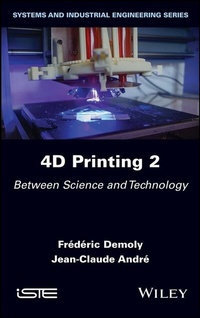
4D Printing, Volume 2
Description

To prepare for the future, two chapters are introduced: “Material-Process Duality in Industrial 4D Printing” and “How to Approach 4D Printing in Design”. If the capture and reuse of 4D printing knowledge is necessary for this objective, the conclusion leaves the existing myth around the 4D printing theme and proposes a “draft” roadmap that should be the subject of reflection and scientific debate on a concept that is still immature, but full of promise.
More details
Other editions
Additional editions
Content
Chapter 1. Getting Things Moving 1
1.1. Introduction 2
1.2. Actuators 4
1.2.1. General information 4
1.2.2. Different types of actuator 8
1.2.3. Amplification 11
1.2.4. Other modes of action from mechanics 12
1.2.5. Remarkable properties 16
1.3. Actuators and 4D printing 26
1.3.1. General framework 27
1.3.2. Specificities linked to the manufacturing process 30
1.4. Stimulations of matter 60
1.4.1. Programmable matter 61
1.4.2. Materials for 4D printing 70
1.4.3. Activations by physical pathway 88
1.4.4. A transition to 4D printing: swimming robots 97
1.4.5. Current scientific offer and application specifications 103
1.4.6. Some constraints 105
1.5. And tomorrow? 112
1.6. References 114
Chapter 2. Energy Stimulation: The Abandoned Child? 159
2.1. Introduction 159
2.2. To go a little further 162
2.3. References 164
Chapter 3. Material-Process Duality in Industrial 4D Printing 167
3.1. Introduction 167
3.2. From research to innovation 168
3.2.1. Research 169
3.2.2. Innovation 172
3.2.3. Inclusion of 4D printing in future projects 178
3.2.4. Weaknesses between research and profitable applications 181
3.3. From matter to 4D form; from 4D form to function 184
3.3.1. General considerations 189
3.3.2. Algorithms by/for 4D printing 190
3.3.3. Preforming the material 193
3.4. References 194
Chapter 4. Design for 4D Printing 203
4.1. Introduction 203
4.2. How can 4D printing in design be approached? 204
4.3. Opportunities and challenges in design: a strategic roadmap for research 207
4.3.1. Evolution of technological solutions and associated challenges 207
4.3.2. Design for 4D printing 209
4.3.3. Methodological framework for the design of energy-sensitive structures 211
4.4. Capture and reuse of 4D printing knowledge 213
4.5. Functional design 218
4.5.1. Functional modeling and solution principles 218
4.5.2. Smart material/stimulus selection and processing planning 219
4.6. From architectural design to detailed design 219
4.6.1. Definition of design spaces and CAD representations 220
4.6.2. Voxel-based modeling and simulation of active material behavior 221
4.6.3. Distribution of active materials 224
4.6.4. Distribution of active materials by integrating empty elements 227
4.6.5. Additional scientific challenges 229
4.7. Digital chain for 4D design and prototyping 230
4.8. Claims and practical constraints 231
4.9. Conclusion 232
4.10. References 232
Conclusion 243
Appendix 281
Index 293
1
Getting Things Moving
Manufacturing, but not action or speech, always involves means and ends; in fact, the category of means and ends derives its legitimacy from the sphere of making and manufacturing, where a clearly reasonable end, the final product, determines and organizes everything that plays a role in the process - the material, the tools, the activity itself, even the people who participate in it; all of them become mere means to the end and are justified as such. (Arendt 1972)
Warning
In the 16th century, in his treatise on magic, Giordano Bruno had, among other ideas, a certain notion of reactivity and consequently of adaptive materials. Thus, he wrote:
If one resorts to the virtue of sympathy and antipathy of things, as when substances repel, transmute or attract other substances [.], one rightly speaks of extra-natural magic. [.] From these premises, it can be deduced that the magnet stone attracts by its very nature. Indeed, attraction is twofold: certain objects attract first of all by sympathy, as when parts move towards their whole, when what has a definite place joins its place. (Bruno 2020)
This chapter tries, however, to move away from any magical context by examining, as scientifically as possible, how by various stimulations a form can change spatially or in functionality, alone in a homogeneous way or by association with materials.
1.1. Introduction
The introduction of additive manufacturing in the 1980s transformed the manufacturing industry. This technology, despite its success, still has some drawbacks, such as printing speed, surface finish of the final product and lack of fully functional materials (Manikandan et al. 2021). 4D printing uses smart or active materials to achieve a change in form or functionality. Materials that are sensitive to certain stimuli, the stimuli themselves and the time required for the change in state to occur are key research areas in 4D printing.
This chapter summarizes the developments in 4D printing, with a focus on the materials and methods used for the manufacture of 4D printed objects and structures. Smart or active printed structures can be disrupted in a custom manner by external stimulus such as water, heat, electricity, light and solvents with different pH values. Although printed structures exhibit self-healing, self-diagnosing, self-acting and self-sensing capabilities, etc., this chapter illustrates attractive possibilities and also highlights some difficulties. The field is not yet mature and still needs further research.
Innovations, such as new tools, devices and processes, can bring significant benefits to society by providing elements of comfort, means of medical treatment, etc., all in conditions of frugality imposed by a crying environmental need. Only then will innovations become inventions that can help the world's citizens live better, longer, healthier, more productive lives, and provide new ways to build, move, communicate, heal, learn and play. Understanding and clearly communicating the value of innovation (not the promises of it) can help decision-makers understand the benefits of supporting initiatives for their development. With 4D printing, we are at the beginning of a new scientific and technological adventure and the reality principle must be taken into account.
The Rand Corporation (2021) highlights three lessons:
- - The impact of innovations goes beyond the direct effect of the invention itself; it can serve as an inspirational image for other fields.
- - Success stories, which must be seen by the public, can help solve challenges facing society.
- - But, it is not enough to create an invention that must meet the challenges of industrial application and manufacturing to satisfy a potential public demand.
This is another book that all employees on the verge of burnout are snatching up and running to buy in their bookstores, like a crocodile rushing into a leather shop. (Vervisch 2020)
However, before reaching this stage, we must go beyond simple proofs-of-concepts (POCs). However, in Chapter 1 of Volume 1 we have shown a significant difficulty linked to the control of the deformation of complex shaped objects coming out of the basic origami. Methods of "successive approximations" have thus been proposed to reach a certain satisfaction in transformable devices, allowing for the adjustment of ends and means. If Lippmann (1937) wrote:
Technical progress, experimental in nature, requires much trial and error [.]. For these great centralized controls [.] are not suitable for a system of production which can only make a profit by new invention if it is flexible, experimental, and competitive,
this is only true if one has properly circumscribed the subject to avoid wasting time.
In order to do this, we felt that it was important to start from the most robust bases possible, in order to attack a market that still expects little or nothing from 4D printing. One of the elements that has already been widely discussed (because it is essential) is the effect of a stimulation to transform cohesive matter - thus materials - (we are obviously not talking about chemistry, which could claim this definition, nor about cooking) by providing a new functionality and/or a deformation. We know from Tahon (2003) that, despite (or because of) an increasingly unstable demand, unless we change the business model, there will continue to be pressure to produce as quickly as possible, and the diversity of products will increase. It will also be a matter of being ready on time in 4D printing.
Thus, the purpose of this chapter is to provide an overview of the means, of whatever nature, which make it possible to reach this objective. On the basis of the proposals, it will then be possible to evoke exploitation paths of these means for 4D printing applications. It is at this (partial) price that we will know if it is really a potentially attractive "disruptive technology". The concept of disruption was introduced and argued by Christensen (1997) because he recognized that few technologies are intrinsically of a disruptive or continuative nature. It is, according to Bessen et al. (2020), their use that manifests a disruptive effect.
Box 1.1 General note
In André (2017), a chapter was devoted to 4D printing and transformation processes under stimulation. These data and presentations are re-used here with (legitimate) enrichments, following recently published work, as the background from four years ago is considered robust.
It is true that the test of causality - the predictability of the effect, if all the causes are known - cannot be applied to the field [.]. But this practical unpredictability is not proof of freedom; it simply means that we are never in a position to know all the causes that come into play. (Darwin 2020)
1.2. Actuators
2,000 years before our time, Sumer imagined that the gods created humans in the form of animated clay statues, so that they could work in their place (principle of intentionality). This is the active matter side. But this myth would be found, according to Couveinhes (2012), in the legend of the Golem: the clay creatures could be animated thanks to inscriptions, as well as by a scroll. There would thus be an association between active matter and information. The central question in this chapter is to know how these androids can move (and not why). According to Wikipedia (2021), an actuator is an object that transforms the energy supplied to it into a physical phenomenon that provides work, and modifies the behavior or the state of a system. To do this, the initial energy can be pneumatic, hydraulic, electrical, electromagnetic, mechanical, thermal, photochemical, chemical, biochemical, biological, etc., to finally transform into mechanical energy and provide work. The link sought is therefore the actuator or engine that connects matter to energy for practical actions.
Box 1.2. Remark on robots
Robots are platforms for the integration of advanced technologies: energy storage, support and active materials, information and acquisition, data processing and transmission, mechatronics, sensors, etc. These are autonomous systems for producing a service. "The convergence of advanced technologies and their increasing interoperability, resulting from dematerialization, make the robot a fertile ground for innovation, cost reduction, and new uses" (Roure and Arcier 2012).
Thus, an actuator is a device capable of producing (and reproducing) a physical phenomenon such as a displacement, heating, an emission of light, sounds and a change of functionality. It is a transformer of one form of energy into another.
1.2.1. General information
Culture is nothing more than the transmission and sharing of representations that are temporal discretizations produced by the techniques of a given era. Telling is ultimately about organizing temporal discretizations in time. (Kaplan 2012)
While looking in the past for traces concerning actuators (before including them in additive manufacturing), we wished to give a quick overview on this aspect. While, a long time ago, industrial activity was focused on a centralized energy: windmill, water mill, etc., steam, the explosion engine and especially electricity allowed us to include or distribute engines and actuators in any object whatever its size, as a way to...
