

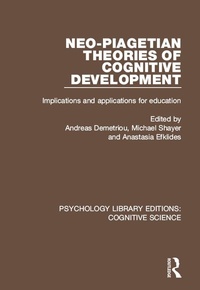
Neo-Piagetian Theories of Cognitive Development
Implications and Applications for Education
Published on 7. July 2016
324 pages
978-1-317-27682-1 (ISBN)
Description

Piagetian theory was once considered able to describe the structure and development of human thought. As a result, it generated an enthusiasm that it could direct education to develop new teaching methods, particularly in science and mathematics. However, disillusionment with Piagetian theory came rather quickly because many of its structural and developmental assumptions appeared incongruent with empirical evidence.
In recent years several neo-Piagetian theories have been proposed which try to preserve the strengths of Piaget's theory, while eliminating its weaknesses. At the same time several other models have been advanced originating from different epistemological traditions, such as cognitive/differential psychology or socio-historical approaches.
Originally published in 1992, this title was unique in representing most of these theories and traditions. Specifically, the authors focus their work on the educational implications of their research. The chapters are organised in three parts: the first part presents some widely known models of cognitive development and discusses their implications for different aspects of education; the second part is devoted to learning and cognitive acceleration; while part three highlights teaching methods that would improve the acquisition of particular skills in specific areas.
Written by an eminent group of truly international contributors, this title will still be useful to students and researchers in cognitive development and education, as well as educational policy makers.
In recent years several neo-Piagetian theories have been proposed which try to preserve the strengths of Piaget's theory, while eliminating its weaknesses. At the same time several other models have been advanced originating from different epistemological traditions, such as cognitive/differential psychology or socio-historical approaches.
Originally published in 1992, this title was unique in representing most of these theories and traditions. Specifically, the authors focus their work on the educational implications of their research. The chapters are organised in three parts: the first part presents some widely known models of cognitive development and discusses their implications for different aspects of education; the second part is devoted to learning and cognitive acceleration; while part three highlights teaching methods that would improve the acquisition of particular skills in specific areas.
Written by an eminent group of truly international contributors, this title will still be useful to students and researchers in cognitive development and education, as well as educational policy makers.
More details
Series
Language
English
Place of publication
London
United Kingdom
Publishing group
Taylor & Francis Ltd
Target group
College/higher education
Professional and scholarly
File size
13,57 MB
ISBN-13
978-1-317-27682-1 (9781317276821)
Copyright in bibliographic data and cover images is held by Nielsen Book Services Limited or by the publishers or by their respective licensors: all rights reserved.
Schweitzer Classification
Other editions
Additional editions
Andreas Demetriou | Michael Shayer | Anastasia Efklides
Neo-Piagetian Theories of Cognitive Development
Implications and Applications for Education
Book
06/2018
1st Edition
Routledge
€63.90
Shipment within 10-20 days
Andreas Demetriou | Michael Shayer | Anastasia Efklides
Neo-Piagetian Theories of Cognitive Development
Implications and Applications for Education
Book
06/2016
1st Edition
Routledge
€223.21
Shipment within 10-20 days
Persons
Content
Foreword. Introduction Part 1: General Principles of Cognitive Organization and Change and Implications for Education 1. Cognitive Development in Educational Contexts: Implications of Skill Theory Thomas R. Bidell and Kurt W. Fischer 2. Modes of Learning, Forms of Knowing, and Ways of Schooling John B. Biggs 3. The Role of Central Conceptual Structures in the Development of Children's Scientific and Mathematical Thought Robbie Case 4. Social Organization of Cognitive Development: Internalization and Externalization of Constraint Systems Jaan Valsiner 5. Structural Systems in Developing Cognition, Science, and Education Andreas Demetriou, Jan-Eric Gustafsson, Anastasia Efklides and Maria Platsidou Part 2: Inducing Cognitive Change 6. Problems and Issues in Intervention Studies Michael Shayer 7. Training, Cognitive Change, and Individual Differences Anastasia Efklides, Andreas Demetriou and Jan-Eric Gustafsson 8. Improving Operational Abilities in Chlidren: Results of a Large-Scale Experiment Benoe Csapo 9. Training Scientific Reasoning in Children and Adolescents: A Critical Commentary and Quantitative Integration Luc Goossens Part 3: Applications in Specific Domains 10. Value and Limitations of Analogues in Teaching Mathematics Graeme S. Halford and Gillian M. Boulton-Lewis 11. Developing Thinking Abilities in Arithmetic Class Lauren B. Resnick, Victoria Bill and Sharon Lesgold 12. Causal Theories, Reasoning Strategies, and Conflict Resolution by Experts and Novices in Newtonian Mechanics J. Ignacio Pozo and Mario Carretero 13. Cognitive Prerequisites of Reading and Spelling: A Longitudinal Approach Wolfgang Schneider and Jan Carol Naeslund Concluding Chapter 14. Returning to School: Review and Discussion John B. Biggs. Name Index. Subject Index.
