

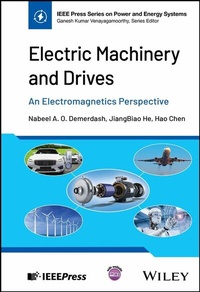
Electric Machinery and Drives
Description

Comprehensive resource on the fundamentals of electric machinery and variable speed drives, and their many conventional and emerging applications
Electric Machinery and Drives: An Electromagnetics Perspective provides advanced concepts of electrical machinery with control/drives and emphasizes the necessity of integration of power electronics and control strategy when studying modern electrical machinery. The text incorporates the fundamentals of electric machinery, variable speed drives, and motor controls, with the scope of including both the introduction of detailed operating principles as well as the electromagnetic design and control details from scratch.
The authors start with the introduction of electric circuit notations and elementary concepts of electrical circuits, power electronics, magnetostatics, magnetic circuits, and fundamentals of electromechanical energy conversion. Later, the book elaborates on the operating principles of polyphase induction machines and synchronous machines, as well as the associated scale and vector controls of these machines.
To aid in reader comprehension, the text includes a solutions manual and accompanying video animations.
Electric Machinery and Drives also contains information on:
- Real and reactive power in single-phase and balanced three-phase circuits and devices using consumer system concepts and notations
- Forces and torques in simple magnetically linear and nonlinear, multi-excited electromechanical devices and systems
- Simplified T-equivalent circuit model and its use in performance calculations of induction machines and associated torque-slip (speed) characteristics
- Brush-commutator and brushless DC machines, and natural ABC frame and Park's two-reaction DQO frame state-space modeling of synchronous and induction machines
- Special machines, including single-phase induction machines, switched reluctance machines, and others
Electric Machinery and Drives is an ideal learning resource in undergraduate or graduate-level courses for all universities with electrical engineering programs across the world. Additionally, the text may be used as a fundamental reference by researchers and engineers in electrical, mechanical, automotive, aerospace, and automation engineering.
More details
Other editions
Additional editions
Persons
Nabeel A. O. Demerdash, PhD, IEEE Life Fellow, the recipient of the 1999 IEEE Nicola Tesla Technical Field Award, is an emeritus Professor in electrical engineering and the Director of the SEMPEED Consortium at Marquette University, USA. He has over 50 years of teaching and research experience in electric machines and drives in U.S. academia. He is the author and/or co-author of more than 250 technical articles, including more than 150 papers published in various IEEE Transactions and journals.
JiangBiao He, PhD, IEEE Senior Member, is an Associate Professor in Electrical Engineering at the University of Tennessee, Knoxville, USA. Previously, he was an Associate Professor at the University of Kentucky. Before he joined academia in 2019, he worked in multiple large industry R&D centers, most recently as a Lead Engineer at GE Global Research, Niskayuna, New York. His research interests include motor-drive systems and power electronic converters. He has authored and co-authored over 150 technical articles in IEEE journals and conferences, in addition to 10 granted patents.
Hao Chen, PhD, IEEE Senior Member, is an Associate Professor (Pre-Tenure) with the College of Electrical Engineering, Zhejiang University, Hangzhou, China. From 2016 to 2018, he was with the Department of Electrical and Computer Engineering, Marquette University, Milwaukee, WI, USA, as a Joint PhD Student. From 2019 to 2021, he was a Postdoctoral Research Fellow with the School of Electrical and Electronic Engineering, Nanyang Technological University, Singapore. From 2022 to 2023, he was a Researcher with the Department of Electrical Engineering, Chalmers University of Technology, Gothenburg, Sweden. His research interests include design and optimization of electric machines, power electronic drives, and motor controls. He has published over 50 papers in IEEE journals and conferences.
Content
About the Authors xiii
Preface xv
About the Companion Website xviii
1 Electric Circuit Notations and Elementary Concepts 1
1.1 Frequency-Domain RMS Phasor Representation of Time-Domain AC Voltages and Currents 1
1.2 Time-Domain and RMS Frequency-Domain Power Concepts Using Consumer System Formulation and Notations 3
1.3 Elementary Concepts of Complex Real and Reactive Power in Balanced Three-Phase Circuits and Devices Using Consumer System Notations 5
2 Power Electronics and Converters 11
2.1 Semiconductor Devices 11
2.1.1 Power Diodes 11
2.1.2 Thyristors 12
2.1.3 Igbt 14
2.1.4 SiC MOSFET 15
2.1.5 GaN HEMTs 17
2.2 DC-DC Converters 19
2.2.1 Buck Converter 19
2.2.2 Boost Converter 21
2.3 Voltage Source Inverter 22
2.4 Pulse Width Modulation (PWM) 23
Homework Problems 26
References 28
3 Review of Magnetostatics, Magnetic Circuits, and Fundamentals of Electromechanical Energy Conversion 29
3.1 Magnetostatic Fields Notations and Ampere's Law 29
3.2 Magnetic Circuits with Ferrous Magnetic Cores 31
3.3 Magnetic Flux Linkages, Inductance, and Electromotive Forces 34
3.4 Energy Storage, Motion, and Forces in Magnetic Circuits 37
3.4.1 Ferromagnetic Material B-H Characteristics 39
3.5 Lorentz's Law-Induced Voltage and Forces in Magnetic Fields 43
3.6 Electromagnet Polarity and Permanent Magnets 44
3.7 Elementary Electromechanical Torque Production and Magnetomotive Force (MMF) Distribution Concepts 45
3.8 Elements of Three-Phase Stator and Rotor Windings 48
3.9 Elementary Three-Phase Synchronous and Induction Machines 52
3.10 Elementary Brush-Commutator DC Machines 56
3.11 Mechanical Torque Production in AC and DC Machines 57
3.12 Forces and Torques in Magnetically Linear Singly Excited Electromechanical Devices and Systems 65
Homework Problems 68
4 Electromechanical Concepts in Electric Machines 73
4.1 Introductory Discussion 73
4.2 Motor-Mechanical Load Dynamics 73
4.3 Mechanical Load Torque-Speed Characteristics 79
4.4 Mass Polar Moment of Inertia 82
4.5 Effects of Belt and Gear Couplings on Mechanical Dynamic Formulations 84
4.6 Operating Modes of Electric Machines 87
4.7 On Time Constants of the Mechanical Dynamics of Motor-Mechanical Load Systems 89
4.8 Modeling and Simulation of Motor Starting Transients 91
Homework Problems 91
Reference 91
5 Electric Machinery Windings and Associated Electromotive and Magnetomotive Forces 93
5.1 AC Winding Layouts 93
5.2 dc Winding Layouts 95
5.3 Induced Electromotive Forces in Single-Phase and Poly-Phase AC Windings 96
5.4 Induced Electromotive Forces in Brush-Commutator-Type dc Windings 105
5.5 MMF in Distributed and Concentrated AC and DC Machine Windings and Associated Flux Density Distributions/Waveforms in Airgaps 107
5.6 Relationships Among Magnetomotive Forces, Flux Density Distributions, Volume, Developed Torque, and Power 132
5.7 Relationship Among Electric Machinery Volume and Developed Torque and/or Volt-Ampere Capabilities 138
5.8 Worked Examples 140
Homework Problems 146
6 The Poly-Phase Induction Machine 149
6.1 Main Constructional Features 149
6.2 The T-Equivalent Circuit Model and Its Fundamental Formulation 150
6.3 Performance Calculations Using the T-Equivalent Circuit Model 159
6.4 The Simplified T-Equivalent Circuit Model and Its Use in Performance Calculations and Associated Torque-Slip (Speed) Characteristics 162
6.5 On Torque-Slip (Speed) Simplification and Its Formulation 168
6.6 The Motor Starting Transient Modeling Using the Simplified T-Equivalent Circuit 182
6.7 On Legacy and Modern Constant Volts Per Hertz Control of Torque and Speed of Induction Motors 195
6.8 Field-Oriented Control of Induction Motors 200
Homework Problems 205
References 211
7 The Poly-phase Synchronous Machine 213
7.1 Main Constructional Features of the Salient-Pole and Cylindrical Rotor Varieties 213
7.2 The Types of Synchronous Machine Exciter-Conventional and Modern Brushless Excitation Systems 218
7.3 The Equivalent Circuit Model of the Idealized Cylindrical Rotor Synchronous Machine 220
7.4 Phasor-Vector Diagrams of Synchronous Motors and Generators 223
7.5 Elementary Treatment of Effects of Rotor Saliency 236
7.6 Synchronous Motor Under Constant Volts Per Hertz Control 237
7.7 Vector Control of Synchronous Motors in ASDs 244
Homework Problems 246
References 247
8 Brush-Commutator and Brushless DC Machines 249
8.1 Main Constructional Features of Brush-Commutator and Brushless DC Machines 249
8.2 Armature Windings of Brush-Commutator DC Machines 252
8.3 Separately Excited DC Motors, Modeling, and Formulations 256
8.4 Shunt-Excited DC Motors Modeling and Formulations 261
8.5 Series-Excited DC Motors Modeling and Formulations 266
8.6 Compound-Excited DC Motors Modeling and Formulations 270
8.7 dc Motors Input-Output Powers, Losses, and Efficiency 273
8.8 Worked Examples on DC Motors 275
8.9 Operating Principles and Modeling of Brushless DC Motors 278
8.10 Brushless DC Motors Torque-Speed Control 297
Homework Problems 299
References 305
9 State-Space Modeling of Synchronous Machines Including Full Effects of Rotor Saliency 307
9.1 Discrete Representation of the Windings of a Synchronous Machine in the Natural Frame of Reference 307
9.2 State-Space Modeling Derivations of a Synchronous Machine in the Natural ABC Frame of Reference of the Poly-Phase Stator Windings 310
9.3 A Magnetic Field Flux-Map Finite-Element Computed Point of View of Salient-Pole and Cylindrical Rotor Machines 318
9.4 Park's DQ0 Frame of Reference Transformation 324
9.5 Applying Park's DQ0 Transformation to the ABC State-Space Model Voltages, Currents, and Flux Linkages 333
9.6 State-Space Modeling Derivation in the DQ0 Reference Frame of a Synchronous Machine Including Saliency Effects - The Inductance and Flux Linkage Matrices and Vectors 339
9.7 Synchronous Machine DQ0 State-Space Model in the DQ0Flux Linkage Frame of Reference 344
9.8 Power and Torque Formulations for a Synchronous Machine in the DQ0 Frame of Reference and ABC Frame of Reference 347
9.9 Derivation of the Synchronous Machine Phasor and Space-Vector Diagrams in the DQ0 Frame of Reference 350
9.10 Initial Conditions in Transient Synchronous Machinery State-Space Time-Domain Simulations 357
9.11 Synchronous Machine ABC Frame State-Space Models with Permanent Magnet Excitations 359
9.12 Synchronous Machine DQ0 Frame State-Space Models with Permanent Magnet Excitations 372
9.13 Vector Control of Wound-Field Synchronous Machines 379
Homework Problems 383
References 395
10 State-Space Modeling of Induction Machines 397
10.1 Discrete Representation of the Windings of a Wound-Rotor Induction Machine in the Natural Frame of Reference 397
10.2 State-Space Modeling Derivations of an Induction Machine in the Natural ABC-abc Frame of Reference for the Poly-phase Stator and Rotor Windings 398
10.3 On the Relationship Between the Terms of an Induction Machine's Inductance Matrix and the Inductances and Reactances of Its Conventional T-Equivalent Circuit 404
10.4 State-Space Model of an Induction Machine Using the Winding Flux Linkages as State Variables 408
10.5 Transformation of the State-Space Model of an Induction Machine from the ABC-abc Frame to the DQ0-dq0Frameof Reference 410
10.6 Three Types of DQ0-dq0 Frame of Reference Transformation and the Resulting State-Space Models 413
10.7 On Torque and Power Computations in an Induction Machine in the DQ0-dq0 and ABC-abc Reference Frames 434
10.8 On Inductance Parameters in Induction Machine State-Space Models 445
10.9 On Design and Parameter Computation Aspects in Induction Machines 459
10.10 Direct Torque Control of Induction Motors 469
Homework Problems 471
References 475
11 Single-Phase Induction Motors and Other Special Motors 479
11.1 Single-Phase Induction Motors 479
11.1.1 Split-Phase Induction Motors 479
11.1.2 Capacitor-Start Induction Motors 481
11.1.3 Capacitor-Start Capacitor-Run Induction Motors 481
11.2 Torque-Speed Characteristics of Single-Phase Induction Motors 483
11.3 Field Analysis of Split-Phase and Capacitor-Start Induction Motors 485
11.3.1 Rotating Wave Point of View 485
11.3.2 Elliptic Field Point of View 487
11.4 Power and Torque for Split-Phase Induction Motors 488
11.5 Power and Torque for Capacitor-Start Induction Motors 492
11.6 Switched Reluctance Motors 497
Reference 498
12 Emerging Applications, Technical Trends, and Challenges 499
12.1 Emerging Applications 499
12.1.1 Transportation Electrifications 499
12.1.2 Renewable Power Generation 501
12.1.3 Robotics 502
12.1.4 Drones 503
12.2 Future Technical Trends 503
12.2.1 Advanced Materials 503
12.2.2 Advanced Manufacturing 505
12.2.3 Integrated Motor-Drive Systems 506
12.3 Technical Challenges 506
12.3.1 Extreme Operating Environmental Conditions 506
12.3.2 Systematic Multiphysics Synergistic Designs 507
12.3.3 Electromagnetic Interference 508
References 510
Index 513
1
Electric Circuit Notations and Elementary Concepts
In this introductory chapter, we start by defining the electric circuit notations and elementary circuit concepts, including symbolisms used in representation of time-domain and AC phasor variables, such as voltage and currents, used throughout Chapters 1-12 of this textbook. These include multivariable arrays, the so-called vectors in matrix linear-algebra parlance, as well as concepts of time-domain instantaneous power and complex power in AC phasor formulation of electric circuits.
A basic and fundamental complex-algebra concept to all that will follow is the well-known Euler formulation that yields the following identities:
(1.1) (1.2)and
(1.3)With these identities, Eqs. (1.1)-(1.3), we are ready to discuss frequency-domain root mean square (RMS) phasor representation of time-domain AC voltages and currents.
1.1 Frequency-Domain RMS Phasor Representation of Time-Domain AC Voltages and Currents
Here, lower-case variables (symbols) such as v, i, e, and p stand for time-domain voltages, currents, electromotive forces (emfs), and real powers, respectively. Also here, upper-case variables (symbols) such as, V, I, E, and P stand for RMS magnitudes (absolute values) of voltage phasors, current phasors, emf phasors, and average real power in phasor complex power computations, respectively. Meanwhile, variables (symbols) such as , , , and stand for RMS phasor complex form voltages, currents, emfs, and complex power (real and reactive) in phasor complex power computations, respectively.
Accordingly, in steady-state AC circuit analysis, one can write the following:
(1.4)where V is the RMS AC voltage magnitude (absolute value), ? = (2pf) is the angular frequency in electrical radians per second, f is the AC frequency in Hertz, t is the time in seconds, and f is the phase angle of the voltage signal.
Hence, based on the Euler identities given earlier, Eqs. (1.1)-(1.3), one can rewrite v(t) as follows:
(1.5)or
(1.6)In AC phasor form, the term (ej?t) is common to all voltage, current, and other signals. Hence, all the information that is needed is in terms (V) and (ejf). Hence, in RMS phasor notation, the voltage, , can be written as follows in exponential phasor form:
(1.7)or in Cartesian coordinate polar and rectangular complex forms as follows:
(1.8)Similarly, for an instantaneous steady-state time-domain, current, i(t), given by the following equation:
(1.9)The corresponding Euler formulation gives
(1.10)and for the corresponding RMS phasor notation, the current, , can be written as follows:
(1.11)or, in Cartesian coordinate polar and rectangular complex forms, the current, , can be written as follows:
(1.12)In this text, is the conjugate of the phasor and is the conjugate of the phasor . Therefore,
(1.13)and
(1.14)1.2 Time-Domain and RMS Frequency-Domain Power Concepts Using Consumer System Formulation and Notations
Consider the two-terminal "system or device" shown in Figure 1.1. The current i (or ) is taken to be flowing in a positive orientation when flowing into the terminal designated with a positive voltage polarity, v (or ). In such a case, the instantaneous input power, p(t), is given by the following:
(1.15)where a positive p(t) means that real power (watts) is being consumed and a negative p(t) means that real power (watts) is being generated.
Figure 1.1 A summary graphical and formulation representation of the consumer system in the time-domain and frequency-domain phasor power computation.
Meanwhile, in phasor frequency-domain, the complex power, , is given by the following:
(1.16)where P is the real power in watts and Q is the reactive power in vars, and once again, P is positive means that watts is being consumed (as in a motoring mode) and P is negative means that watts is being generated (as in a generating mode), and Q is the reactive power in vars, in which Q is positive means that vars is being consumed (as in inductive loads) and Q is negative means that vars is being generated (as in capacitive loads). The reader is urged to examine the complex powers, , , , and , associated with the current phasors, , , , and , respectively, relative to the terminal voltage phasor, , associated with the two-terminal system (or device), shown in Figure 1.1.
In the Consumer System Notation:
- Positive p(t) means watts is consumed (load/motoring).
- Negative p(t) means watts is generated (generator/source).
Now, for a multiterminal (or port), n, system (or device), the voltages can be written in matrix/array (vector) form in the time-domain, , or phasor frequency-domain, , respectively, as follows:
(1.17)and
(1.18)Similarly, the currents can be written in matrix/array (vector) form in the time-domain, , or phasor frequency-domain, , respectively, as follows:
(1.19)and
(1.20)Therefore, the instantaneous time-domain power, p(t), can be written as follows in an n-polyphase device:
(1.21)where is the transpose of .
Meanwhile, the frequency-domain phasor computation of the complex power, , can be written as follows:
(1.22)That is,
(1.23)where is the transpose of .
1.3 Elementary Concepts of Complex Real and Reactive Power in Balanced Three-Phase Circuits and Devices Using Consumer System Notations
A balanced three-phase set of current phasors, , , and , is shown in Figure 1.2. We will always assume counterclockwise rotation for such phasor diagrams throughout this textbook, unless it is explicitly stated otherwise. Accordingly, for an "observer" located at the star-point in this diagram, the observer will see an a, b, c, a, b, c, . sequence, that is, a positive (+) sequence as designated in this figure. Meanwhile, if the rotation of this phasor diagram is reversed to a clockwise orientation, the sequence would become an a, c, b, a, c, b, . one, that is, a negative (-) sequence.
Figure 1.2 A balanced three-phase set of current phasors, , , and , and the concepts of positive a, b, c and negative a, c, b sequencing.
If one would interchange the locations of the and phasors, as shown in Figure 1.3, and still preserve the counterclockwise rotation and the location of the star-point "observer," the result will be an a, c, b, a, c, b, . sequence. That is, one will be seeing a negative (-) sequence as designated in Figure 1.3.
Figure 1.3 Another approach to negative a, c, b sequencing in balanced three-phase set of currents, , , and .
Meanwhile, we discuss complex power, , in the context of a balanced three-phase Y-connected impedance load with an isolated neutral, n. See Figure 1.4 in which the impedance per-phase is , and the phase-currents, , , and , which are also equal to the a, b, c line-currents as depicted in this figure. Also, given in Figure 1.4 are the formulations for the phase (line-to-neutral) voltages, , , and , as well as phase-currents. The phasor diagram of the voltages depicts the graphical/schematic phasor representation of the line-to-line voltages, , , and . Here, one can write the complex power, , as follows:
(1.24)where P is the real power in watts and Q is the reactive power in vars. Again, here, one can write the following:
(1.25)and in the case of a balanced three-phase load, the power factor, PF, is
(1.26)where the angle, ?, is the power factor angle given by
(1.27)which is the angle of the impedance per-phase, , where ; see Figure 1.4. Furthermore, in this balanced...
