

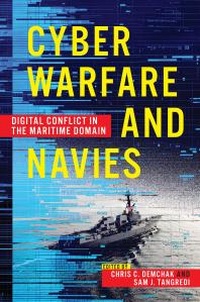
Cyber Warfare and Navies
Description

Cyber Warfare and Navies, an edited collection, takes a penetrating look into the threats that cyber warfare poses to operations in the maritime environment and the means of defending against cyberattack.
As with all elements of the digital age, navies and commercial maritime operations around the world have become increasingly vulnerable to cyber conflict. Navies are obvious targets of hostile national and nonstate cyber actions. Almost every aspect of commercial maritime activities has become digitized and interconnected and thus vulnerable to cyber intrusions, sabotage, viruses, and destruction. In an era when 85 percent of global trade and 70 percent of all liquid fuels travel by sea, cyber effects on ships, port-handling equipment, shipping companies, maritime suppliers, and other maritime industries can cripple manufacturing industries and retail businesses on a global basis. Neither navies nor commercial shipping can "sail away" from cyber threats.
Initially, naval leaders had difficulty accepting and preparing for cyber warfare, which is largely viewed as a problem on land and from which ships were perceived as disconnected. As a consequence, effectively integrating cyber operations into its naval warfighting planning has proven challenging not only for the U.S. Navy, but for allied and adversary navies as well. The U.S. Navy created Fleet Cyber Command (FCC), with the U.S. Navy's Tenth Fleet as its cyber operational arm and the Navy's component contributing to U.S. Cyber Command (USCYBERCOM). However, thus far those efforts appear not to have served the Navy or USCYBERCOM as well as anticipated.
Cyber Warfare and Navies outlines the various threats that cyber warfare poses to naval and commercial maritime operations as well as the abilities of modern navies to defend against those threats. It explains how navies are organized and equipped for cyber operations and the concepts and doctrine adopted by those navies-and provides recommendations on how to improve maritime cyber operations. The book covers not just the U.S. Navy, U.S. Marine Corps, and U.S Coast Guard, but also the navies of allies, opponents (China, Russia), and others. The book also explores the relationship between the U.S. Navy, Marine Corps, Coast Guard, and USCYBERCOM.
More details
Other editions
Additional editions
Persons
Chris C. Demchak, PhD,¿is the Grace Hopper Chair of Cyber Security and the Senior Cyber Scholar, Cyber and Innovation Policy Institute, U.S. Naval War College. She holds degrees in engineering, economics, and comparative complex organization systems/political science. Works published or in progress include Wars of Disruption and Resilience; Great Systems Conflict:¿Rise of Cyber Westphalia and Collective Resilience; Organizing for Great Systems Conflict; and Sustaining a Digital Democracy. Dr. Demchak lives in North Kingstown, RI.
Sam J. Tangredi, USN (Ret.), is the Leidos Chair of Future Warfare Studies and professor of National, Naval, and Maritime Strategy at the U.S. Naval War College. A surface warfare officer and warship captain deployed world-wide, Dr. Tangredi also served multiple tours of duty in the Pentagon as a leader of strategic planning teams. He has published seven books and more than two hundred journal articles. A graduate of the U.S. Naval Academy class of 1978, he earned an MA from the Naval Postgraduate School and a PhD from the University of Southern California. He splits his time between Newport, RI, and Coronado, CA.
