

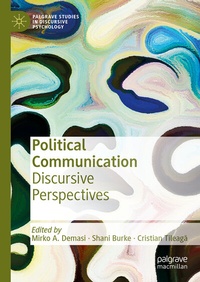
Political Communication
Description

This book explores discursive psychological empirical research in the context of political communication. Drawing together a well-established field of study and a variety of discursive psychology approaches the authors confront the theoretical and practical challenges that discursive psychology and political communication studies face today. Using a diverse range of approaches, including the analysis of TV shows, cartoons, social media groups and blogs, face-to-face verbal interaction, political rhetoric and mainstream news reports, the authors explain the ways in which discursive psychology can offer insight into the nature of contemporary political communications. The book offers timely and international reflections on the context of online political communication, Brexit rhetoric, prejudice discourse and political persuasion, showcasing the analytical acumen and empirical insight that can be gleaned from discursive psychology methods.
Political Communication: DiscursivePerspectives highlights the value of contributions from outside English speaking academia and is essential reading for academics, researchers and students interested in political communication or discursive psychology.
More details
Other editions
Additional editions
Persons
Mirko A. Demasi is a lecturer in psychology at York St John University, UK. His current research interest is in the study of political debates on the European Union in the context of Brexit, constructions of truth and factuality as rhetorical and moral concerns, contested political discourse and the study of racist discourse in Finland and beyond.
Shani Burke is a senior lecturer in psychology at Teesside University, UK. Her research interests are applying discursive psychology to Islamophobic and far-right discourse, focusing on how potentially prejudicial arguments are presented as 'reasonable'. Her work has been published in a range of journals, such as Discourse and Society and the Journal of Community and Applied Social Psychology .
Cristian Tileaga is Reader in Social Psychology in the School of Social Sciences and Humanities at Loughborough University, UK. He has written extensively on discursive psychology, prejudice and discrimination, collective memory, and interdisciplinarity. He is the author of a number of books, including Discursive Psychology: Classic and Contemporary Issues (2015, with Elizabeth Stokoe) and The Nature of Prejudice: Society, Discrimination and Moral Exclusion (2016).