

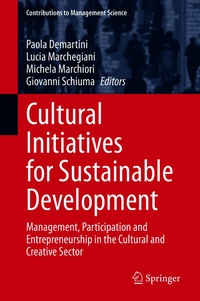
Cultural Initiatives for Sustainable Development
Description

This book explores the relevance of new sources, dimensions, and characteristics of knowledge for supporting creative and cultural organizations and initiatives.
Special emphasis is placed on cultural heritage, participatory approaches, and entrepreneurship in the cultural and creative sector. The role of cultural heritage and contemporary culture as a source of economically effective, socially sustainable development is also discussed. The authors examine new ways of developing and testing new and innovative models of management for cultural heritage assets. In line with the participatory approaches in culture heritage governance promoted by the EU, the authors analyze participatory approaches to cultural and creative initiatives. The role of public and private actors, as well as the way they interact with each other in order to achieve collective outcomes, is of particular interest in this section of the book. With regard to cultural and creative entrepreneurship, the book adds an innovative view of cultural ventures, offering some clues from an entrepreneurial ecosystem perspective.
More details
Other editions
Additional editions
Persons
Lucia Marchegiani is an associate professor of business organization and human resources management at Roma Tre University, Italy. Her research interests cover topics such as creative and cultural industries, innovations and organizations, experimental organizational behavior, knowledge management and social media and participatory approaches in culture.
Michela Marchiori is a professor of organizational design and human resource management at the Department of Business Studies at Roma Tre University, Italy. Since 2016, she is member of the project "Cultural Heritage and Contemporary Culture: Transferring knowledge, Managing Outcomes, and Enabling Sustainability" founded in collaboration between Corporate Governance Lab at Rome Tre University, Italy and the "Institut für Organisation und Lernen" at Innsbruck University, Austria.
Giovanni Schiuma is the chairman of the "Arts for Business Institute and Director of the CLabUnibas", Centre for Entrepreneurship and Innovation Development, at the University of Basilicata, Italy. He is also the director of the master in business administration and a professor in innovation management. Currently he holds the position of visiting professor at the University of the Arts London, where he directed the Innovation Insights Hub, and held the first international professorship chair in arts based management. He is alsoa visiting professor at the Graduate School of Management of St. Petersburg University, Russia and an adjunct professor at Tampere University of Technology, Finland and he is a fellow of the Royal Society of Arts.
