

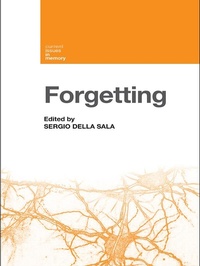
Forgetting
Published on 10. June 2010
352 pages
978-1-136-97087-0 (ISBN)
Description

Memory and forgetting are inextricably intertwined. In order to understand how memory works we need to understand how and why we forget. The topic of forgetting is therefore hugely important, despite the fact that it has often been neglected in comparison with other features of memory.
This volume addresses various aspects of forgetting, drawing from several disciplines, including experimental and cognitive psychology, cognitive and clinical neuropsychology, behavioural neuroscience, neuroimaging, clinical neurology, and computational modeling. The first chapters of the book discuss the history of forgetting, its theories and accounts, the difference between short-term and long-term forgetting as well as the relevance of forgetting within each of the numerous components of memory taxonomy. The central part summarizes and discusses what we have learned about forgetting from animal work, from computational modeling, and from neuroimaging. Further chapters discuss pathological forgetting in patients with amnesia and epilepsy, as well as psychogenic forgetting. The book concludes by focusing on the difference between forgetting of autobiographical memories versus collective memory forgetting.
This book is the first to address the issue of forgetting from an interdisciplinary point of view, but with a particular emphasis on psychology. The book is scientific and yet accessible in tone, and as such is suitable for advanced undergraduate and postgraduate students of psychology and related subjects, such as science and neuroscience.
This volume addresses various aspects of forgetting, drawing from several disciplines, including experimental and cognitive psychology, cognitive and clinical neuropsychology, behavioural neuroscience, neuroimaging, clinical neurology, and computational modeling. The first chapters of the book discuss the history of forgetting, its theories and accounts, the difference between short-term and long-term forgetting as well as the relevance of forgetting within each of the numerous components of memory taxonomy. The central part summarizes and discusses what we have learned about forgetting from animal work, from computational modeling, and from neuroimaging. Further chapters discuss pathological forgetting in patients with amnesia and epilepsy, as well as psychogenic forgetting. The book concludes by focusing on the difference between forgetting of autobiographical memories versus collective memory forgetting.
This book is the first to address the issue of forgetting from an interdisciplinary point of view, but with a particular emphasis on psychology. The book is scientific and yet accessible in tone, and as such is suitable for advanced undergraduate and postgraduate students of psychology and related subjects, such as science and neuroscience.
Reviews / Votes
"Forgetting is a well-written, thought-provoking book. The chapters are concise and provide an understandable explanation of various aspects of forgetting and memory. ... the individual chapters are engaging and comprehensible in a way that takes the book beyond ordinary educational literature. ... It is both enjoyable and a much-needed reference for both memory scholars and their students." - Benton H. Pierce and Melissa J. Hawthorne in PsycCRITIQUES"For many years, the study of forgetting has been a relatively neglected area of memory. As this collection of chapters richly demonstrates, this has now begun to change. New approaches using behavioural, neuropsychological and neurobiological methods are turning what previously appeared as tired old controversies into exciting new growth points. I think this collection of chapters by leading theorists will be important in forging a new and more comprehensive approach to our understanding of forgetting." - Alan Baddeley, Professor of Psychology, University of York, UK
"You could build an entire seminar for advanced undergraduate or graduate students around Forgetting. In compellingly-written chapters, leading researchers describe fascinating recent discoveries and provide invigorating new perspectives on long-standing puzzles. Forgetting is a model for interdisciplinary examination of a complex topic." - Keith B. Lyle, Assistant Professor, Department of Psychological and Brain Sciences, University of Louisville, USA
"This volume represents multiple areas of cutting-edge research on forgetting. Although some kinds of memory loss owe to mental limitations, others free the mind for more important memories. Bringing together the rich insights from leading psychologists and neuroscientists, this is a unique and definitive resource on the science of forgetting." - David A. Gallo, Assistant Professor of Psychology, University of Chicago, USA and author of Associative Illusions of Memory "For many years, the study of forgetting has been a relatively neglected area of memory. As this collection of chapters richly demonstrates, this has now begun to change. New approaches using behavioural, neuropsychological and neurobiological methods are turning what previously appeared as tired old controversies into exciting new growth points. I think this collection of chapters by leading theorists will be important in forging a new and more comprehensive approach to our understanding of forgetting." - Alan Baddeley, Professor of Psychology, University of York, UK
"You could build an entire seminar for advanced undergraduate or graduate students around Forgetting. In compellingly-written chapters, leading researchers describe fascinating recent discoveries and provide invigorating new perspectives on long-standing puzzles. Forgetting is a model for interdisciplinary examination of a complex topic." - Keith B. Lyle, Assistant Professor, Department of Psychological and Brain Sciences, University of Louisville, USA
"This volume represents multiple areas of cutting-edge research on forgetting. Although some kinds of memory loss owe to mental limitations, others free the mind for more important memories. Bringing together the rich insights from leading psychologists and neuroscientists, this is a unique and definitive resource on the science of forgetting." - David A. Gallo, Assistant Professor of Psychology, University of Chicago, USA and author of Associative Illusions of Memory
More details
Series
Language
English
Place of publication
London
United Kingdom
Publishing group
Taylor & Francis Ltd
Target group
College/higher education
Illustrations
9 s/w Photographien bzw. Rasterbilder, 42 s/w Zeichnungen, 2 s/w Tabellen, 51 s/w Abbildungen
2 Tables, black and white; 42 Line drawings, black and white; 9 Halftones, black and white; 51 Illustrations, black and white
File size
8,12 MB
ISBN-13
978-1-136-97087-0 (9781136970870)
Copyright in bibliographic data and cover images is held by Nielsen Book Services Limited or by the publishers or by their respective licensors: all rights reserved.
Schweitzer Classification
Other editions
Additional editions
Sergio Della Sala
Forgetting
Book
11/2013
1st Edition
Psychology Press Ltd
€84.30
Shipment within 15-20 days
Sergio Della Sala
Forgetting
Book
05/2010
1st Edition
Psychology Press Ltd
€207.20
Shipment within 3-4 weeks
Person
Sergio Della Sala is Professor of Human Cognitive Neuroscience at the University of Edinburgh, and is a Fellow of the British Psychological Society and the Royal Society of Edinburgh. His research focuses on cognitive deficits associated with brain damage, in particular amnesia following stroke and Alzheimer's-type dementia.
Content
H.L. Roediger III, Y. Weinstein, P.K. Agarwal, Forgetting: Preliminary Consideration. H.J. Markowitsch, M. Brand, Forgetting: An Historical Perspective. R. Cubelli, A New Taxonomy of Memory and Forgetting. G.D.A. Brown, S. Lewandowsky, Forgetting in Memory Models: Arguments Against Trace Decay and Consolidation Failure. J.M.J. Murre, Connectionist Models of Forgetting. F. Valtorta, F. Benfenati, Synaptic Plasticity and the Neurobiology of Memory and Forgetting. B.J. Levy, B.A. Kuhl, A.D. Wagner, The Functional Neuroimaging of Forgetting. P. Peigneux, R. Schmitz, C. Urbain, Sleep and Forgetting. M. Dewar, N. Cowan, S. Della Sala, Forgetting due to Retroactive Interference in Amnesia Findings and Implications. C. Butler, N. Muhlert, A. Zeman, Accelerated Long-Term Forgetting. M. Brand, H.J. Markowitsch, Aspects of Forgetting in Psychogenic Amnesia. C.B. Harris, J. Sutton, A.J. Barnier, Autobiographical Forgetting, Social Forgetting and Situated Forgetting: Forgetting in Context. J.T. Wixted, The Role of Retroactive Interference and Consolidation in Everyday Forgetting.
